网址:http://m.1010jiajiao.com/timu3_id_2972804[举报]
根据短文内容,从下框的A~F选项中选出能概括每一段主题的最佳选项.选项中有一项为多余项.
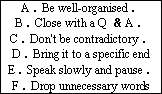
Speaking to a group can be difficult, but listening to a bad speech is truly a tiresome task-especially when the speaker is confusing.Don't want to confuse your audience? Follow these suggestions:
1.________
When it comes to understanding new information, the human brain needs a little time.First, we hear the words; then, we compare the new information to what we already know.If the two are different, we need to pause and think.But a breathless speaker never stops to let us think about what he or she is saying and risks confusing us.Slow it
2.________
Sometimes we all start a sentence one way and then switch directions, which is very difficult to follow.When you the audience confuse your listeners with opposing information, you leave the audience wondering what part of the information is right and what part they should remember.Instead of relying and keeping correcting yourself, work to get the facts clear and straight.
3.________
Jumping from point to point as it comes to your mind puts the onus(责任)on your listeners to make up for your lack of organisation.And it's confusing for them to listen, reorganise, and figure out what you're saying all at once.But going smoothly from one point to the next helps them understand information more easily.You can arrange things from beginning to end, small to large, top to bottom or by some other order.Just be sure to organise.
4.________
Repeated use of um, ah, like, you know and some other useless noises can drive an audience crazy.It makes the speaker sound uncertain and unprepared, and it can leave listeners so annoyed that they can't pay attention.Recently I attended a speech that was marked by so many ums that audience members were rolling their eyes.Was anybody grasping the intended message? Um, probably not.
5.________
Many speakers finish up their speeches with question-and-answer(Q & A)sessions, but some let the Q & A go on without a clear end.The audience is often left confused about whether the meeting is over and when they can get up and leave.Do your listeners a favour by setting a time limit on questions, and close your speech with a specific signal-even if it's something simple like, “If you have any more questions, you know where to reach me.”
Or even more to the point, conclude your speech with “Thanks for your time.”
阅读下面短文,掌握其大意,然后从各题所给的四个选项中,选出一个最佳答案。
“A little hero”is selected 1 “Heart”a famous book 2 by an Italian writer, Edmondo De Amics. The book has been put 3 many languages.
About 100 years 4 , Italy was ruled 5 Austrian Empire. Don't confuse Austria 6 Australia, 7 lies in Oceania(大洋洲), 8 the capital 9 Canberra(堪培拉).
10 a brave Italian boy, the little hero 11 the text, was working 12 the branch before a farm house, he saw a group of Italian soldiers 13 14 to him. The captain who led the group 15 whether he had seen 16 Austrians(奥地利人)pass 17 . From this he knew that they were searching 18 the enemy. He was glad to hear that and was quite 19 to do anything 20 them.
1.
[ ]
2.
[ ]
3.
[ ]
4.
[ ]
5.
[ ]
6.
[ ]
7.
[ ]
8.
[ ]
9.
[ ]
10.
[ ]
11.
[ ]
12.
[ ]
13.
[ ]
14.
[ ]
15.
[ ]
16.
[ ]
17.
[ ]
18.
[ ]
19.
[ ]
20.
[ ]
阅读下面一篇短文,按照要求回答短文后面的问题。
A Different DianaBook shows her life not unhappy as people think.
LONDON-Nearly four years after Britain's Princess Diana died in a Paris car crash, most people remember her unhappy childhood, a loveless marriage, infidelity and a brief affair. But British journalists Tim Clayton and Phil Craig, who had a frequent view of Charles and Diana, insist her life wasn't quite like that. Their book, Diana: Story of a Princess, has been published in a British tabloid days before what would have been Diana's 40th birthday on July 1.
So much for her loveless marriage to Prince Charles: “When they looked at each other, they looked as though they wanted to rip the clothes off each other. They looked so much in love. I am convinced of it to this day.” veteran newspaper photographer Arthur Edwards told the authors about the couple's early tour to Australia.
Photographer Ken Lennox, whose telephoto snaps of the pregnant princess in a bikini outraged much of the country before Prince William's 1982 birth, agreed with Edwards.
They were “a very happy couple together”, Lennox is quoted as saying. “They went into the water and kissed each other. He carried her out of the water. She threw a towel over his head and they raced up the sand.”
An unidentified senior member of the royal household reportedly said the same. They were not unhappy at the beginning-just stormy; loving at times and confused at times, he reportedly said.
The book also says that some who knew Diana felt she exaggerated the unhappiness of her childhood.
The book includes an unusual number of quotes from identified sources.
One of them, astrologer Felix Lyle, describes a visit from Diana when she was trying to decide whether to participate in Andrew Morton's.1992 book, “Diana, Her True Story.”
This publication of her side of the marriage breakdown, with its deeply unattractive portrayal of the heir to the British throne, sealed her fate within the royal family and led to separation in 1992 and divorce in 1996.
Lyle is quoted as saying Diana told him about her marriage and of her reservations about taking part in the book.
“But she wanted revenge--there's no question about that… I think she was bitterly, bitterly hurt and would see the tearing down of the royal family as a perfectly justifiable end.”
1.Most people thought Diana________________.
2.Who insist Diana's life was not quite like what most people thought?________________.
3.选择合适的释义解释。
a) snap A.shock and anger
b) outrage B.photograph
c) confuse C.make seem larger or greater than it really is
d) exaggerate D.throw into disorder
查看习题详情和答案>>Every day,the news of the world reaches people by over 300 million copies of daily papers,over 400 million radio sets,and over 150 million television sets. Additional news is 1 by motion(动作) pictures,in theatres and cinemas all over the world. As more people learn what the important events of the day are, 2 still only care for the events of their own household. Nearly four hundred years ago the English writer John Donne said,“No man is an island.”This 3 is more appropriate(恰当的)today than it was 4 Donne lived. In short,wherever he lives,a man 5 to some society;and we are becoming more and more aware(清楚的) that ? 6 happens in one particular society affects,somehow,the life of mankind.?
Newspapers have been published in the 7 world for about four hundred years. Most of the newspapers 8 today are read in Europe and North America. However, 9 they may be read in all parts of the world, 10 to the new inventions that are changing the techniques of newspaper 11 .?
Electronics and automation(自动化) have made it 12 to produce pictures and texts far more quickly than before. Photographic(照相的) copying doesn't 13 to use type(铅字) and printing machines.And fewer specialists(专家), 14 type?setters,are needed to produce a paper? or magazine by the 15 method. Therefore,the publishing of newspapers and magazines can 16 more money. Besides,photocopies can be sent over great 17 now by means of ?television channels and satellites such as Telstar. Thus(因此), 18 can be brought to the public more quickly than before.?
Machines that prepare printed texts for photocopies are being used a great deal today. Film, 19 light and small,can be sent rapidly to other places and used to print copies of the text 20 they are needed. Film pictures can also be projected(投影) easily on a movie or television screen.?
1.A. taken B. shown C. seen D. known
2.A. fewer B. higher C. lower D. less?
3.A. study B. argument C. knowledge D. idea?
4.A. that B. while C. when D. then?
5.A. moves B. goes C. belongs D. comes?
6.A. it B. whatever C. something D. anything?
7.A. common B. modern C. ordinary D. usual?
8.A. bought B. printed C. found D. discovered?
9.A. fast B. suddenly C. immediately D. soon?
10.A. has B. brings C. thanks D. imagines?
11.A. delivering B. making C. selling D. publishing
12.A. clear B. possible C. bright D. successful?
13.A. want B. need C. like D. hope?
14.A. including B. besides C. such as D. except?
15.A. advanced B. easy C. unusual D. suitable?
16.A. make B. earn C. save D. get?
17.A. places B. distances C. cities D. villages
18.A. pictures B. newspapers C. letters D. words?
19.A. becoming B. feeling C. turning D. being?
20.A. where B. there C. which D. because of
查看习题详情和答案>>
完形填空
Paul could not sleep late last night. He woke up 1 got up, then he 2 down again. He felt terrible. “I must be sick,”he thought, “ 3 I must study 4 the test.”
He got up and looked 5 his history notebook. He finally found it under 6 clothes on his chair. He 7 his notes. “What 8 I do?”he thought.
9 , Paul's telephone rang. So he put down his notebook and 10 the telephone.
“Good morning,”Jack's 11 said, “you must be wrong about the test.”
“What do you mean?”Paul asked weakly.
“We are not 12 to have a test today,”Jack said. “I wrote down the 13 in my notebook. The test will be next Wednesday; it isn't today. 14 do you feel this morning?”
“Fine,”said Paul. “Just fine!”Suddenly he 15 felt fine.
选择最佳答案
1.
[ ]
2.
[ ]
3.
[ ]
4.
[ ]
5.
[ ]
6.
[ ]
7.
[ ]
8.
[ ]
9.
[ ]
10.
[ ]
11.
[ ]
12.
[ ]
13.
[ ]
14.
[ ]
15.
[ ]