网址:http://m.1010jiajiao.com/timu3_id_2970585[举报]
听力(共两节,满分35分)
第一节:听力理解(5段共15小题;每小题2分,满分30分)
每段播放两遍.各段后有几个小题,各段播放前每小题有5秒钟的阅题时间.请根据各段播放内容及其相关小题,在5秒钟内从题中所给的A、B、C项中,选出最佳选项.
听第一段对话,回答第1-3题.
1.What does the girl want her father to buy7
A.A ruler.
B.High-tech things.
C.Pencils and erasers.
2.Which of the following does the father consider buying for his daughter?
A.A calculator.
B.A computer.
C.An MP3.
3.Which of the following could be a reason for her father to buy what she wants7
A.She volunteers to use some of her own money.
B.She asks her father to buy a cheap one online.
C.She tells her father she is the best in school.
听第二段对话,回答第4-6题.
4.What do the speakers think of San Francisco?
A.It is a big city.
B.They both love the city.
C.It isn't so expensive to live there.
5.What does the woman think of cell phone interruption?
A.She likes it.
B.She doesn't mind it.
C.She considers it rude.
6.What reason does the man give to answer his cell phone?
A.He feels like answering.
B.He wants to know who's calling.
C.He thinks that it could be something important.
听第三段对话,回答第7-9题.
7.What is the man complaining about?
A.Not accepting any gift from his friend.
B.Not receiving any answer from his friend.
C.Not hearing any good news from his friend.
8.According to the woman, when should you write a thank-you card?
A.You receive a gift from your friend.
B.You are invited to a birthday party.
C.You spend a holiday with your friend.
9.What's the speakers' attitude towards writing thank-you cards?
A.They think it out-dated.
B.They think it inconvenient.
C.They think it good to keep the custom.
听第四段独白,回答第10-12题.
10.What does the speaker imply about traffic in big cities?
A.Buses are slow, but comfortable.
B.Parking in the rush hour is very difficult.
C.All the people use private transport instead of public transport.
11.What does the speaker recommend to do to improve the situation?
A.To enlarge city centers.
B.To move to the areas outside the city.
C.To make good use of existing space.
12.How many aspects of our lives does the speaker mention as affected by overcrowding?
A.Two.
B.Three.
C.Four.
听第五段对话,回答第13-15题.
13.Why does the man like The Times?
A.It has 20 pages every day.
B.It carries a lot of sports news.
C.It doesn't devote 5 pages every day to baseball results.
14.In what way is the jobs section on The Times useful to the local people?
A.It carries job ads from the local businesses.
B.It is the place where local businesses hire people.
C.It provides much information about local economy.
15.What does the woman think will happen to job ads if The Times closes down?
A.The other two newspapers will open a local jobs newspaper.
B.The local economy will be much affected but not destroyed.
C.The job ads will be carried in either of the other two newspapers.
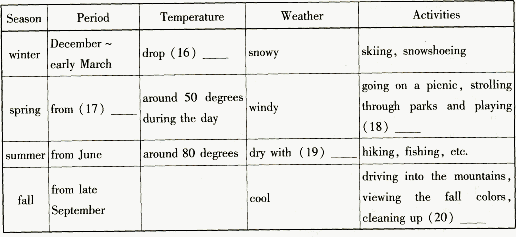
第二节:听取信息(共5小题;每小题1分,满分5分)
听下面一段独白,请根据题目要求,从所听到的内容中获取必要的信息,填入答题卡标号为16-20的空格中.听录音前,你将有10秒钟的阅题时间.录音读两遍,你将有80秒钟的作答时间.
My parents have certainly had their troubles, and as their child I’ll never know how they made it to 38 years of marriage. They loved each other, but they didn’t seem to like each other very much. Dad was too fond of his beer, and he talked down to Mom a lot. When she tried to stand up to him, a fight would unavoidably follow.
It was my dad’s disease that began to change things. The year 1998 was the beginning of a remarkable transformation for my family. My father, Jim Dineen, the always healthy, weightlifting, never-missed-a-day-of-work kind of dad, discovered he had kidney (肾)disease.
The decision to go ahead with a transplant for my father was a long and tough one, mostly because he had liver damage too. One physician’s assistant told him, “According to your file, you’re supposed to be dead.” And for a while, doctors mistakenly thought that he would need not just a kidney transplant, but a liver transplant too. Dad’s future hung in midpoint.
When the donor testing process finally began in the spring of 2003, numerous people, including me, my uncle Tom, and my mom, came back as matches of varying degree. But Mom was the one who insisted on going further. She decided to donate a kidney to my father. She said she was not scared, and it was the right thing to do. We all stepped back in amazement.
At last a date was chosen – November 11, 2003. All of a sudden, the only thing that seemed to matter Dad was telling the world what a wonderful thing Mom was doing for him. A month before the surgery, he sent her birthday flowers with a note that read, “I love you and I love your kidney! Thank you!”
Financially, the disease was upsetting to them. So my sister and I were humbled and surprised when, shortly before his surgery day, Dad handed us a diamond jewelry that we were to give to Mom after the operation. He’d accumulated his spare dollars to buy it.
At the hospital on the day of the transplant, all our relatives and friends gathered in the waiting room and became involved in a mean euchre (尤克牌游戏) tournament. My family has always handled things with a lot of laughter, and even though we were all tense, everybody was taking bets on how long this “change of conduct” would last in my parents.
We would inform Dad that if he chose to act like a real pain on any particular day after the operation, he wasn’t allowed to blame it on PMS just because he’d now have a female kidney.
The surgeries went well, and not long afterward, my sister and I were allowed to go in to visit. Dad was in a great deal of pain but again, all he could talk about was Mom. Was she okay? How was she feeling? Then the nurses let us do something unconventional. As they were wheeling Mom out of recovery room, they rolled her into a separate position to visit Dad. It was strange to see both my parents hooked up to IVs and machines and trying to talk to each other through tears. The nurses allowed us to present the diamond jewelry to Mom so that Dad could watch her open it. Everyone was crying, even the nurses.
As I stood with digital camera in hand, I tried to keep the presence of mind to document the moment. My dad was having a hard time fighting back emotion, and suddenly my parents unexpectedly reached out to hold each other’s hands.
In my nearly 35 years of existence, I’d never seen my parents do that, and I was spellbound. I snapped a picture and later rushed home to make sure I’d captured that enormous, life-defining moment. After so many years of disagreement, it was apparent to me that they finally understood how much each loved the other. 65—70
1.From the first paragraph we can learn that ____________.
A. Dad was fond of drinking B. My parents got along well
C. Dad often beat Mom D. Mom never obeyed Dad
2.The underlined part “Dad’s future hung in midpoint” in Para.3 suggests that ____________.
A. Dad was bound to die
B. Dad came to a serious moment in his life
C. Dad’s future was decided by doctors
D. Dad faced a tough decision in his life
3.Before the surgery, which of the following words can best describe the feeling of the families?
A. Worried and negative. B. Anxious and helpless.
C. Nervous but optimistic. D. Relaxed and positive.
4.Which of the following is TRUE according the passage?
A. Dad bought a diamond jewelry to Mom for their wedding anniversary.
B. Dad asked the nurse to visit Mom soon after the operation.
C. Despite a lot of pain, Dad was eager to know Mom’s condition soon after the operation.
D. On the day of the transplant, the families involved in a euchre tournament to relax themselves.
5.What’s in the writer’s photo?
A. Everyone was crying, even the nurses.
B. His parents were trying to talk to each other.
C. Dad watched Mom opening the gift.
D. His parents were holding each other’s hands.
6.What’s the best title for the passage?
A. Dad’s disease B. Mom’s decision C. The Gift of Life D. The photo of hands
查看习题详情和答案>>
A typical day at work for Cesar Millan includes taking a four-hour jog with 40 dogs, large and small, young and old, and none of them on leashes (缰绳).Although most of these dogs belong to him, the rest are troubled dogs sent to Millan to learn good behaviour.Obviously, Millan has a special gift for working with these animals.
Growing up on a farm in Mexico, Millan knew he would work with dogs.His first job, at age 15, was helping a veterinarian (兽医).He was so good at calming scared dogs and handling all kinds of situations that people started calling him 'the dog boy.’ Since then, he has built a rewarding career around his favourite animal.
Studying dogs on the farm where he grew up, Millan realised they need a lot of exercise to be calm.He explains his approach; "Exercise and discipline (纪律) first, and then affection!" He says a lot of people get it wrong because they do not realise what dogs really need.Millan does not only train dogs, he also trains owners to understand that their pets need rules.He has helped celebrities like Oprah Winfrey and Will Smith and everyday people too.
At his Dog Psychology Centre in Los Angeles, California, Millan also works with dogs whose dangerous behaviour has prevented them from finding homes.He teaches them to be loving gentle pets.Viewers can actually see the change in dogs with troublesome behaviour on Millan's TV show The Dog Whisperer.
To find the right career, Millan encourages kids to do what they enjoy."You can always find a job.But I find that happiness comes when you follow your passion.Success followed me because I was following my dream of being the best dog trainer in the world."
66. Which of the fo llowing is NOT true according to the first paragraph?
A. Cesar Millan usually walks his dogs every day.
B. Cesar Millan owns 40 dogs altogether.
C. Cesar Millan is good at handling dogs.
D.Some of the dogs do not behave well.
67. From the second paragraph we can learn that Millan ______.
A. was born into a poor family B. never went to school
C. has loved dogs since his childhood D. has been a successful veterinarian
68. Which of the following does NOT agree with Millan's principles for training dogs?
A. Walk the dogs every day. B. Set rules for them.
C. Show your love to them. D. Keep troubled dogs separately.
69. Which of the following can be inferred from, the passage?
A. Either Millan's father or his mother was a dog expert.
B. Oprah Winfrey and Will Smith are everyday people.
C. Millan makes good money from his dog business.
D. Millan frequently gets hurt by troublesome dogs.
70. According to Millan, your choice of major at college should be based on _____.
A. your interest B. social needs
C. your parents' hope D. its popularity
查看习题详情和答案>>As a young boy, I sometimes traveled the country roads with my dad. He was a rural mill carrier, and on Saturdays he would ask me to go with him. Driving through the countryside was always an adventure: There were animals to see, people to visit, and chocolate cookies if you knew where to stop, and Dad did.
In the spring, Dad delivered boxes full of baby chickens, and when 1 was a boy it was such a fun to stick your finger 'through one of the holes of the boxes and let the baby birds peck on your fingers.
On Dad' s final day of work, it took him well into the evening to complete his rounds because at least one member from each family was waiting at their mailbox to thank him for his friendship and his years of service. "Two hundred and nineteen mailboxes on my route." he used to say, "and a story at every one. " One lady had no mailbox, so Dad took the mail in to her every day because she was nearly blind. Once inside, he read her mail and helped her pay her bills.
Mailboxes were sometimes used for things other than mail. One note left in a mailbox read. "Nat, take these eggs to Marian; she's baking a cake and doesn't have any eggs. " Mailboxes might be buried in the snow, or broken, or lying on the groom:. bat the mail was always delivered On cold days Dad might find one of his customers waiting for him with a cup of hot chocolate. A young wrote letters but had no stamps, so she left a few button on the envelope in the mailbox; Dad paid for the stamps. One businessman used to leave large amounts of cash in his mailbox for Dad to take to the bank. Once, the amount came to 8 32,000.
A dozen years ago, when I traveled back to my hometown on the sad occasion of Dad’s death, the mailboxes along the way reminded me of some of his stories. I thought I knew them all, but that wasn't the case.
As I drove home, I noticed two lamp poles, one on each side of the street. When my dad was around, those poles supported wooden boxes about four feet off the ground. One box was painted green and the other was red, and each had a long narrow hole at the top with white lettering: SANTA CLAUS, NORTH POLE. For years children had dropped letters to Santa through those holes.
I made a turn at the comer and drove past the post office and across the railroad tracks to our house. Mom and I were sitting at the kitchen table when I heard footsteps. There, at the door, stood Frank Townsend, Dad's postmaster and great friend for many years. So we all sat down at the table and began to tell stories.
At one point Frank looked at me with tears in his eyes. " What are we going to do about the letters this Christmas?" he asked.
"The letters?"
'I guess you never knew. "
"Knew what?"
" Remember, when you were a kid and you used to put your letters to Santa in those green and red boxes on Main Street? It was your dad who answered all those letters every year. "
I just sat there with tears in my eyes. It wasn’t hard for me to imagine Dad sitting at the old table in our basement reading those letters and answering each one. I have since spoken with several of the people who received Christmas letters during their childhood, and they told me how amazed they were that Santa had known so much about their homes and families.
For me, just knowing that story about my father was the gift of a lifetime.
- 1.
It can be inferred from the passage that the writer regarded his travels with Dad us_____.
- A.great chances to help other people
- B.happy occasions to play with baby chickens
- C.exciting experience* with a lot of fun
- D.good opportunities to enjoy chocolate cookies
- A.
- 2.
The writer provides the detail about the businessman to show that_____.
- A.Dad had a strong sense of duty
- B.Dad was an honest and reliable man
- C.Dad had a strong sense of honor
- D.Dad was a kind and generous man
- A.
- 3.
According to the passage, which of the following impressed the writer most?
- A.Dad read letters for a blind lady for years.
- B.Dad paid for the stamps for a young girl.
- C.Dad delivered some eggs to Marian.
- D.Dad answered children's Christmas letters every year.
- A.
- 4.
The method the writer uses to develop Paragraph 4 is______.
- A.offering analyses
- B.providing explanations
- C.giving examples
- D.making comparisons
- A.
- 5.
What surprised the children most when they received letters in reply from Santa Claus every year?
- A.Santa Claus lived alone in the cold North Pole.
- B.Santa Claus answered all their letters every year.
- C.Santa Claus had unique mailboxes for the children.
- D.Santa Claus had so much information about their families.
- A.
- 6.
Which of the following is the best title for the passage?
- A.The Mail
- B.Christmas Letters
- C.Special Mailboxes
- D.Memorable Travels
- A.
on Saturdays he would ask me to go with him. Driving through the countryside was always an adventure:
There were animals to see, people to visit, and chocolate cookies if you knew where to stop, and Dad
did.
In the spring, Dad delivered boxes full of baby chickens, and when 1 was a boy it was such a fun to
stick y our finger 'through one of the holes of the boxes and let the baby birds peck on your fingers.
On Dad' s final day of work, it took him well into the evening to complete his rounds because at least
one member from each family was waiting at their mailbox to thank him for his friendship and his years
of service. "Two hundred and nineteen mailboxes on my route." he used to say, "and a story at every
one. " One lady had no mailbox, so Dad took the mail in to her every day because she was nearly blind.
Once inside, he read her mail and helped her pay her bills.
Mailboxes were sometimes used for things other than mail. One note left in a mailbox read. "Nat, take
these eggs to Marian; she's baking a cake and doesn't have any eggs. " Mailboxes might be buried in the
snow, or broken, or lying on the groom:. bat the mail was always delivered On cold days Dad might find
one of his customers waiting for him with a cup of hot chocolate. A young wrote letters but had no
stamps, so she left a few button on the envelope in the mailbox; Dad paid for the stamps. One
businessman used to leave large amounts of cash in his mailbox for Dad to take to the bank. Once, the
amount came to 8 32,000.
A dozen years ago, when I traveled back to my hometown on the sad occasion of Dad's death, the
mailboxes along the way reminded me of some of his stories. I thought I knew them all, but that wasn't
the case.
As I drove home, I noticed two lamp poles, one on each side of the street. When my dad was
around, those poles supported wooden boxes about four feet off the ground. One box was painted green
and the other was red, and each had a long narrow hole at the top with white lettering: SANTA CLAUS, NORTH POLE. For years children had dropped letters to Santa through those holes.
I made a turn at the comer and drove past the post office and across the railroad tracks to our house. Mom and I were sitting at the kitchen table when I heard footsteps. There, at the door, stood Frank
Townsend, Dad's postmaster and great friend for many years. So we all sat down at the table and began
to tell stories.
At one point Frank looked at me with tears in his eyes. " What are we going to do about the letters
this Christmas?" he asked.
"The letters?"
'I guess you never knew. "
"Knew what?"
" Remember, when you were a kid and you used to put your letters to Santa in those green and red
boxes on Main Street? It was your dad who answered all those letters every year. "
I just sat there with tears in my eyes. It wasn't hard for me to imagine Dad sitting at the old table in
our basement reading those letters and answering each one. I have since spoken with several of the
people who received Christmas letters during their childhood, and they told me how amazed they were
that Santa had known so much about their homes and families.
For me, just knowing that story about my father was the gift of a lifetime.
B.happy occasions to play with baby chickens
C.exciting experience* with a lot of fun
D. good opportunities to enjoy chocolate cookies
B. Dad was an honest and reliable man
C. Dad had a strong sense of honor
D. Dad was a kind and generous man
B. Dad paid for the stamps for a young girl.
C. Dad delivered some eggs to Marian.
D. Dad answered children's Christmas letters every year.
B. providing explanations
C. giving examples
D. making comparisons
B. Santa Claus answered all their letters every year.
C. Santa Claus had unique mailboxes for the children.
D. Santa Claus had so much information about their families.
B. Christmas Letters
C Special Mailboxes
D. Memorable Travels