网址:http://m.1010jiajiao.com/timu3_id_2970426[举报]
首先请阅读下列外国影片的广告图及简介:


以下是观众的需要。请将影片与观众匹配起来。
1.Robin is a boy full of imagination who often dreams of having superb skills to fight against monsters and becoming a hero. His favorite films are Superman and Spiderman. Having getting permission from his mother, he’s now looking for something he likes for this weekend.
2.Sunny is a 4-year-old girl. Like most kids, she likes cartoons very much. And she has a pet dog in her company. Her parents will be busy this Sunday, so they are looking for a comedy for her to enjoy.
3.Betty is an outgoing and emotional woman who likes traveling. She has been very busy lately. So with the weekend drawing near, she’s considering going to see a romance film to relax with her husband.
4.George and Adam have been good friends since middle school. They have a lot in common, both of whom like playing football and reading, especially detective stories. This weekend they’re planning to go to see a film that fits their taste.
5.After spending a year in South Africa doing some survey about poor children’s welfare, Mike has come back for a break. Knowing her husband is a fan of Jack London’s novel, his wife has some idea how to kill their time this weekend.
查看习题详情和答案>>
Maricel Apatan,22,stands in the kitchen of the Edsa Shangri—La Hotel in Manila,preparing to decorate a cheesecake. It would seem to be a(n)__ __ task for a pastry(糕点) chef,but Maricel is no __ __ chef-she has no hands.
“When I first saw Maricel, I was worried she might __ __ herself when using a chef’s knife __ __ that has never been a problem, ” says Maricel’s manager. “She doesn’t get __ __ treatment and works just as hard as the rest of the chefs.”
Despite financial __ __ from Archbishop Ledesma, a distant relative, Maricel __ __ to deal with her disability. “I was __ __ dependent on my mother and couldn’t do anything,” she recalls.
In 2004, Archbishop Ledesma __ __ for Maricel to live in the House with No Steps, a training centre for people with disabilities. She __ __ how to write and do regular tasks and, more importantly, __ __ her disability. She became more determined to __ __ hard to live a normal life.
Maricel __ __ graduated from high school and enrolled(注册) in a two-year Hotel and Restaurant Management course in Cagayan de Oro City. I have really enjoyed __ __ since I was seven years old,” she says.
After Maricel moved back to Manila to continue her studies, the media started reporting __ __ this determined young woman. She didn't shy away from the __ __.“I wanted others living with disabilities to believe it's __ __ to live a normal life,” Maricel says.
Later, Maricel's three younger brothers and sisters moved to Manila.She __ __ the rent of their small apartment, __ __ their parents look after the family farm in Mindanao.“It is difficult to make ends meet but I don't lose __ __. I believe anything is possible if you dream, and work hard.”
1.A. impossible B. simple C. practical D. important
2.A. ordinary B. admirable C. talented D. gentle
3.A. absorb B. express C. hurt D. forgive
4.A. for B. or C. but D. and
5.A. special B. equal C. official D. effective
6.A. advice B. control C. information D. help
7.A. hesitated B. disagreed C. struggled D. pretended
8.A. gradually B. hardly C. increasingly D. totally
9.A. searched B. arranged C. applied D. begged
10.A.explained B. realized C. wondered D. learned
11.A.accepted B. blessed C. cured D. forgot
12.A.think B. try C. listen D. relax
13.A.partly B. firstly C. eventually D. immediately
14.A.reading B. cooking C. writing D. drawing
15.A.beyond B. by C. against D. on
16.A.attention B. description C. decoration D. connection
17.A.successful B. difficult C. possible D. certain
18.A.raises B. pays C. collects D. receives
19.A.unless B. once C. though D. while
20.A.memory B. weight C. hope D. patience
查看习题详情和答案>>
阅读下面短文,从短文后各题所给的四个选项(A、B、C和D)中,选出可以填入空白处的最佳选项,并在答题卡上将该项涂黑。
The True Story of Treasure Island
It was always thought that Treasure Island was the product of Robert Louis Stevenson’s imagination. ___1___,recent research has found the true story of this exciting work.
Stevenson, a Scotsman, had lived 2for many years in 1881 he returned to Scotland for a 3. With him were his American wife Fanny and his son 4.
Each morning Stevenson would take them out for a long 5over the hills. They had been 6this for several days before the weather suddenly took a turn for the worse, Kept indoors by the heavy rain. Lloyd felt the days 7. To keep the boy happy Robert asked the boy to do some 8.
One morning, the boy came to Robert with a beautiful map of an island. Robert 9that the boy had drawn a large cross in the middle of 10. “What’s that?” he asked “That’s the 11treasure “said the boy Robert suddenly 12something of an adventure story in the boy’s 13While the rain was pouring, Robert sat down by the fire to write a story. He would make the 14a twelve-year-old boy just like Lloyd. But who would he the pirate(海盗)?
Robert had a good friend named Henley, who walked around with the 15of a wooden leg. Robert had always wanted to 16such a man in a story 17Long John Silver the pirate with a wooden leg, was 18.
So thanks to a 19.September in Scotland a friend with a wooden leg and the imagination of a twelve-year-old boy we have one of the greatest 20stories in the English language.
1.A.However B.Therefore C.Besides D.Finally
2.A.alone B.next door C.at home D.abroad
3.A.meeting B.story C.holiday D.jib
4.A.Lloyd B.Robert C.Henley D.John
5.A.talk B.rest C.walk D.game
6.A.attempting B.missing C.planning D.enjoying
7.A.quiet B.dull C.busy D.cold
8.A.cleaning B.writing C.drawing D.exercising
9.A.doubted B.noticed C.decided D.recognized
10.A.the sea B.the house C.Scotland D.the island
11.A.forgotten B.buried C.discovered D.unexpected
12.A.saw B.drew C.made D.learned
13.A.book B.reply C.picture D.mind
14.A.star B.hero C.writer D.child
15.A.help B.problem C.use D.bottom
16.A.praise B.produce C.include D.accept
17.A.Yet B.Also C.But D.Thus
18.A.read B.born C.hired D.written
19.A.rainy B.sunny C.cool D.windy
20.A.news B.love C.real-life D.adventure
查看习题详情和答案>>
A bicycle helmet is a helmet intended to be worn while riding a bicycle.They are designed to reduce impacts to the skull(头颅骨) of a cyclist in falls.However, there is a debate on whether helmets are useful for road cyclists.
The World Health Organization promotes the use of helmets as a strategy for preventing people' s heads from being injured by bicycle crashes or falls.Use of cycling helmets is supported by numerous groups in the United States. US-based cycling activist John Forester suggests that helmet wearing could prevent 300 deaths a year in the United States out of a total of 1530 preventable deaths.Public Health Law Research reports that there is enough evidence to establish that bicycle helmet laws are an effective public health intervention(干涉)aimed to reduce the number of head-related deaths.Received opinion in some countries is that bicycle helmets are useful and that every cyclist should wear one. Professional bodies elsewhere have agreed, such as the Swiss Council for Accident Prevention.
Mayer Hillman, a transport and road safety analyst from the UK, does not support the use of helmets, reasoning that they are of very limited value in the event of a collision(碰撞) with a car. He compares it to drawing conclusions on whether it is worthwhile to buy lottery tickets. Cyclists' representative groups complain that focus on helmets diverts(转移) attention from other issues which are much more important for improving bicycle safety, such as road danger reduction.The UK's largest cyclists' organization, the CTC, believes that the "overall health effects of compulsory helmets are negative.'' The same report estimated(估计) that universal helmet use would save the life of one child aged 0 to 15 each year.
Up to now, the debate is with no consensus(共识), but an organization has published a review of studies in 2011, saying there is a good deal of evidence that those wearing a helmet are more likely to crash than bareheaded cyclists.
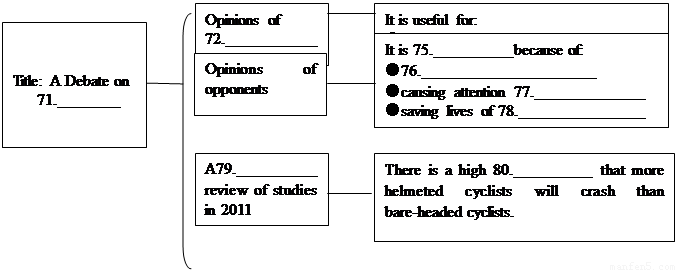
查看习题详情和答案>>
Money spent on advertising is money spent as well as any I know of. It serves directly to bring about a rapid sale of goods at reasonable prices, so setting up a firm home market and making it possible to provide for export (出口) at good prices. By drawing attention to new ideas it helps greatly to raise standards of living. By helping to increase demand it causes an increased need for labour, and is therefore a nice way to fight unemployment. It lowers the costs of many services: without advertisements your daily newspaper would cost four times as much, the price of your television program would need to be doubled, and travel by bus or subway would cost more.
And perhaps most important of all, advertising provides a promise of reasonable value in the products and services you buy. Besides the fact that twenty-seven Acts of Parliament(国会)govern the terms of advertising, no regular advertiser dare produce anything that fails to live up to the promise of his advertisements. He might fool some people for a little while through misleading advertising. He will not do so for long, for the public has the good sense not to buy the poor goods more than once. If you see product frequently advertised, it is the proof I know that the product does what is promised for it, and that it has good value.
Advertising does more for the good of the public than any other force I can think of.
There is one more point I feel I ought to touch on. Recently I heard a well-known television person declared that he was against advertising because it persuades rather than informs. He was telling us the real difference. Of course advertising tries to persuade.
If its message were nothing but information, that would be difficult to get more people to buy, for even the choice of the colour of a shirt is a bit persuasive (有说服力的)--advertising would be so boring that no one would pay any attention. But perhaps that is what the well-known television person wants.
By the first sentence of the passage the writer means that ___.
A. he is fairly familiar with the cost of advertising
B. everybody knows well that advertising is a waste of money
C. advertising costs more money than everything else
D. money on advertising is worth spending
In the passage, which of the following is NOT included in the advantages of advertising?
A. Getting greater fame. B. Providing more jobs.
C. Raising living standards. D. Reducing newspaper cost.
The writer thinks that the well-known TV person is _____.
A. quite right in passing his judgment on advertising
B. interested in nothing but the buyers' attention
C. correct in telling the difference between persuasion and information
D. obviously unfair in his views on advertising
In the writer's opinion, ________.
A. advertising can seldom bring material interest to man by providing information
B. advertising informs people of new ideas rather than wins them over
C. there is nothing wrong with advertising in persuading the buyer
D. the buyer is not interested in getting information from an advertisement
查看习题详情和答案>>