网址:http://m.1010jiajiao.com/timu3_id_2967195[举报]
通读下面短文,掌握其大意,然后在各题所给的A,B,C,D四个选项中,选出一个最佳答案。
Growing up is not always easy. When facing difficulties, courage and a spirit of independence can be more useful than crying for 36 . That's what Hong Zhanhui's story of 37 from boy to man with family hardships tells us.
Hong was born in 1982 in a poor family in Xihua County , Henan Province. When he was 38 11, his father became mentally ill and one day came back with an abandoned baby girl. A year later, Hong's mother and younger brother both 39 home because of poverty and pressure from his ill father.
Their burdens fell onto the 12-year-old's shoulders: to treat his father's illness, 40 the adopted sister Chenchen, and to go on to study.
Hong didn’t 41 . Since a young age, he has worked in part-time jobs to feed his family. At the same time, he has studied at college. To take care of Chenchen, he worked hard to 42 a room near his campus for her, and send her to school.
After Hong's story went public, people were 43 to tears by his selflessness. Hard 44 his life was, Hong didn't abandon his father and the adopted 45 , because they needed his help. With his hard-won money, he even aided other students 46 against misfortunes.
Today when many tend to worry more about their own happiness, Hong's deeds 47 us of what we usually neglect (忽略) : love and care for others. Without these, 48 of us could survive.
Hong 49 donations(捐赠) from others. He said he felt encouraged by kind offers, but he could 50 his own work. Short of money to buy food, the boy climbed tall trees to get birds' eggs for his baby sister. He walked two hours at weekends to buy different things to 51 around his school to earn money. Through his hard life, the boy developed 52 rise above misfortune that made him a hero in people's eyes.
Hong's story shows that with love and willpower, no hardship can 53 a person but himself. So when facing difficulties, don't 54 about bad luck. Consider what more you could do for your family and society 55 you'll find the world smiling back.
36. A. money B. food C. help D. clothes
37. A. changing B. moving C. growing D. turning
38 A. already B. ever C. still D. only
39. A. left B. went C. sold D. stayed
40. A. bring up B. turn to C. stick to D. devote to
41. A. go away B. run out C. turn down D. give up
42. A. rent B. buy C. paint D. build
43. A. encouraged B. inspired C. made D. moved
44. A. because B. as C. unless D. while
45. A. brother B. daughter C. sister D. uncle
46. A. struggling B. leaning C. standing D. turning
47. A. left B. reminded C. remembered D. told
48. A. anyone B. none C. everyone D. no one
49. A. turned down B. turned out C. gave off D. threw away
50. A. stick to B. refer to C. turn to D. depend on
51. A. show B. eat C. sell D. share
52. A. a chance B. an ability C. a spirit D. a belief
53. A. bury B. defeat C. win D. knock
54. A. worry B. care C. complain D. joke
55. A. when B. while C. until D. and
查看习题详情和答案>>
通读下面短文,掌握其大意,然后在各题所给的A,B,C,D四个选项中,选出一个最佳答案。
I found out one time that doing a ___26___for someone could get you into a lot of trouble.I was in the eighth grade at the time, and we were having a final test.During the test, the girl sitting next to me ___27____ something, but I didn’t understand.So I ____28___ her way and found out that she was trying to ask me if I had an extra pen.She showed me that hers was ____29____ and would not write.I happened to have an extra one, so I took it out of my pocket and ____30____ it on her desk.
Later, after the test papers had been turned in, the teacher asked me to stay in the room when all the other students were____31_____.As soon as we were alone she began to talk to me about ____32___ it meant to grow up; she talked about how important it was to____33____ your own two feet and be responsible for your own ____34___.For a long time, she talked about honesty and emphasized the fact ____35____ when people do something____36____, they are really cheating themselves.She made me ____37 __ that I would think seriously about all the things she had said, and then she told me I could leave.I walked out of the room ____38____ why she had chosen to talk to me about all those things.
____39____, I found out that she thought I had cheated on the test.When she saw me lean over to talk to the girl next to me, it looked as if I was copying answers ____40____ the girl’s test paper.I ___41____ to explain about the pen, but all she____42____ say was that it seemed very strange to her that I hadn’t talked of anything about the pen the day she talked to me ____43___ after the test.____44____ I tried to explain that I was just doing the girl a favor by letting her use my pen, I was sure she ____45____ to believe that I had cheated on the test.
26.A.help B.hand C.favor D.fever
27.A.whispered B.talked C.told D.spoke
28.A.turned over B.came over C.leaned over D.looked over
29.A.out of sight B.out of work C.out of place D.out of ink
30.A.place B.put C.gave D.lent
31.A.punished B.dismissed C.praised D.parted
32.A.what B.that C.which D.how
33.A.stand up B.stand on C.stand for D.stand by
34.A.attitude B.activity C.action D.behavior
35.A.what B.if C.that D.where
36.A.honest B.dishonest C.modest D.disappointed
37.A.promise B.permit C.recognize D.prove
38.A.wandering B.reflecting C.understanding D.wondering
39.A.Long before B.Therefore C.Ever before D.Later on
40.A.of B.in C.from D.on
41.A.managed B.planned C. tried D.promoted
42.A.could B.would C.can D.will
43.A.right B.only C.slight D.once
44.A.After B.Until C.As if D.Even if
45.A.remained B.continued C.kept D.wanted
查看习题详情和答案>>
完形填空 :通读下面的短文, 掌握其大意, 然后在1—25各题所给的四个选项中, 选出 一个最佳答案。
When you read a story in English, do you read it for the story or for the English? This is a 1 that is not so foolish 2 it may seem. For I 3 that many students of English 4 far more attention to the story than to the English. They read and 5 and for a long time 6 remember the story, but do not care to study the 7 of words and 8 in it. For instance, they care for the memory of 9 the mystery (神秘) in the story is solved, but do not remember a 10 sentence in the story and cannot 11 what preposition is used before or after a certain 12 in the speech of a 13 character.
Of course, it is all right to read and enjoy and 14 a story, and so 15 as one wants to 16 the story only, one need not bother (费心) about the language. But the case is quite different with a 17 of English. I mean a student of English is different from a student of stories or 18 is called the general reader.
As you may also have 19 from the above, you ought to read very 20. Not only very carefully but also aloud, and that again and again 21 you know the passage by heart and can 22 it as if it were your own. Positively (正面) this will teach you many 23 words and phrases; negatively (负面) it will help you to avoid many errors and faults in expression. Incidentally I have found from 24 that intelligent copying is a help to 25 by heart.
|
(1) A. question |
B. fact |
C. thing |
D. story |
[ ] |
|
(2) A. since |
B. as |
C. when |
D. while |
[ ] |
|
(3) A. discover |
B. see |
C. find |
D. feel |
[ ] |
|
(4) A. give |
B. take |
C. keep |
D. pay |
[ ] |
|
(5) A. like |
B. admire |
C. think |
D. enjoy |
[ ] |
|
(6) A. afterwards |
B. forwards |
C. before |
D. ago |
[ ] |
|
(7) A. meaning |
B. use |
C. difference |
D. structure |
[ ] |
|
(8) A. title |
B. paragraphs |
C. phrases |
D. sentences |
[ ] |
|
(9) A. when |
B. where |
C. why |
D. how |
[ ] |
|
(10) A. simple |
B. long |
C. single |
D. compound |
[ ] |
|
(11) A. tell |
B. understand |
C. realize |
D. notice |
[ ] |
|
(12) A. sentence |
B. word |
C. noun |
D. adjective |
[ ] |
|
(13) A. strange |
B. curious |
C. great |
D. certain |
[ ] |
|
(14) A. remember |
B. forget |
C. study |
D. make |
[ ] |
|
(15) A. short |
B. long |
C. hard |
D. little |
[ ] |
|
(16) A. read |
B. tell |
C. know |
D. recite |
[ ] |
|
(17) A. student |
B. teacher |
C. master |
D. boy |
[ ] |
|
(18) A. that |
B. what |
C. which |
D. how |
[ ] |
|
(19)A. collected |
B. got |
C. reached |
D. gathered |
[ ] |
|
(20) A. silently |
B. carefully |
C. slowly |
D. fast |
[ ] |
|
(21) A. till |
B. as |
C. since |
D. when |
[ ] |
|
(22) A. keep |
B. read |
C. recite |
D. learn |
[ ] |
|
(23) A. useful |
B. important |
C. lively |
D. necessary |
[ ] |
|
(24) A. experiment |
B. others |
C. past |
D. experience |
[ ] |
|
(25) A. remembering |
B. learning |
C. knowing |
D. using |
[ ] |
查看习题详情和答案>>
补全对话,根据对话内容,从对话后的选项中选出能填入空白处的最佳选项,并将答案填入题号后空白处。选项中有两项为多余选项。
A:I feel cold now.
B: 1
A:But I haven't got enough clothes.
B:Why not ask your father to bring you some?
A: 2 My home is quite far from here.
B:Then you'd better buy one.
A: 3 But I don't know where to buy.
B:You can go to the Fifth Street.There is a dress shop there.
A:How can I get there?
B: 4 It's warm in it.
A: 5
B:You are welcome.
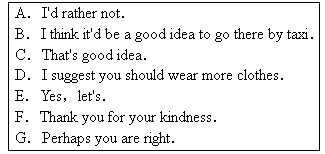 查看习题详情和答案>>
阅读理解
阅读下面短文,从每题所给的四个选项(A,B,C和D)中选出最佳选项。
Increasingly, over the past ten years, people especially young people, have become aware of the need to change their eating habits, because much of the food they eat, particularly processed food, is not good for health. Consequently, there has been a growing interest in natural foods , foods which do not contain chemical additives(添加剂) and which have not been affected by chemical fertilizer (化肥) widely used in farming today.
Natural foods, for example, are vegetables, fruit and grain which have been grown in soil that is rich in organic matter. In simple terms, this means that the soil has been nourished(养育) by unused vegetable matter, which provides it with essential vitamins and minerals. This in itself is a natural process compared with the use of chemicals and fertilizers, the main purpose of which is to increase the amount - but not the quality of foods grown in commercial farming area.
Natural foods also include animals which have been allowed to feed and move freely in healthy pastures (牧场) . Compare this with what happens in the mass production of poultry (家禽) ; there are battery farms, for example, where thousands of chickens live crowded together in one building and feed on food which is little better than rubbish. Chickens kept in this way are not only tasteless as food; they also produce eggs which lack important vitamins.
There are other aspects of healthy eating which are now receiving increasing attention from experts on diet. Take, for example, the question of sugar. This is actually a non-essential food! Although a natural alternative like honey can be used to sweeten food if necessary, we can in fact do without it. It is rat that sugar is harmful in itself. But it does seem to be an additive. The quantity we use has grown steadily over the last two centuries and in Britain today each person consumes an average of 200 pounds a year! Yet all it does is to provide us with energy, in the form of calories. There are no vitamins in it, no minerals and no fibre (纤维).
It is significant that nowadays fibre is considered to be an important part of a healthy diet. In white bread, for example, the fibre has been removed. But it is present in unrefined flour and of course in vegetables. It is interesting to note that in countries where the national diet large quantities of unrefined flour and vegetables, certain diseases are comparatively rare. Therefore the emphasis is placed on the eating of wholemeal(全麦) bread and more vegetables by modern experts on“healthy eating”.
1.People have become more interested in natural foods because ________.
[ ]
A.they care more about their health
B.they want to taste all kinds of foods
C.natural foods are more delicious than processed foods
D.they want to return to nature
2.Soil that is rich in organic matter ________.
[ ]
A.has had chemicals and fertilizers added to it
B.contains vegetable matter that has not been consumed
C.has been nourished by fertilizers
D.already contains large quantities of vitamins and minerals
3.Which of the statements are FALSE about chickens raised in poultry farms?
[ ]
A.They live in very crowded condition.
B.They are allowed to move about and eat freely.
C.They are fed on food that is little better than rubbish.
D.The eggs they produce lack vitamins.
4.Which of the following about sugar is right according to the writer?
[ ]
A.The use d sugar is bad for health.
B.People need sugar to give them energy.
C.Sugar only makes food sweet, but provides us with nothing useful.
D.The use of sugar is habit-forming.
5.The best title for the passage can be ________.
[ ]
A.The Importance of Fibre in Foods
B.Harmful Effects of Sugar
C.Natural Foods and a Healthy Diet
D.People's Growing Interest in Natural Foods
查看习题详情和答案>>