网址:http://m.1010jiajiao.com/timu3_id_2963628[举报]
| |||||||||||||||||||||||||||||||||||||||||||||||||||||||||||||||||||||||||
In 1931, it was discovered that some unknown substance present only in certain foods was necessary for good health. This substance was what is now called “Vitamin A”.
Vitamin A's biggest job is to keep the eyes going. Without it, people and animals get “night blindness” and eye problems. Lack of Vitamin A for a long time can even cause total blindness, particularly among children. This had a chance to be tested in Denmark during World Was I. Because of food shortage, many children had to eat man-made butter and skim milk(脱脂奶), which contains no Vitamin A. Soon, they developed eye diseases. It was after they were given real butter and whole milk that they had no eye problems.
After Vitamin A was discovered, it took more than thirty years of experiments for scientists to be able to get a small amount of pure Vitamin A. Vitamin A is manufactured and is used successfully to treat a number of diseases. You can easily get enough Vitamin A by eating a variety of food. Good sources of Vitamin A are liver(肝脏) from some animals and dairy products such as milk and cream. Not only many vegetables contain carotene(胡萝卜素), from which your liver can make its own Vitamin A, some fruits also provide carotene which helps your liver to supply Vitamin A. As long as you are getting Vitamin A from food you won't need to take any extra in the form of liquid or pills.
(1)According to the passage, if Vitamin A is not provided enough, which of the following are likely to be affected most se riously?
[ ]
(2) Vitamin A is a very. important substance mainly because it _______.
[ ]
A.is hard to made
B.helps to keep one's eyes healthy
C.can make butter more delicious
D.can not be produced in large quantity
(3) What made the children in Denmark get eye diseases during World War I?
[ ]
A.The war they experienced.
B.Their poor housing conditions.
C.The experiments on food.
D.The lack of Vitamin A in their food.
(4) According to the text, the following are all good sources of Vitamin A except _______.
[ ]
(5) Which of the following could be the best title of the passage?
[ ]
Read the following passage.Complete the diagram by using the information from the passage.Write NO MORE THAN 3 WORDS for each answer.
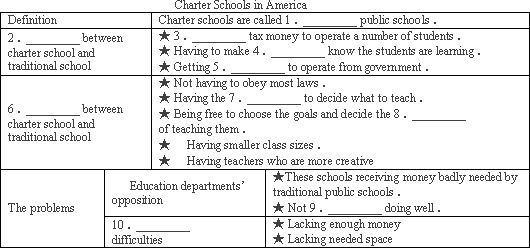
American public education has changed in recent years.One change is that increasing numbers of American parents and teachers are starting independent public schools called charter schools.
In 1991, there were no charter schools in the Unite States.Today, more than 2300 charter schools operate in 34 states and the District of Columbia.575.000 students attend these schools.The students are from 5 years of age through 18 or older.
A charter school is created by groups of parents, teachers and community members.It is similar in some ways to a traditional public school.It receives tax money to operate a number of students.The charter school must prove to local or state governments that its students are learning.These governments provide the school with the agreement, or charter that permits it to operate.
Unlike a traditional public school, however, the charter school does not have to obey most laws governing public schools.Local, state or federal governments cannot tell it what to teach.
Each school can choose its own goals and decide the ways it wants to reach those goals.Class sizes are usually smaller than in many traditional public schools.Many students and parents say teachers in charter schools can be more creative.
However, state education agencies, local education-governing committees and unions often oppose charter schools.They say these schools may receive money badly needed by traditional public schools.Experts say some charter schools are doing well while others are struggling.
Congress provided 200 million dollars for establishing charter schools in the 2006 federal budget.But, often the schools say they lack enough money for programs.Many also lack needed space, District officials say they have provided 14 former school buildings for charter education.Yet charter school supporters say officials should try harder to find more space.
根据短文内容,从短文后的选项中选出能填入空白处的最佳选项,选项中有两项为选项.
Ea sy Way s to Keep Your Brain SharpEveryone i s forgetful, but a s we age, we start to feel like our brain s are slowing down a bit-and that can be a very annoying thing. 1 Read on for some technique s worth trying.
1. 2
People who regularly made plan s and looked forward to upcoming event s had a 50 percent reduced chance of Alzheimer' s di sea se(老年性痴呆症), according to a recent study. 3 Something a s simple a s setting a goal to have a weekly coffee date with a friend will do.There' s evidence that people who have a purpo se in life or who are working on long or short-term goal s appear to do better.In other word s, keep your brain looking forward.
2.Go for a walk.
Mildly rai sed glucose(葡萄糖)level s can harm the area of the brain that help s you form memorie s and phy sical activity can help get blood glucose down to normal level s.In fact, exerci se produce s chemical s that are good for your brain. 4
3.Learn something new.
Take a Spani sh cla s s online, join a drawing club, or learn to play card s.A study found that mental stimulation limit s the weakening effect s of aging on memory and the mind.But the be st thing for your brain i s when you learn something new and are phy sically active at the same time. 5 Or you can ju st go dancing with your friend s.
A.Focu s on the future.
B.Thi s can be e specially harmful to the aged.
C.It should be something like learning gardening.
D.So take a few minute s each day to do some reading.
E.But don't worry if our schedule i sn't filled with life-changing event s.
F.Luckily, re search show s there i s a lot you can do to avoid tho se moment s.
G.In other word s, when you take care of your body, you take care of your brain.
请认真阅读下列短文,并根据短文的内容要点完成文章后的表格列单。
注意:补全填空应符合语法和搭配要求,每空只填一个单词。
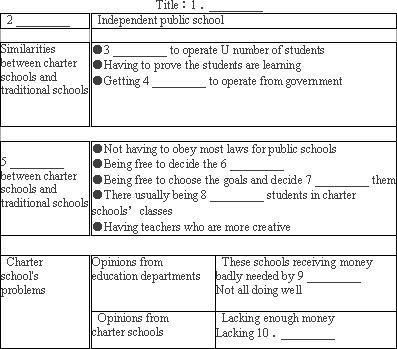
American public education has changed in recent years.One change is that increasing numbers of American parents and teachers are starting independent public schools called charter schools.
In 1991, there were no charter schools in the United States.Today, more than 2300 charter schools operate in 34 states and the District of Columbia.575000 students attend these schools.The students are from 5 years of age through 18 or older.
A charter school is created by groups of parents, teachers and community members.It is similar in some ways to a traditional public school.It receives tax money to operate a number of students.The charter school must prove to local or state governments that its students are learning.These governments provide the school with the agreement, or charter that permits it to operate.
Unlike a traditional public school, however, the charter school does not have to obey most laws governing public schools.Local, state or federal governments cannot tell it what to teach.
Each school can choose its own goals and decide the ways it wants to reach those goals.Class sizes are usually smaller than in many traditional public schools.Many students and parents say teachers in charter schools can be more creative.
However, state education agencies, local education-governing committees and unions often oppose charter schools.They say these schools may receive money badly needed by traditional public schools.Experts say some charter schools are doing well while others are struggling.
Congress provided 200 million dollars for establishing charter schools in the 2006 federal budget.But, often the schools say they lack enough money for programs.Many also lack needed space.District officials say they have provided 14 former school buildings for charter education.Yet charter school supporters say officials should try harder to find more space.