网址:http://m.1010jiajiao.com/timu3_id_2959794[举报]
| |||||||||||||||||||||||||||||||||||||||||||||||||||||||||||
During the Second World War, Winston Churchill was the British prime minister. One day he had to go to the British Broadcasting Corporation (the BBC) to make an important speech to the nation.
An hour before the time of his speech, he stopped a taxi in the street and asked the driver to take him to the BBC; but the taxi-driver, who did not recognize him, said he could not take him anywhere just then, because he wanted to go back to his home at the other end of London to hear Churchill make a speech on the radio.
Churchill was so pleased when he heard this answer that he gave the man a pound, which was worth quite a lot in those days.
“All right, get in,”said the driver happily, opening the door of the taxi. “I'll take you, and to hell with Churchill and his speech.”
(1) Winston Churchill was the head of______ during World War II.
[ ]
A.the American government
B.the Italian government
C.the British government
D.the French government
(2) One day Churchill went to the BBC to _______.
[ ]
A.make a speech to his people
B.see his friends
C.meet the British prime minister
D.listen to an important speech
(3) The driver refused to take Churchill to the BBC because _______.
[ ]
A.he hated Churchill
B.he had something important to do
C.he wanted to go home in the opposite direction
D.Churchill offered him too little money
(4) According to the story Churchill was_______.
[ ]
A.a modest man
B.a great man
C.a generous man
D.fond of listening to good words
查看习题详情和答案>>
D
A few years ago it was popular to speak of a generation gap, a disagreement between young people and their elders. Parents said that children did not show them proper respect and obedience (服从), while children complained (抱怨) that their parents did not understand them at all. What had gone wrong? Why had the generation gap suddenly appeared? Actually the generation gap has been around for a long time. Many people argue that a gap is built into the fabric (结构) of our society.
One important cause of the generation gap is the chance that young people have to choose their own ways of life. In more traditional societies, when children grow up, they are expected to live in the same area as their parents, to marry people that their parents know and agree to, and to continue the family occupation (职业). In our society, young people often travel great distances for their education, move out of the family home at an early age, marry or live with people whom their parents have never met, and choose occupations different from those of their parents.
In our easily changing society, parents often expect their children to do better than they did: to find better jobs, to make more money, and to do all the things that they were unable to do. Often, however, the strong desire that parents have for their children are another cause of the disagreement between them. Often, they discover that they have very little in common with each other.
Finally, the speed at which changes take place in our society is another cause of the gap b etween the generations. In a traditional culture, elderly people are valued for their wisdom, but in our society the knowledge of a lifetime may become out of date overnight. The young and the old seem to live in two very different worlds, separated by different skills and abilities.
No doubt, the generation gap will continue to be a feature (特点) of American life for some time to come. Its causes are rooted in the freedom and changes of our society, and in the rapid speed at which society changes.
69. The main idea of the first paragraph is that ____________.
A. the generation gap suddenly appeared
B. the generation gap is a feature of modern social life
C. people can reduce the generation gap
D. many critics argue over the nature of the generation gap
70. The word “around” in Paragraph 1 means ____________.
A. on all sides B. near C. in every direction D. in existence
71. In American society, young people often ____________.
A. depend on their parents to make a life
B. stay with their parents in order to get a chance for higher education
C. seek the best advice from their parents
D. have very little in common with their parents
72. Which of the following statements is true according to the passage?
A. Parents should be strict with their children.
B. The younger generation should value the older generation for their wisdom.
C. The generation gap is partly caused by the older generation.
D. The generation gap does not exist in American society.
阅读理解
EARTH WEEK-A DIARY OF THE PLANETEnduring Storms
Several more rounds of severe storms, tornadoes and flash flooding struck many parts of the American Midwest and Northeast as bad weather continued across the US for a second month.
Monsoon Storms
A south-west monsoon has caused havoc in parts of SriLanka. Government meteorologists said that unexpected monsoonal winds blew directly across the country from the Southern Hemisphere at about 100 km/h, producing several rounds of stormy weather. Nearly 250 houses in the capital Colombo were damaged.
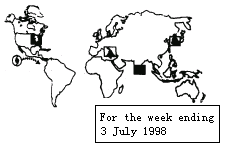
For the week ending 3 July 1998
Mt. Etna Erupts
Sicily’s Mount Etna volcano erupted shortly after midnight on July 1, shooting“bombs”of lava nearly 1.5 metres in diameter on the eastern side of the mountain. The 30-minute eruption could be seen for several miles, but did not threaten any nearby villages.
Hurricane
Hurricane Blas lost strength as it moved over cooler waters in the Pacific Ocean to the west of Mexico. Blasformed off southwest Mexico during the previous week, but squalls on the outer fringes of the storm lashed western Michoacan State, killing four people when their wood and cardboard home collapsed.
Monkey Repellent
After years of unsuccessful attempts to keep crop-eating monkeys out of Japanese fields, a Tokyo research team believes that it may have finally found a way to prevent the damage caused by the monkeys. Animal raids on crops were successfully prevented by shooting chilli powder into the air, irritating the eyes and noses of monkeys that passed in front of carefully-placed warning sensors.“We’ve tried…all kinds of preventive measures, but the monkeys are smart enough to outwit the tricks,”said Toshiaki Wada, Director of the Tokyo Forestry Experiment Station in western Tokyo.
1.The monsoon is Sri Lanka ________.
[ ]
A.was of average strength
B.destroyed more property than previous monsoons
C.was not typical for that time of the year
D.affected only the outer areas of the nation
2.What aspect of Hurricane Blas does the map show?
[ ]
3.According to the information, which of the following statements is TRUE?
[ ]
A.The eruption of Mt. Etna lasted thirty days.
B.Hurricane Blas was formed off the coast of Italy.
C.The American Midwest had fine weather throughout July 1998.
D.The eruption of Mt. Etna did not destroy local villages.
4.According to the information, the monkeys in the Japanese fields ________.
[ ]
A.destroy crops
B.kill unsuspecting humans
C.spread eye diseases to humans
D.stop farmers from working
5.Toshiaki Wada, Director of the Tokyo Forestry Experiment Station, would describe the monkeys as ________.
[ ]
The flag, the most common symbol of a nation in the modern world, is also one of the most ancient. With a clear symbolic meaning, the flag in the traditional form is still used today to mark buildings, ships and other vehicles related to a country.
The national flag as we know it today is in no way a primitive artifact. It is, rather, the product of thousands of years’ development. Historians believe that it had two major ancestors, of which the earlier served to show wind direction.
Early human beings used very fragile houses and boats. Often strong winds would tear roofs from houses or cause high waves that endangered travelers. People’s food supplies were similarly vulnerable. Even after they had learned how to plant grains, they still needed help from nature to ensure good harvests. Therefore they feared and depended on the power of the wind, which could bring warmth from one direction and cold from another.
Using a simple piece of cloth tied to the top of a post to tell the direction of the wind was more dependable than earlier methods, such as watching the rising of smoke from a fire. The connection of the flag with heavenly power was therefore reasonable. Early human societies began to fix long pieces of cloth to the tops of totems (图腾) before carrying them into battle. They believed that the power of the wind would be added to the good wishes of the gods and ancestors represented by the totems themselves.
These flags developed very slowly into modern flags. The first known flag of a nation or a ruler was unmarked: The king of China around 1,000 B.C. was known to have a white flag carried ahead of him. This practice might have been learned from Egyptians even further in the past, but it was from China that it spread over trade routes through India, then across Arab lands, and finally to Europe, where it met up with the other ancestor of the national flag.
【小题1】 The underlined word “ vulnerable” in paragraph 3 means _______.
| A.easy to damage | B.likely to be protected |
| C.impossible to make sure of | D.difficult to find |
| A.could tell wind direction | B.could bring good luck to fighters |
| C.were believed to stand for natural forces | D.were handed down by the ancestors |
| A.He knows when it was sent to Europe. | B.He doubts where it started. |
| C.He thinks it came from China. | D.He believes it was made in Egypt. |
| A.The role of China in the spread of the national flag. |
| B.The importance of modern flags. |
| C.The use of modern flags in Europe. |
| D.The second ancestor of the national flag. |