网址:http://m.1010jiajiao.com/timu3_id_2950648[举报]
Learning the language of a country isn't enough. If you see the manners of your foreign friends, you will probably be surprised just how different they can be from your own.
A visitor to India should remember that they are impolite to use the left hand for passing food at table. The left hand is for washing yourself. Also in India, you might see a man shaking his head at another to show that he is disagreeing. But in many parts of India a rotating(转)movement of the head is to show agreement. In Bulgaria you shake your head to show “yes”—a nod to show “no”.
In Europe it is quite usual to cross your legs while sitting and talking to someone, even at an important meeting. But doing this could cause offence to a Thailander. Also touching the head of a grown-up is impolite. It's just not done in Thailand.
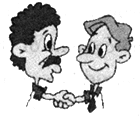
American informality is well known. But we Chinese are very likely to regard it as a lack of respect when we first encounter(遇见)it, especially in the business world. The almost immediate use of first names upsets Chinese who are not used to it.
We should not be surprised if Americans don't shake hands with us. They often just nod or smile. And they simply say “Hi”or“Hello”. Americans at a party are not likely to say“goodbye”to everyone when they leave. They just wave their hands or say something informal to the whole group such as“Well, see you tomorrow”or“So long everybody”. Then they disappear, no handshakes, for Americans have different senses of timing and pace from us. We need to understand this if we want to understand Americans.
Knowing about manners is useful when you are traveling, but you need to know the language used to express for ritual(礼节).
(1) Generally speaking, in India people ______.
[ ]
A.usually use their left hand impolitely
B.don't often use their left hand to pass food at a table
C.use their left hand to pass food at a table
D.don't use their left hand to wash themselves
(2) Shaking your head means “yes” _____.
[ ]
(3) A Thailander will be angry if you ______.
[ ]
A.touch his head
B.cross your legs while you are talking to him
C.shake your head
D.both A and B
(4) From the passage, we can know American are ______.
[ ]
(5) We can infer from the passage that ______.
[ ]
A.you should not touch a grown-up's head in India
B.you should not cross your legs at an important meeting in Europe
C.different countries have different manners
D.we must have good manners in every country.
查看习题详情和答案>>
| |||||||||||||||||||||||||||||||||||||||||||||||||||||||||||
| |||||||||||||||||||||||||||||||||||||||||||||||||||||||||||||||||||||||||

Learning the language of a country isn't enough. If you see the manners of your foreign friends, you will probably be surprised just how different they can be from your own.
A visitor to India should remember that they are impolite to use the left hand for passing food at table. The left hand is for washing yourself. Also in India, you might see a man shaking his head at another to show that he is disagreeing. But in many parts of India a rotating(转)movement of the head is to show agreement. In Bulgaria you shake your head to show “yes”—a nod to show “no”.
In Europe it is quite usual to cross your legs while sitting and talking to someone, even at an important meeting. But doing this could cause offence to a Thailander. Also touching the head of a grown-up is impolite. It's just not done in Thailand.
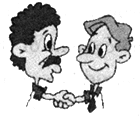
American informality is well known. But we Chinese are very likely to regard it as a lack of respect when we first encounter(遇见)it, especially in the business world. The almost immediate use of first names upsets Chinese who are not used to it.
We should not be surprised if Americans don't shake hands with us. They often just nod or smile. And they simply say “Hi”or“Hello”. Americans at a party are not likely to say“goodbye”to everyone when they leave. They just wave their hands or say something informal to the whole group such as“Well, see you tomorrow”or“So long everybody”. Then they disappear, no handshakes, for Americans have different senses of timing and pace from us. We need to understand this if we want to understand Americans.
Knowing about manners is useful when you are traveling, but you need to know the language used to express for ritual(礼节).
(1) Generally speaking, in India people ______.
[ ]
A.usually use their left hand impolitely
B.don't often use their left hand to pass food at a table
C.use their left hand to pass food at a table
D.don't use their left hand to wash themselves
(2) Shaking your head means “yes” _____.
[ ]
(3) A Thailander will be angry if you ______.
[ ]
A.touch his head
B.cross your legs while you are talking to him
C.shake your head
D.both A and B
(4) From the passage, we can know American are ______.
[ ]
(5) We can infer from the passage that ______.
[ ]
A.you should not touch a grown-up's head in India
B.you should not cross your legs at an important meeting in Europe
C.different countries have different manners
D.we must have good manners in every country.
查看习题详情和答案>>How many coins nave you got in your pocket right now? Three? Two? A bent one?
With a phonecard you can make up to 200 calls without any change at all.
(1) What do you do with it?
Go to a telephone box marked(you guessed it) “phonecard”.Put in your card, make your call and when you’ve finished, a screen tells you how much is left on your card.
(2) Now appear in a shop near you.
Near each Cardphone place you’ll find a shop where you can buy one. They’re at bus, train and city tube stations(地铁).
Many universities, hospitals and clubs. Restaurants and gas stations on the highway and shopping centres. At airports and seaports.
(3) No more broken payphones.
Most broken payphones are like that because they’ve been vandalized(故意破坏). There are no coins in Cardphone to excite thieves’ interest in it. So you’re not probably to find a vandalized one.
Get a phonecard yourself and try it out ,or get a bigger wallet.
The passage is most probably ________ .
A. a warning
B. a note
C. an advertisement(广告)
D. an announcement
There are three sections(部分) in the passage. Which section do you think is about why phonecards are good?
A. Section 1. B. Section 2.
C. Section 3. D. None.
Choose the right order or the steps under“How do you use a phonecard”.
a. Put in your phonecard.
b. Look at the screen to find out how many calls you can still make.
c. Go to a telephone box marked “Phonecard”.
d. Make your call.
A. a, b, c, d B. c, a, d, b
C. a, d, c, b D. c, d, a, b
查看习题详情和答案>>