网址:http://m.1010jiajiao.com/timu3_id_2947907[举报]
Starry Night
Have you ever seen a real night sky that looks like Van Gogh’s Starry Night? I hope not! So, why would an artist paint the sky this way? Perhaps I can answer that with another question. When you’re happy, why do you sing instead of speaking? Or when you’re in love, why do you speak of roses and honey? When we do these things, we, too are artists. We’re using something that goes beyond a mere scientific description in order to communicate our feelings more powerfully than straightforward words can. So consider for a moment that Van Gogh might not have been hallucinating (产生幻觉的) on the night he painted this. Maybe he felt something so powerful that he had to go beyond the familiar to express it.
I hope I’m reminding you of something you already know as I describe the experience of being outside at night under a crystal clear sky that makes everything seem clean and refreshing. So you look up. And suddenly you see the sky that you’ve seldom seen before. It’s not just the same old dark night sky tonight. Instead, the blackness is a deep, rich blue that is more bottomless than any ocean. The stars are not spots of light but brilliant, magical diamonds that dance like tiny angels. In just this special moment, the sky is somehow alive, and it seems to speak to you silently about the meaning of infinity (无限).
Now look at the painting again. Can you see something of what makes this such a famous and well-loved image? But there’s more here than that. Van Gogh painted this while he was quite struck down by a mental disease. It is natural to imagine that he frequently battled the fear that he would never escape his prison to true freedom. It is natural for us to imagine this because each of us has faced our own personal prison, whether it be disease, the loss of a loved one, serious financial problems … In such moments it is tempting to give up to despair (绝望) and collapse in hopelessness.
Looking at this painting, I imagine Van Gogh in just such a moment of despair, when he is struck by the memory of one of those amazing night skies. He recalls the sense that he is not alone, that there is a living, infinite world with rich colorful creatures and scenes all around.
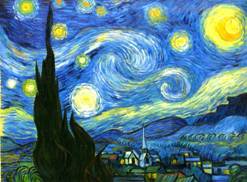
And so th e sky flows across the canvas (画布) full of vitality (活力) and power. The stars don’t just sparkle; they explode. Looking closer, we notice that the earth itself seems to respond to the movement in the sky, forming its own living waves in the mountain and rolling trees. In the sleepy village, the windows of the houses glow (发光) with the same light that brightens the universe. The giant trees at the left seem to capture the joy by stretching upwards toward the sky.
What a tremendous message of hope there is in this masterpiece! Even if our troubles persist, the world around us assures us that life is worth living. That’s what the angels sing about. Doesn’t it make you want to sing, too?
【小题1】Looking at the painting Starry Night, we can see all the following except________.
| A.The singing angels | B.the giant trees |
| C.the sleepy village | D.the sparkling stars |
| A.happiness | B.vitality | C.power | D.despair |
| A.trouble in one’s life | B.mental illness |
| C.control from the authority | D.a place where criminals are kept |
| A.To explain how Van Gogh painted the Starry Night. |
| B.To tell us how to appreciate the Starry Night. |
| C.To prove Van Gogh was in a hallucinating state of mind while painting the picture. |
| D.To show us the beauty of the sky on a starry night. |
Starry Night
Have you ever seen a real night sky that looks like Van Gogh’s Starry Night? I hope not! So, why would an artist paint the sky this way? Perhaps I can answer that with another question. When you’re happy, why do you sing instead of speaking? Or when you’re in love, why do you speak of roses and honey? When we do these things, we, too are artists. We’re using something that goes beyond a mere scientific description in order to communicate our feelings more powerfully than straightforward words can. So consider for a moment that Van Gogh might not have been hallucinating (产生幻觉的) on the night he painted this. Maybe he felt something so powerful that he had to go beyond the familiar to express it.
I hope I’m reminding you of something you already know as I describe the experience of being outside at night under a crystal clear sky that makes everything seem clean and refreshing. So you look up. And suddenly you see the sky that you’ve seldom seen before. It’s not just the same old dark night sky tonight. Instead, the blackness is a deep, rich blue that is more bottomless than any ocean. The stars are not spots of light but brilliant, magical diamonds that dance like tiny angels. In just this special moment, the sky is somehow alive, and it seems to speak to you silently about the meaning of infinity (无限).
Now look at the painting again. Can you see something of what makes this such a famous and well-loved image? But there’s more here than that. Van Gogh painted this while he was quite struck down by a mental disease. It is natural to imagine that he frequently battled the fear that he would never escape his prison to true freedom. It is natural for us to imagine this because each of us has faced our own personal prison, whether it be disease, the loss of a loved one, serious financial problems … In such moments it is tempting to give up to despair (绝望) and collapse in hopelessness.
Looking at this painting, I imagine Van Gogh in just such a moment of despair, when he is struck by the memory of one of those amazing night skies. He recalls the sense that he is not alone, that there is a living, infinite world with rich colorful creatures and scenes all around.
And so the sky flows across the canvas (画布) full of vitality (活力) and power. The stars don’t just sparkle; they explode. Looking closer, we notice that the earth itself seems to respond to the movement in the sky, forming its own living waves in the mountain and rolling trees. In the sleepy village, the windows of the houses glow (发光) with the same light that brightens the universe. The giant trees at the left seem to capture the joy by stretching upwards toward the sky.
What a tremendous message of hope there is in this masterpiece! Even if our troubles persist, the world around us assures us that life is worth living. That’s what the angels sing about. Doesn’t it make you want to sing, too?
1.Looking at the painting Starry Night, we can see all the following except________.
A. The singing angels B. the giant trees
C. the sleepy village D. the sparkling stars
2.Van Gogh does NOT describe a feeling of ______ through the Starry Night.
A. happiness B. vitality C. power D. despair
3.The underlined word “prison” in the 3rd paragraph probably means ______.
A. trouble in one’s life B. mental illness
C. control from the authority D. a place where criminals are kept
4.What is the main purpose of this passage?
A. To explain how Van Gogh painted the Starry Night.
B. To tell us how to appreciate the Starry Night.
C. To prove Van Gogh was in a hallucinating state of mind while painting the picture.
D. To show us the beauty of the sky on a starry night.
查看习题详情和答案>>
Starry Night
 Have you ever seen a real night sky that looks like Van Gogh’s Starry Night? I hope not! So, why would an artist paint the sky this way? Perhaps I can answer that with another question. When you’re happy, why do you sing instead of speaking? Or when you’re in love, why do you speak of roses and honey? When we do these things, we, too are artists. We’re using something that goes beyond a mere scientific description in order to communicate our feelings more powerfully than straightforward words can. So consider for a moment that Van Gogh might not have been hallucinating (产生幻觉的) on the night he painted this. Maybe he felt something so powerful that he had to go beyond the familiar to express it.
I hope I’m reminding you of something you already know as I describe the experience of being outside at night under a crystal clear sky that makes everything seem clean and refreshing. So you look up. And suddenly you see the sky that you’ve seldom seen before. It’s not just the same old dark night sky tonight. Instead, the blackness is a deep, rich blue that is more bottomless than any ocean. The stars are not spots of light but brilliant, magical diamonds that dance like tiny angels. In just this special moment, the sky is somehow alive, and it seems to speak to you silently about the meaning of infinity (无限).
Now look at the painting again. Can you see something of what makes this such a famous and well-loved image? But there’s more here than that. Van Gogh painted this while he was quite struck down by a mental disease. It is natural to imagine that he frequently battled the fear that he would never escape his prison to true freedom. It is natural for us to imagine this because each of us has faced our own personal prison, whether it be disease, the loss of a loved one, serious financial problems … In such moments it is tempting to give up to despair (绝望) and collapse in hopelessness.
Looking at this painting, I imagine Van Gogh in just such a moment of despair, when he is struck by the memory of one of those amazing night skies. He recalls the sense that he is not alone, that there is a living, infinite world with rich colorful creatures and scenes all around.
And so the sky flows across the canvas (画布) full of vitality (活力) and power. The stars don’t just sparkle; they explode. Looking closer, we notice that the earth itself seems to respond to the movement in the sky, forming its own living waves in the mountain and rolling trees. In the sleepy village, the windows of the houses glow (发光) with the same light that brightens the universe. The giant trees at the left seem to capture the joy by stretching upwards toward the sky.
What a tremendous message of hope there is in this masterpiece! Even if our troubles persist, the world around us assures us that life is worth living. That’s what the angels sing about. Doesn’t it make you want to sing, too?
72. Looking at the painting Starry Night, we can see all the following except________.
A. the sparkling stars B. the giant trees
C. the sleepy village D. The singing angels
73. Van Gogh does NOT describe a feeling of _______ through the Starry Night.
A. happiness B. vitality C. power D. despair
74. The underlined word “prison” in the 3rd paragraph probably means _______.
A. mental illness B. trouble in one’s life
C. control from the authority D. a place where criminals are kept
75. What is the main purpose of this passage?
A. To tell us how to appreciate the Starry Night.
B. To explain how Van Gogh painted the Starry Night.
C. To prove Van Gogh was in a hallucinating state of mind while painting the picture.
D. To show us the beauty of the sky on a starry night.
查看习题详情和答案>>
People say teenagers are no good. They make too much noise in shopping malls; they drive recklessly up and down America’s main streets; they carry chips on their shoulders as big as the Sears Tower. And at least some of the time those things are true. But we shouldn’t forget that there are hard moments in the life of a teenager too.
I watched such a moment not long ago at a woman’s funeral (葬礼). I didn’t expect the event to affect me. Through much of the ceremony, in fact, I remained unmoved.
Then her teenage grandson stepped forward. With his very first deep breath, every heart in that church was achingly reminded of something we had all forgotten. Softly he began: “I want to share a few values that Nana taught me. She never failed to see light in any situation. When our family dog would literally attract her, what would Nana say? ‘Oh, what beautiful markings that dog has.’ That was Nana.
“She was a strong woman who often lived in the shadow of my grandpa, who was a successful businessman in this city. But she was the one behind the scenes who provided the strength and support for Grandpa’s career,” he said, with a voice now trembling. “That was Nana’s way.”
Through a muffled sob, he continued. “Whenever she did anything worth recognition, you’d have to hear about it from a different source, because she was never one to brag.”
Finally, in a voice breaking free of sorrow, he looked up and said, “Nana taught me courage. She put up an incredible fight to the end, when she died peacefully, which is how she lived her life. That was Nana’s way, and I hope I can carry on in the same manner.”
There are no hearts as sensitive as those of teenagers, because everything is happening to them for the first time. The trouble with teenagers is that they haven’t learned to be controlled.
When that boy rose to speak about the woman who surely had been his truest ally and dearest friend, his honest voice dragged each of us out into the open where we could no longer hide in the calm ritual. He exposed us to the truth about this very real woman who believed in a boy who probably tried the patience of many adults. He reminded us that his grandmother was more than another dot on the chart of life and death.
All over again we felt those powerful losses crisscrossing our own hearts, and we knew that when you say good-bye to a beloved grandparent, you say good-bye to something happy, something young in yourself. And that something never really returns, and the pain never really goes away.
| Teenagers | |||||
| According to the passage, people don’t think (1) _________ of teenagers. | |||||
| I seldom felt (2) ________at a funeral. But from the boy’s speech, I know his grandmother had great (3) _________ on the boy when she was alive. | This time at the funeral, the author felt great differently. | ||||
| She would always found something (4) _______ even in some unpleasant situation. | She was a respectful woman who never (5) ________ off her talent in (6) ________. | She had a strong will and would never (7) ______ her career till she died. | The author was in deep (8) ______ at the moving situation. | The author has changed his (9) ________ on teenagers through this funeral ceremony. | The only problem with the young is that they can’t (10)________ themselves well. |
查看习题详情和答案>>
People say teenagers are no good. They make too much noise in shopping malls; they drive recklessly up and down America’s main streets; they carry chips on their shoulders as big as the Sears Tower. And at least some of the time those things are true. But we shouldn’t forget that there are hard moments in the life of a teenager too.
I watched such a moment not long ago at a woman’s funeral (葬礼). I didn’t expect the event to affect me. Through much of the ceremony, in fact, I remained unmoved.
Then her teenage grandson stepped forward. With his very first deep breath, every heart in that church was achingly reminded of something we had all forgotten. Softly he began: “I want to share a few values that Nana taught me. She never failed to see light in any situation. When our family dog would literally attract her, what would Nana say? ‘Oh, what beautiful markings that dog has.’ That was Nana.
“She was a strong woman who often lived in the shadow of my grandpa, who was a successful businessman in this city. But she was the one behind the scenes who provided the strength and support for Grandpa’s career,” he said, with a voice now trembling. “That was Nana’s way.”
Through a muffled sob, he continued. “Whenever she did anything worth recognition, you’d have to hear about it from a different source, because she was never one to brag.”
Finally, in a voice breaking free of sorrow, he looked up and said, “Nana taught me courage. She put up an incredible fight to the end, when she died peacefully, which is how she lived her life. That was Nana’s way, and I hope I can carry on in the same manner.”
There are no hearts as sensitive as those of teenagers, because everything is happening to them for the first time. The trouble with teenagers is that they haven’t learned to be controlled.
When that boy rose to speak about the woman who surely had been his truest ally and dearest friend, his honest voice dragged each of us out into the open where we could no longer hide in the calm ritual. He exposed us to the truth about this very real woman who believed in a boy who probably tried the patience of many adults. He reminded us that his grandmother was more than another dot on the chart of life and death.
All over again we felt those powerful losses crisscrossing our own hearts, and we knew that when you say good-bye to a beloved grandparent, you say good-bye to something happy, something young in yourself. And that something never really returns, and the pain never really goes away.
| Teenagers | |||||
| According to the passage, people don’t think (1) _________ of teenagers. | |||||
| I seldom felt (2) ________at a funeral. But from the boy’s speech, I know his grandmother had great (3) _________ on the boy when she was alive. | This time at the funeral, the author felt great differently. | ||||
| She would always found something (4) _______ even in some unpleasant situation. | She was a respectful woman who never (5) ________ off her talent in (6) ________. | She had a strong will and would never (7) ______ her career till she died. | The author was in deep (8) ______ at the moving situation. | The author has changed his (9) ________ on teenagers through this funeral ceremony. | The only problem with the young is that they can’t 10)________ themselves well. |
查看习题详情和答案>>