网址:http://m.1010jiajiao.com/timu3_id_2943157[举报]
Listening
Part 1
1.warming up
Pay attention to the following words and phrases which you will hear while listening.
North Pole北极
celebrate one's birthday 庆祝生日
blow away 吹走
thaw 烘烤
2.Listen to the tape and choose the correct answers.
1)Who traveled to the North Pole with me?
[ ]
A.My friends.
B.My family.
C.None.
D.My sisters.
2)What was the weather like on the first day?
[ ]
A.Snowy and windy.
B.Windy and sunny.
C.Snowy and rainy.
D.Sunny and windy.
3)What should I do before the wind became strong?
[ ]
A.Put up my tent.
B.Sleep in the sleeping bag.
C.Find a hole.
D.Make a fire.
4)When was my birthday?
[ ]
A.November 10th.
B.November 1st.
C.November 20th.
D.November 12th.
5)Which one is not true?
[ ]
A.I hurt my foot in the accident.
B.I had to thaw my birthday cake over the fire.
C.On the 22nd day, my workday was increased to 12 hours a day.
D.I waited to get better at last.
3.Listen to the tape once more and fill in the blanks.
1)I made a journey to ________ to celebrate my birthday .
2)Luckily, ________ ________ and I weren't blown away by the howling ________.
3)I had fallen into a very deep ________ and was hanging on the ________.
4)With my ________ and ________, I put my tent up.
5)It's an experience I shell never ________ and shall ________ for the rest of my life.
Part 2
Dick and Becky live in England. They have a farm, a shop and a tea-shop. People come to the tea-shop to drink tea and have lunch.
1.Listen to the tape. Tick the words you hear on the tape.
|
( )A.cows |
( )B.vegetables |
( )C.chickens |
|
( )D.apples |
( )E.milk |
( )F.horses |
|
( )G.cabbages |
( )H.pears |
( )I.cakes |
|
( )J.ducks |
( )K.flowers |
( )L.eggs |
|
( )M.food |
( )N.pigs |
( )O.dogs |
2.Listen to the tape again. Complete the words on the diagram.
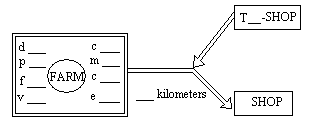
3.Answer the following questions.
1)Do their two children work on the farm after they graduated from school?
2)How do they raise their chickens?
3)Do they sell cakes made by themself? Why?
查看习题详情和答案>>Over the last 70 years.researchers have been studying happy and Unhappy people and finally found out ten factors that make a difference.Our feelings of well-being at any moment are determined to a certain degree by genes.However of all the factors,wealth and age are the top two.
Money can buy a degree of happiness.But once you can afford to feed,clothe and house yourself, each extra dollar makes less and less difference.
Researchers find that,on average,wealthier people are happier.But the link between money and happiness is complex.In the past half-century, average income has sharply increased in developed countries,yet happiness levels have remained almost the same.Once your basic needs are met,money only seems to increase happiness if you have more than your friends,neighbors and colleagues.
“Dollars buy Status(社会地位),and status makes people feel better,” conclude some experts,which helps explain why people who can seek status in other ways-scientists or actors,for example-may happily accept relatively poorly-paid jobs.
In a research,Professor Alex Michalos found that the people whose desires-not just for money,but for friends,family, job,health-rose furthest beyond what they already had,tended to be less happy than those who felt a smaller gap(差距).Indeed,the size of the gap predicted happiness about five times better than income alone.“The gap measures just blow away the only measures of income,”says Michalos.
Another factor that has to do with happiness is age.Old age may not be so bad.“Given all the problems of aging,how could the elderly be more satisfied?” asks Professor Laura Carstensen.
Why are old people happier? Some scientists suggest older people may expect life to be harder and learn to live with it,or they're more realistic about their goals,only setting ones that they know they can achieve.But Carstensen thinks that with time running out,older people have learned to focus on things that make them happy and let go of those that don't.
“People realize not only what they have,but also that what they have cannot-last forever,” she says.“A goodbye kiss to a husband or wife at the age of 85,for example,may bring far more complex emotional responses than a similar kiss to a boy or girl friend at the age of 20.”
1.According to the passage,the feeling of happiness _________.
A.has little to do with wealth B.increases gradually with age
C.is measured by desires D.is determined partly by genes
2.Some actors would like to accept poorly-paid jobs because the jobs _________.
A.make them feel much better B.provide chances to make friends
C.improve their social position D.satisfy their professional interests
3.Aged people are more likely to feel happy because they are more _________.
A.optimistic B.practical C.successful D.emotional
4.Professor Alex Michalos found that people feel less happy if __________.
A.the gap between reality and desire is bigger
B.they have a stronger desire for friendship
C.their income is below their expectation
D.the hope for good health is greater
查看习题详情和答案>>
假定英语课上老师要求同桌之间交换修改作文,请你修改你同桌写的以下作文。文中共有10处语言错误,每句中最多有两处。错误涉及一个单词的增加、删除或修改。
增加:在缺词处加一个漏字符号(∧),并在其下面写出该加的词。
删除:把多余的词用斜线(\)划掉。
修改:在错的词下划一横线,并在该词下面写出修改后的词。
注意:1. 每处错误及其修改仅限一词;
2. 只允许修改10处,多者(从第11处起)不计分。
Dear editor,
Some years ago, my hometown was used to be a beautiful place. Thick trees and grass can be seen all over the hills. As time going by, people destroyed almost the whole forest grow more crops. To make matters worse, people let their cattles eat up the grass. So you can only see wasteland instead green forests now. As a result of, when it rains, the soil is washed down the hills and into the rivers. Strongly winds also blow away the valuable soil lie on the top of the fields.
I do hope all the people will take good care of the forests but plant more trees to improve our living conditions.
V.短文改错
Dear editor,
Some years ago, my hometown was used to be a beautiful place. 66.
Thick trees and grass can be seen all over the hills. 67.
As time going by, people destroyed almost the whole 68.
forests grow more crops. To make matters worse, people let their 69.
cattles eat up the grass. So, you can only see wasteland 70.
instead green forests now. As a result, when it rains, the 71.
soil is washed down the hills and in the rivers. Strong winds also 72.
blow away the valuable soil lie on the top of the fields. 73.
I do hope all the people will take good care of the forests 74.
and plant more trees to improve our living conditions better. 75.
Over the last 70 years, researchers have been studying happy and unhappy people and finally found out ten factors that make a difference. Our feelings of well-being at any moment are determined to a certain degree by genes. However, of all the factors, wealth and age are the top two.
Money can buy a degree of happiness. But once you can afford to feed, clothe and house yourself, each extra dollar makes less and less difference.
Researchers find that, on average, wealthier people are happier. But the link between money and happiness is complex. In the past half-century, average income has sharply increased in developed countries, yet happiness levels have remained almost the same. Once your basic needs are met, money only seems to increase happiness if you have more than your friends, neighbors and colleagues.
“Dollars buy status, and status makes people feel better,” conclude some experts, which helps explain why people who can seek status in other ways-scientists or actors, for example-may happily accept relatively poorly-paid jobs.
In a research, Professor Alex Michalos found that the people whose desire-not just for money, but for friends, family, job, health-rose furthest beyond what they already had, tended to be less happy than those who felt a smaller gap(差距). Indeed, the size of the gap predicted happiness about five times better than income alone. “The gap measures just blow away the only measures of income.” Says Michalos.
Another factor that has to do with happiness is age. Old age may not be so bad. “Given all the problems of aging, how could the elderly be more satisfied?” asks Professor Laura Carstensen.
In one survey, Carstensen interviewed 184 people between the ages of 18 and 94, and asked them to fill out an emotions questionnaire. She found that old people reported positive emotions just as often as young people, but negative emotions much less often.
Why are old people happier? Some scientists suggest older people may expect life to be harder and learn to live with it, or they’re more realistic about their goals, only setting ones that they know they can achieve. But Carstensen thinks that with time running out, older people have learned to focus on things that make them happy and let go of those that don’t.
“People realize not only what they have, but also that what they have cannot last forever,” she says. “A goodbye kiss to a husband or wife at the age of 85, for example, may bring far more complex emotional responses than a similar kiss to a boy or girl friend at the age of 20.”
1.According to the passage, the feeling of happiness __________.
A.has little to do with wealth B.increases gradually with age
C.is determined partly by genes D.is measured by desires
2.Some actors would like to accept poorly-paid jobs because the jobs ____________.
A.make them feel much better B.improve their social position
C.provide chances to make friends D.satisfy their professional interests
3.Aged people are more likely to feel happy because they are more _________.
A.optimistic B.successful C.practical D.emotional
4.Professor Alex Michalos found that people feel less happy if __________.
A.the gap between reality and desire is bigger
B.they have a stronger desire for friendship
C.their income is below their expectation
D.the hope for good health is greater
查看习题详情和答案>>