网址:http://m.1010jiajiao.com/timu3_id_2942825[举报]
In the eyes of the newlyelected prime minister,there is never too small a thing as far as the farmers ______.
A.are concerning B.concern C.are concerned D.concerned
查看习题详情和答案>>
阅读理解
EARTH WEEK-A DIARY OF THE PLANETEnduring Storms
Several more rounds of severe storms, tornadoes and flash flooding struck many parts of the American Midwest and Northeast as bad weather continued across the US for a second month.
Monsoon Storms
A south-west monsoon has caused havoc in parts of SriLanka. Government meteorologists said that unexpected monsoonal winds blew directly across the country from the Southern Hemisphere at about 100 km/h, producing several rounds of stormy weather. Nearly 250 houses in the capital Colombo were damaged.
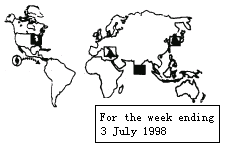
For the week ending 3 July 1998
Mt. Etna Erupts
Sicily’s Mount Etna volcano erupted shortly after midnight on July 1, shooting“bombs”of lava nearly 1.5 metres in diameter on the eastern side of the mountain. The 30-minute eruption could be seen for several miles, but did not threaten any nearby villages.
Hurricane
Hurricane Blas lost strength as it moved over cooler waters in the Pacific Ocean to the west of Mexico. Blasformed off southwest Mexico during the previous week, but squalls on the outer fringes of the storm lashed western Michoacan State, killing four people when their wood and cardboard home collapsed.
Monkey Repellent
After years of unsuccessful attempts to keep crop-eating monkeys out of Japanese fields, a Tokyo research team believes that it may have finally found a way to prevent the damage caused by the monkeys. Animal raids on crops were successfully prevented by shooting chilli powder into the air, irritating the eyes and noses of monkeys that passed in front of carefully-placed warning sensors.“We’ve tried…all kinds of preventive measures, but the monkeys are smart enough to outwit the tricks,”said Toshiaki Wada, Director of the Tokyo Forestry Experiment Station in western Tokyo.
1.The monsoon is Sri Lanka ________.
[ ]
A.was of average strength
B.destroyed more property than previous monsoons
C.was not typical for that time of the year
D.affected only the outer areas of the nation
2.What aspect of Hurricane Blas does the map show?
[ ]
3.According to the information, which of the following statements is TRUE?
[ ]
A.The eruption of Mt. Etna lasted thirty days.
B.Hurricane Blas was formed off the coast of Italy.
C.The American Midwest had fine weather throughout July 1998.
D.The eruption of Mt. Etna did not destroy local villages.
4.According to the information, the monkeys in the Japanese fields ________.
[ ]
A.destroy crops
B.kill unsuspecting humans
C.spread eye diseases to humans
D.stop farmers from working
5.Toshiaki Wada, Director of the Tokyo Forestry Experiment Station, would describe the monkeys as ________.
[ ]
Reading Comprehension
Section B
Directions:Read the following passages. Each passage is followed by several questions or unfinished statements. For each of them there are four choices marked A, B, C and D. Choose the one that fits best according to the information given in the passage you have just read.
Are organically grown foods the best food choices?The advantages claimed for such foods over conventionally (传统地) grown and marketed food products are now being debated. Supporters of organic foods—a term whose meaning varies greatly—frequently announce that such products are safer and more nutritious than others.
The growing interest of consumers in the safety and nutritional quality of the typical North American diet is a welcome development. However, much of this interest has been sparked by sweeping claims that the food supply is unsafe or inadequate in meeting nutritional needs. Although most of these claims are not supported by scientific evidence, the flood of written material advancing such claims makes it difficult for the general public to separate fact from fiction. As a result, claims that eating a diet consisting entirely of organically grown foods prevents or cures disease or provides other benefits to health have become widely publicized.
Almost daily the public is besieged by claims for “no-aging” diets, new vitamins and other wonder foods. There are numerous unproved reports that natural vitamins are superior to synthetic ones, that fertilized eggs are nutritionally superior to unfertilized eggs, that untreated grains are better than fumigated grains and the like.
One thing that most organically grown food products seem to have in common is that they cost more than conventionally grown foods. But in many cases consumers are misled if they believe organic foods can maintain health and provide better nutritional quality than conventionally grown foods. So there is real cause for concern if consumers,particularly those with limited incomes, distrust the regular food supply and buy only expensive organic foods instead.
1.The “welcome development” mentioned in paragraph 2 is an increase in ______.
A. attention to food safety and nutrition among north Americans
B. the nutritional quality of the typical North American diet
C. the amount of healthy food grown in North America
D. the number of consumers in North America
2. The author implies that there is cause for concern if consumers buy organic foods instead of conventionally grown foods because ______.
A. organic foods can be more expensive but are often not better than conventionally grown foods
B. many organic foods are actually less nutritious than similar conventionally grown foods
C. conventionally grown foods are more readily available than organic foods
D. too many farmers will stop using conventional methods to grow food crops
3.What is the author’s attitude toward the claims made by advocates of health foods?
A. Enthusiastic. B. Favorable. C. Neutral. D. Distrustful.
查看习题详情和答案>>
完形填空
Computers have done a lot since they turned up. In the future they will play a more important part in many 1 , such as education, transport, personal lives, scientific research and 2 Nowadays computers are being 3 in agriculture and industry 4 can help the farmers to 5 the conditions of the plants.
More and more computers will come into our daily life with the 6 of science and technology. If you want to change money or pay your electricity bills, you won’t have to go to the 7 . A computer and a telephone will help you. It can also help you to do the housework and it can even 8 human voices and carry out the instructions. It is 9 10 the majority of the labour force will work at home. People will be able to use the videophone 11 conferences. This can help us to save a lot of energy and 12 .It is said that trains in Japan will have 13 , because they’ll be well 14 by computers, which can also tell the best 15 between trains.
Computer programmes for 16 whole texts are already will be developed. You can 17 the name of a certain subject and a 18 list of book titles, then they will 19 on your screen. You may choose 20 you want.
|
(1)A.families |
B.fields |
C.factories |
D.places |
|||
|
(2)A.so on |
B.so forth |
|||||
|
C.so on and so forth |
D.A or B or C |
|||||
|
(3)A.used |
B.put |
C.shown |
D.given |
|||
|
(4)A.which |
B.that |
C.and |
D.so |
|||
|
(5)A.form |
B.grow |
C.control |
D.manage |
|||
|
(6)A.increase |
B.progress |
C.production |
D.development |
|||
|
(7)A.office |
B.bank |
C.shop |
D.post office |
|||
|
(8)A.understand |
B.carry out |
C.hear |
D.recognize |
|||
|
(9)A.important |
B.necessary |
C.possible |
D.complete |
|||
|
(10)A.when |
B.why |
C.which |
D.that |
|||
|
(11)A.at |
B.for |
C.with |
D.in |
|||
|
(12)A.material |
B.time |
C.place |
D.money |
|||
|
(13)A.driver |
B.some drivers |
|||||
|
C.fewer drivers |
D.no drivers |
|||||
|
(14)A.operated |
B.done |
C.made |
D.run |
|||
|
(15)A.position |
B.direction |
C.distance |
D.way |
|||
|
(16)A.storing |
B.writing |
C.remaining |
D.recording |
|||
|
(17)A.give |
B.put |
C.type |
D.write |
|||
|
(18)A.first-rate |
B.world-famous |
C./ |
D.worldwide |
|||
|
(19)A.show |
B.appear |
C.offer |
D.come up |
|||
|
(20)A.whatever |
B.what |
C.whichever |
D.which |
|||
Back in my country, when I was a child, I used to go to “market day” with my mother. One day each week, farmers used to ___1___ their fruit and vegetables into the city. They ___2___ one street to all cars, and the farmers set up tables for their ___3___. This outdoor market was a great place to ___4___. Everything was fresher than produce in grocery stores because the farmers brought it in ___5___ after the harvest. My mother and I always got there early in the morning to get the ___6___ produce.
The outdoor market was a wonderful adventure for a small child, ___7___ was like a festival — full of colors and ___8___. There are red tomatoes, yellow lemons, green lettuce, peppers, grapes, onions. The farmers did their own ___9___. They all shouted loudly for ___10___ to buy their produce. “Come and buy my beautiful oranges! They’re juicy and delicious and full of vitamins to ___11___ your children healthy and strong!”
Everyone used to ___12___ with the farmers over the ___13___ of their produce. It was like a wonderful drama in a theatre; the buyers and sellers were the “___14___” in this drama. My mother was an ___15___ at this. First, she picked the freshest, most attractive tomatoes, for example. Then she asked the price. The seller told her.
“What?” she said. She looked very surprised. “ So ___16___?”
The seller looked terribly ___17___. “My dear lady!” he replied. “I’m a poor, ___18___ farmer. These are the cheapest tomatoes on the market!”
They always argued for several minutes before agreeing ___19___ a price. My mother took her tomatoes and left. Both buyer and seller were ___20___. The drama was over.
1. A. carry B. take C. bring D. fetch
2. A. opened B. closed C. started D. stopped
3. A. produce B. goods C. food D. product
4. A. buy B. sell C. bargain D. shop
5. A. hurriedly B. immediately C. directly D. straightly
6. A. best B. finest C. freshest D. cheapest
7. A. who B. that C. which D. what
8. A. voices B. noises C. sounds D. accent
9. A. shopping B. business C. shouting D. advertising
10. A. customers B. producers C. themselves D. sellers
11. A. keep B. let C. except D. make
12. A. argue B. talk C. discuss D. speak
13. A. order B. price C. quality D. form
14. A. viewers B. listeners C. actors D. directors
15. A. actress B. inventor C. advancer D. expert
16. A. wonderful B. exciting C. cheap D. expensive
17. A. injured B. hurt C. damaged D. wounded
18. A. excellent B. fair C. honest D. easy
19. A. with B. to C. in D. on
20. A. disappointed B. encouraged C. satisfied D. tired
查看习题详情和答案>>