网址:http://m.1010jiajiao.com/timu3_id_2941145[举报]
Kids will often ignore your requests for them to shut off the TV,start their chores(杂事),or do their homework as a way to avoid following your directions.Before you know it,you’ve started to sound like a broken record as you repeatedly ask them to do their assignments,clean their rooms,or take out the trash.Rather than saying “Do your chores now.” you’ll be more effective if you set a target time for when the chores have to be completed.So instead of arguing about starting chores,just say,“If chores aren’t done by 4 pm,here are the consequences.”Then it’s up to your child to complete the chores.Put the ball back in their court.Don’t argue or fight with them,just say,“That’s the way it’s going to be.”It shouldn’t be punitive(惩罚性的)as much as it should be persuasive.“If your chores aren’t done by 4 pm,then no video game time until chores are done.And if finishing those chores runs into homework time,that’s going to be your loss.”On the other hand,when dealing with homework,keep it very simple.Have a time when homework starts,and at that time,all electronics go off and do not go back on until you see that their homework is done.If your kids say they have no homework,then they should use that time to study or read.Either way,there should be a time set aside when the electronics are off.
When a kid wears his iPod or headphones when you’re trying to talk to him,make no bones about it;he is not ignoring you,he is disrespecting you.At that point,everything else should stop until he takes the earplugs out of his ears.Don’t try to communicate with him when he’s wearing headphones—even if he tells you he can hear you.Wearing them while you’re talking to him is a sign of disrespect.Parents should be very tough about this kind of thing.Remember,mutual respect becomes more important as children mature.
1.According to the passage,it seldom happens that .
A.kids turn a deaf ear to their parents’ requests
B.parents’ directions sound like a broken record
C.children are ready to follow their parents’ directions
D.parents are unaware of what they are repeating to their kids
2.Parents will be able to deal with their children more effectively if they .
A.avoid direct ways of punishment
B.make them do things at their request
C.argue and fight with their children
D.allow their children to behave in their own way
3.When the kid is doing his homework,parents .
A.should provide him with a good learning environment
B.can do whatever they like
C.can stay aside watching TV
D.must switch off the power
4.It can be inferred from the passage that .
A.parents should take off his headphones when trying to have a talk with their child
B.it will make no difference that a kid is wearing his earplugs while talking to his parents
C.parents shouldn’t give in to their kid when he shows no sign of respect
D.kids’ purposely talking to their parents with iPod gives them a sense of power and control
5.The main idea of the passage is .
A.that respecting each other is more important than anything else
B.how kids behave to ignore and disrespect their parents
C.that children should make choices and decisions on their own
D.how parents can deal with their kids’ behavior effectively
查看习题详情和答案>>
根据短文内容,从短文后的选项中选出能填入空白处的最佳选项,选项中有两项为多余选项。
Is bottled water better for you than tap? Or should you choose vitamin-enriched water? Experts say, skip it all.None of these products is likely to make you any healthier.Below, we look at four major myths about the benefits of drinking water. 1 Experts say there’s an easy way to judge.If you are not thirsty, your fluid intake is likely “just right”
Myth No 1:Drink eight glasses each day.
Scientists say there’s no clear health benefit of drinking so much water a day. 2 “Nobody really knows,” says Dr.Stanley Goldfarb, a kidney expert at the University of Pennsylvania.
Myth No.2:Lots of water equals healthier skin.
The body is already 60 percent water. 3 Adding a few extra glasses of water each day has a limited effect.“It’s such a tiny part of what’s in the body,” says Goldfarb.“ It’s very unlikely that one’s getting any benefit.”
Myth No.3: 4
A more accurate statement may be:Drinking water is a helpful tool for dieters.“Water is a great strategy for dieters because it has no calories,” says Madeline Fernstrom of the University of Pittsburgh.“So you can keep your mouth busy without food and get a sense of satisfaction.” But water is not magical, she adds.“Other zero-calorie options such as diet sodas are fine, too.”
Myth No.4:It’s easy to get dehydrated(脱水的)during a workout.
Dehydration sets in when a person has lost 2 percent of his or her body weight. 5 “It’s also obvious that individuals in hot, dry climates have an increased need for water,” says Goldfarb.“But for a walk in the park, no water bottle is necessary.”
A.So where does the standard advice come from?
B.But it’s unclear whether these changes are clinically significant.
C.So for a 200-pound man, this means losing 4 pounds of water.
D.Drinking extra water leads to weight loss.
E.Drink as much water as you can.
F.So, if you take a 200-pound man, he’s 120 pounds of water.
G.But first, how do you know if you’re drinking enough water?
The best way of learning a language is using it. The best way of learning English is talking in English as much as possible. Sometimes you’ll get your words mixed up(混合)and people will not understand you. Sometimes people will say things too quickly and you can’t understand them. But if you keep your sense of humor(幽默感),you can always have a good laugh at the mistakes you make. Don’t be unhappy if people seem to be laughing at your mistakes. It’s better for people to laugh at your mistakes than to be angry with you, because they don’t understand what you are saying.The most important thing for learning English is:“Don’t be afraid of making mistakes because everyone makes mistakes.”
【小题1】What should you do in learning English?
| A.Be careful not to make any mistake. | B.Write as quickly as you can. |
| C.Speak English as much as you can. | D.Laugh all the way. |
| A.not care | B.be happy | C.feel worried | D.be unhappy |
| A.keep quiet | B.get angry | C.be kind | D.keep your sense of humor |
| A.Only foolish people make mistakes | B.Few people make mistakes |
| C.People never make mistakes | D.There is no one who doesn’t make mistakes |
Are some people born clever, and others born stupid? Or is intelligence developed by our environment and our experiences? Strangely enough, the answer to both these questions is yes. To some extent our intelligence is given us at birth, and no amount of special education can make a genius out of a child born with low intelligence. On the other hand, a child who lives in a boring environment will develop his intelligence less than one who lives in rich and varied surroundings. Thus the limits of a person's intelligence are fixed at birth, but whether or not he reaches those limits will depend on his environment. This view, now held by most experts, can be supported in a number of ways.
It is easy to show that intelligence is to some extent something we are born with. The closer the blood relationship between two people, the closer they are likely to be in intelligence. Thus if we take two unrelated people at random(随机地) from the population,it is likely that their degrees of intelligence will be completely different. If on the other hand we take two identical (完全相同的) twins they will very likely be as intelligent as each other. Relations like brothers and sisters, parents and children, usually have similar intelligence, and this clearly suggests that intelligence depends on birth.
Imagine now that we take two identical twins and put them in different environments. We might send one, for example, to a university and the other to a factory where the work is boring. We would soon find differences in intelligence developing, and this indicates that environment as well as birth playsa part. This conclusion is also suggested by the fact that people who live in close contact with each other, but who are not related at all, are likely to have similar degrees of intelligence.
Which of these sentences best describes the writer’s point in Para. 1?
A. To some extent, intelligence is given at birth.
B. Intelligence is developed by the environment.
C. Some people are born clever and others born stupid.
D. Intelligence is fixed at birth, but is developed by the environment.
It is suggested in this passage that_______.
A. unrelated people are not likely to have different intelligence
B. close relations usually have similar intelligence
C. the closer the blood relationship between people, the more different they are likely
to be in intelligence
D. people who live in close contact with each other are not likely to have similar degrees
of intelligence
In Para. 1, the word "surroundings" means_______.
A. intelligence B. life
C. environments D. housing

The best title for this article would be_______.
A. On Intelligence
B. What Intelligence Means
C. We are Born with Intelligence
D. Environment Plays a Part in Developing Intelligence
查看习题详情和答案>>
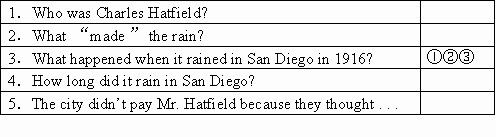
阅读下面短文,根据短文内容回答问题。
The Rainmaker
Can a person make it rain? Many people believed that Charles Hatfiled could. In the early 1900s, Mr. Hatfield traveled through the United States, Canada, and Mexico bringing rain to farms and cities that suffered from drought. For 30 years, people considered him the greatest rainmaker in North America. In order to make it rain, he used a secret mixture of chemicals that be placed high on wooden towers in special trays. As the chemicals evaporated, they attracted rain clouds to the area. Over his career, Mr. Hatfield even offered to help clear the fog from London and to water the Sahara Desert.
One of Mr. Hatfiled's most amazing rainmaking accomplishments happened in southern California in 1916. Because he knew that the city of San Diego did not have enough water, Mr. Hatfield offered to give the city a hand with its water problem. He planned to create enough rain to fill the lake behind Morena Dam near the city. Since the time the dam was built, the lake had never been more than half full, but the lake could hold 57 billion liters (15 billion gallons) of water if it were full. Filling the lake would help the city of San Diego with its constant water problems. Mr. Hatfield suggested that if he succeeded in filling the lake with rain water, the city would pay him $10, 000.If no rain fell, the city would pay nothing. The city agreed because they had nothing to lose from the business deal, and only paying $ 10, 000 for that much water seemed to be a steal.
On January 1, 1916, Mr. Hatfield began his rainmaking procedure. It began to rain four days later. The rain continued for the next five days. On January 10, it began to rain more heavily, and the rain continued for the next 10 days The city of San Diego was flooded. Fifty people died. More than 200 bridges were washed away,. and many miles of train tracks were destroyed. However, Mr. Hatfield did succeed in filling the lake. The water was within 12 centimeters of the top of the dam. Mr. Hatfield thought that he had completed his job, so he went to collect his money from the city. However, the city of San Diego backed out of the deal. They said that the rain was an “act of God” and not the work of the rainmaker. Mr. Hatfield tried to sue the city, but he never collected any money for his work.
Please answer the questions below.