网址:http://m.1010jiajiao.com/timu3_id_2774328[举报]
"Come and have a dinner with me on Thursday," says John.
“But I don’t know where your house is,” says Henry.
“It’s easy,” says John. “There’s no problem. You get off(下车) the bus. Then, you cross the street. You take the first on the left, and you walk for five minutes. Then you come to a big tree about a hundred metres down this street, there is a big red house. You go past the big red house. And after about five hundred metres, you see a small yellow house near a little tree. Open the door with your foot."
“With my foot?” Says Henry.
“Why, yes,” says John, “Your hands will be full(满满的).”
"How do you know my hands will be full?"says Henry.
“You wouldn’t come to my house without(没有) some food with you”.
1.John’s house is _____________.
A. a big and red house B. a small yellow house C. near a big tree
2.Why does John want Henry to open the door with foot? Because ______.
A. John invite(邀请) Henry to have dinner with him
B. There is something wrong Henry’s hands
C. John thinks that when Henry comes, his hands will be full
3. In the story(故事), "You take the first on the left" means(意思)
A. You take No.1 bus on the left B. You take the first turning on the left
C. You take the first step on the left
查看习题详情和答案>>
Last year, some groups of students in their community (社区) made a survey about "How do people spend their free time?" The following diagrams show some results of it:
Diagram (1): Hours for people of different ages who surf the Internet in a week.

Diagram (2): Different days people go to the library. (library attendance)
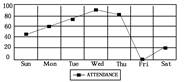
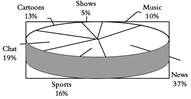
Diagram (3): Different programs people like.
根据上面三个图表内容,选择正确答案。
1.People aged spend the most time surfing the Internet every week.
A.7—16 B.17—30 C.31—55 D.over 56
2.The word "attendance" in Diagram (2) means " in the library".
A.the hours people spend B.the number of people
C.the number of books D.the days people spend
3.On weekends, people go to the library every week.
A.over sixty B.less than sixty
C.about twenty D.more than one hundred
4.Which of the following is true according to the diagrams?
A.The fewest people like watching music.
B.Sports are the most people's favorite programs.
C.People seldom go to the library on weekdays.
D.Half of the people like watching news or cartoons.
5.The three diagrams show us the results of a survey about .
A.what people do every day
B.how people spend their free time
C.people's different lifestyles
D.people's different habits
查看习题详情和答案>>
When you are learning English, you find it not clever to put an English sentence, word for word, into your own language. Take the sentence "How do you do?" as an example. If you look up each word in the dictionary, one at a time, what is your translation (翻译)? It must be a wrong sentence in your own language.
Languages do not just have different sounds, they are different in many ways. It's important to master(掌握) the rules(规则) for word order (顺序) in the study of English, too. If the speaker puts words in a wrong order, the listener can't understand the speaker's sentence easily.Sometimes when the order of words in an English sentence is changed, the meaning of the sentence changes. But sometimes the order is changed, the meaning of the sentence doesn't change.
Let's see the difference between the two sentences:"She only likes apples. " "Only she likes apples. "
When you are learning English, you must use it as the English speaker does.
1.From the passage we know that _______when we are learning English.
A. we shouldn't put every word into our own language
B. we should look up (查阅) every word in the dictionary
C. we need to put every word into our own language
D. we must read word by word
2. The writer thinks it is________in learning English.
A. difficult to understand different sounds
B. possible to remember the word order
C. important to master the rules in different ways
D. easy to master the rules for word order
3.We can learn from the passage that_______.
A. the meaning of an English sentence always changes with the order of the words
B. the order of words can never change the meaning of an English sentence
C. sometimes different order of words has a different meaning
D. if the order of words is different, the meaning of the sentence must be different
查看习题详情和答案>>
用方框中所给单词的适当形式填空,使短文通顺、正确、连贯(每个单词限用一次)
|
Perhaps you've experienced the following situation: You meet an English speaker and begin with what you think is a standard greeting, "How do you do?" Then in ___61___, you hear exactly the same words. You don't know what to say next.
Actually, the exact same greeting is a standard reply to "How do you do?" Don't be nervous, you can __62____ nod and say "fine," and start a new ___63___.
However, next time you watch a Hollywood movie, or ___64___you have the chance to go to an English speaking country, you may be surprised to find that people seldom greet each other ___65___ this sentence. Actually, this expression is very formal (正式的). Many people avoid using such language in everyday life.
Instead of using “how do you do?”, younger people these days use ____66__ own expressions. To people you meet for the first time, you can say: "Nice to meet you." At other__67____, “How's it going?”, “What's up?”, “How are you?” are other casual expressions you can use when talking to friends or ____68__ people.
To reply to ___69___ informal greetings, you can just say "Fine", or "Oh, not so bad". If you are in a good mood, you could even give your friend a "high five". Simply, raise your hand and clap (轻拍) your ___70___ palm in the air.
查看习题详情和答案>>用方框中所给单词的适当形式填空,使短文通顺、正确、连贯(每个单词限用一次)
|
Perhaps you've experienced the following situation: You meet an English speaker and begin with what you think is a standard greeting, "How do you do?" Then in ___61___, you hear exactly the same words. You don't know what to say next.
Actually, the exact same greeting is a standard reply to "How do you do?" Don't be nervous, you can __62____ nod and say "fine," and start a new ___63___.
However, next time you watch a Hollywood movie, or ___64___you have the chance to go to an English speaking country, you may be surprised to find that people seldom greet each other ___65___ this sentence. Actually, this expression is very formal (正式的). Many people avoid using such language in everyday life.
Instead of using “how do you do?”, younger people these days use ____66__ own expressions. To people you meet for the first time, you can say: "Nice to meet you." At other__67____, “How's it going?”, “What's up?”, “How are you?” are other casual expressions you can use when talking to friends or ____68__ people.
To reply to ___69___ informal greetings, you can just say "Fine", or "Oh, not so bad". If you are in a good mood, you could even give your friend a "high five". Simply, raise your hand and clap (轻拍) your ___70___ palm in the air.
查看习题详情和答案>>