网址:http://m.1010jiajiao.com/timu3_id_2702545[举报]
Boys and girls, welcome to our radio club! Our club is very important in our school now. It was started by Tom ten years ago. When he found it was too quiet during the lunch time, Tom advised the headmaster(校长) to set up a radio club, and he agreed. What great advice! Thanks to Tom, we have had many different programmes to listen to at lunch time from then on. There is Music Time for us to hear popular music. And you can hear your favourite songs if you tell us ahead of time. We can give advice on problems, too. For example, how we prepare for exams and how we make friends. And we can also send your best wishes to your friends or teachers on special days. Do you have a good voice? Can you come here to work on time? If the two answers are “Yes”, join us now, please!
| Name | Radio club | |
| Started | By 【小题1】and the headmaster | |
| Programmes | Music | 【小题2】songs |
| Give 【小题3】on problems | How we prepare for exams How we make friends. | |
| Send wishes | To people on 【小题4】 | |
| Requirements(要求) | Have a good voice Work 【小题5】 | |
用划线部分的反义词或对应词填空。
1. --Where do you want to go_? -- here, please. I can tell (告诉) you.
2. The pants are too . Do you have long ones?
3. She likes __ pants, but I like white ones.
4. The blue sweater is very small. I want a one!
5. We __ all kinds of things. What would you like to buy?
根据对话内容,用恰当的单词、短语或句子,补全对话 ,使对话完整通顺。(本题共5小题,每题2分,共计10分)
A: Good morning, sir. ________1__________?
B: I’d like to buy a white shirt. Do you have any white shirts?
A: Yes. ________2____________?
B: I want Size M.
A: Here you are.
B: Can I try it on?
A: Sure. Is it all right?
B: Yes. I like it very much. __________3_________?
A: 296 yuan.
B: That’s a bit expensive. Do you have any other kind? I want a cheaper one.
A: What about this one? It is only 108 yuan.
B: OK. ________4___________. Here is the money.
A. Here you are. Goodbye, sir.
B. 5.
查看习题详情和答案>>
Living in a foreign culture can be exciting, but it can also be confusing(令人疑惑的). A group of Americans who taught English in other countries recently discussed their experiences. They decided that miscommunications were always impossible, even over something as simple as “yes” and “no”.
On her first day in Micronesia, an island in the Pacific, Lisa thought people weren’t paying any attention to her. The day was hot. She went into a store and asked, “Do you have cold drinks?” The woman there didn’t say anything. Lisa repeated the question. Still the woman said nothing. She later learned that the woman had answered her: She had raised her eyebrows(眉毛), which in Micronesia means “yes”.
Jan remembered an experience she had in Bulgaria, a country in Europe. She went to a restaurant that was known for its cabbage. She asked the waiter, “Do you have cabbage today?” He nodded his head. Jan waited, but the cabbage never came. In that country, a nod means “no”.
Tom had a similar problem when he arrived in India. After explaining something in class, he asked his students if they understood. They answered with different nods and shakes of the head. He thought some people had not understood, so he explained again. When he asked again, they did the same thing. He soon found out that his students did understand. In India, people nod and shake their heads in different ways depending on where they come from. You have to know where a person is from to understand whether they mean “yes” or “no”.
【小题1】These Americans teaching English in other countries found that they .
| A.should go abroad for vacations |
| B.needed to learn foreign languages |
| C.should often discuss their experiences |
| D.had problems with communications |
| A.nodding heads | B.raising eyebrows |
| C.shaking heads | D.saying “no” |
| A.he did not know much about India culture |
| B.he didn’t explain everything clearly enough |
| C.some students didn’t understand his questions |
| D.he didn’t know where the students came from |
| A.In Bulgaria, nodding heads means “no”. |
| B.Jan taught English on a Pacific island. |
| C.Lisa was trying to buy some cabbage. |
| D.In India, only shaking heads means “yes”. |
| A.body language in foreign restaurants |
| B.class discussion in India schools |
| C.miscommunication in different cultures |
| D.English teaching in other countries |
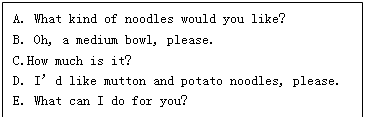
根据对话内容,从方框内选出能填入空白处的最佳选项。
A: 1
B: I’d like some noodles,please.
A: _______2_________
B: What kind of noodles do you have?
A: We have beef, chicken, mutten, potato…
B: ______3______
A: What size would you like? We have large, medium and small bowls.
B: _____4______
A: Ok, A medium bowl of mutton and potato noodles, right?
B: Yes. 5
A: It’s six yuan.