网址:http://m.1010jiajiao.com/timu3_id_2691884[举报]
人造太阳
何 平
①前不久,一条新闻引起全世界关注:中国科学院等离子体物理研究所研制的“人造太阳”调试成功,年内即可试发电。
②“人造太阳”?难道真要在地球上造一个太阳?当然不是!“人造太阳”是指科学家利用太阳核反应原理,为人类制造一种能提供能源的机器——人工可控核聚变装置,科学家称它为“全超导托克马克试验装置”。
③太阳的光和热,来源于氢的两个同胞兄弟——氘和氚(物理学叫氢的同位素)在聚变成一个氦原子的过程中释放出的能量。“人造太阳”就是模仿这一过程。
④氢弹是人们最早制造出的“人造太阳”。但氢弹的聚变过程是不可控的,它瞬间释放出的巨大能量足以毁灭一切。而“全超导托克马克试验装置”却能够稳定控制核聚变,使聚变产生的能量缓缓输出,转化为人们可持续使用的电能。
⑤核聚变反应,首要条件是高温高压。太阳中心的温度高达1500万摄氏度,压强达到3000多亿个大气压。在这样的高温高压下,太阳的聚变反应非常容易。但在地球上可不容易,因为用任何一种材料制作的容器都无法耐受这样的高温高压。
⑥怎么办?科学家们想到了用磁场做容器。从氢弹爆炸至今,科学界用了60年的努力,目前已成功地在磁场容器中将温度提高到4亿至5亿摄氏度,然后投入氘氚产生聚变反应。但由于很难把这种高温长时间维持下去,所以全世界30多个国家上百个实验装置的聚变放电时间都很短!少则几秒,长的也不过数百秒。我国从1965年研究“人造太阳”开始,如今已能使放电时间持续千秒以上。
⑦所以,科学家说,建设核聚变电站投入民用,至少要再等上50年时间。但等待是值得的!现在地球上的石油、煤炭等化石能源至多可用200年时间,其中石油不足50年。即使目前核裂变电站使用的铀燃料,全世界也只能再开采60年。用这些材料做能源还有个致命弱点——环境污染!
⑧相反,氘和氚却是清洁能源,如空气中平时就有氘和氚。所以不用担心聚变反应会产生废气、废渣和放射性污染等问题。有人担心电站爆炸,但科学家说,聚变在磁场中进行,维持温度已很不易,只要稍微马虎,温度就会降下来,聚变就停止了,因此爆炸的可能性是零。
⑨氘和氚是取之不尽用之不竭的能源。世界海洋中大概蕴藏了40万亿吨氘。如果全部用于聚变反应,释放的能量足够人类使用几百亿年,这比太阳的寿命还要长了。
【小题1】选文的说明对象是什么?它的总体特征是什么?(3分)
【小题2】选文第③段的目的在于说明什么?(2分)
【小题3】第⑥自然段与第⑦自然段能不能互换?为什么?(3分)
【小题4】氘和氚是清洁的能源,这样说的根据是什么?在自然界中,你认为还能开发哪些目前还未利用的清洁的能源?简要说说能开发的理由。(4分) 查看习题详情和答案>>
听力
A.听句子,从所给三幅图中选出你所听到的句子情景相同(相近)的图画。(每小题读两遍)(5分)
1.

2.

3.

4.

5.

B.情景反应:根据你所听到的句子,选择恰当的答语。(每小题读两遍)(8分)
6.A.She is clever. B.No, you don't have to. C.Hold on, please.
7.A.You're welcome. B.It doesn't matter. C.Go ahead.
8.A.That sounds interesting. B.Well done! C.It's very kind of you.
9.A.Nice to meet you. B.How are you? C.Thank you.
10.A.Good idea. B.Enjoy yourselves! C.By bike.
11.A.Thank you all the same. B.Sorry, I am new here. C.Here you are.
12.A.Just a little. B.One kilo. C.Fifty yuan.
13.A.It's a knife. B.It's made of paper. C.It's round.
C.对话理解:根据你所听到的对话内容,选择最佳选项回答问题。(每段对话读两遍)(12分)
第一节 听第
14至19段对话,回答第14至19小题。14.How was the film according to the man?
A.Boring. B.Interesting. C.Exciting.
15.What does the man's mother do?
A.A teacher. B.A worker. C.A nurse.
16.How long has Michael been in Zhangzhou?
A.For Five days. B.For three days. C.For two days.
17.Where did the dialog probably happen?
A.In a shop. B.In a school. C.In a restaurant.
18.What did Peter do last night?
A.He watched the soccer game.
B.He did his homework.
C.He went shopping.
19.What will the weather be like tomorrow?
A.Sunny. B.Snowy. C.Rainy.
第二节 听下面两段对话,每段对话后各有三个问题,选择最佳选项回答问题。
听第20段对话,回答第20至22小题。
20.When does Mr.Li drink tea?
A.In the evening. B.In the daytime. C.At any time.
21.Why can't we grow tea in the north?
A.It's too cold. B.It's too windy. C.It's too wet.
22.What does the woman like to drink?
A.Coffee. B.Water. C.Tea.
听第21段对话,回答第23至25小题。
23.Where is Jane from?
A.America. B.Australia. C.Canada.
24.What are Jane's family going to do in the summer holidays?
A.To visit Dalian.
B.To see Jane's grandparents.
C.To visit some cities in the north.
25.Who will travel with Li Ming?
A.His father.
B.His parents.
C.His grandparents.
D.短文理解:根据你所听到的短文内容,填写出下面表格中的空缺部分。(短文读三遍)(5分)

听力测试(共20小题,每小题1分,共20分)
第一部分 听对话回答问题
本部分共有10道小题,每小题你将听到一段对话,每段对话听两遍。
1.Where does Lily come from?
A.
B.
C.
2.When does the shop open today?
A.
B.
C.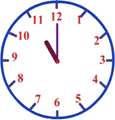
3.Is this Daniel's T-shirt?
A.
B.
C.
4.What is the boy going to do this Saturday?
A.
B.
C.
5.How many blue pens are there?
A.One.
B.Four.
C.Three.
6.What can the woman see?
A.Some books.
B.A box
C.Some bananas.
7.What time is it now?
A.4∶50
B.5∶50
C.5∶10
8.Where are the two speakers?
A.At school.
B.In the library.
C.In a book shop.
9.Is Mary in the classroom or in the Teachers’ office?
A.In the Teachers’ office.
B.In the classroom.
C.Yes, she is.
10.What's the new teacher like?
A.He likes all of us.
B.He teaches very well.
C.He is tall and fat.
第二部分 听对话和短文回答问题,你将听到两段对话和一篇短文,各听两遍。
听第一段对话,回答第11-12小题。
11.Where does the boy see the strange bird?
A.In the park
B.In the zoo
C.Behind his house
12.What colour is the bird?
A.Black
B.White
C.Red
听第二段对话,回答第13-15小题。
13.What will Mary do this evening?
A.Go to Beihai Park
B.Stay at he aunt's home
C.Meet her friends
14.How will she go tomorrow?
A.By bus
B.By taxi
C.By car
15.When will they meet?
A.8∶30 a.m.
B.7∶30 a.m.
C.9∶00a.m.
听一篇短文,回答第16-20小题。
16.How old is Nick?
A.13 years old
B.12 years old
C.15 years old
17.Where is from?
A.America
B.England
C.Canada
18.Can Nick speak a little Chinese?
A.Yes, he can't.
B.No, he can't.
C.Yes, he can.
19.What does Nick often do with his father on Sundays?
A.Go swimming.
B.Go shopping.
C.Play basketball.
20.How many people are there in Nick's family?
A.2
B.8
C.4
一、听力测试(每小题1分,共30分)
第一节 听音辨图
请听句子,选出与所听句子内容相符的图画。每个句子读一遍。
1.

2.

3.
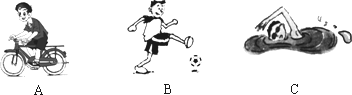
4.
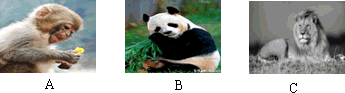
5.
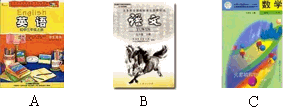
第二节 情景反应
请听句子,选出正确的答语。每个句子读一遍。
6.A.It's under the bed.
B.It's a book.
C.That's all right.
7.A.In Grade One.
B.In Class One.
C.In Room 201.
8.A.Yes, I do.
B.Yes, I am.
C.Yes, I can.
9.A.No, I'm not.
B.You're welcome.
C.It doesn't matter.
10.A.There are 46 students.
B.Those are 46 students.
C.Here are 46 students.
11.A.Yes, we've got some juice.
B.Yes, we've got some milk.
C.Yes, we've got some beef.
12.A.It's Monday.
B.It's at 7∶00 pm.
C.It's at the theatre.
13.A.That's a good idea.
B.Thank you.
C.Yes, I think so.
14.A.Thank you.
B.Sure, here you are.
C.See you.
15.A.Don't mention it.
B.I'm sorry to hear that.
C.Congratulations!
第三节 对话理解
A.请听五组对话,每组对话后你将听到一个问题,请根据对话内容选出正确答案。每组对话和问题读两遍。
16.A.By bus.
B.By subway.
C.On foot.
17.A.It's next to the library.
B.It's behind the library.
C.It's in front of the library.
18.A.In the school.
B.In the office.
C.In the shop.
19.A.It often snows.
B.It's very hot.
C.It often rains.
20.A.Yes, he is.
B.No, he isn't.
C.Sorry, I don't know.
B.请听一段对话,对话后你将听到五个问题,请根据对话内容选出正确答案。对话和问题读两遍。
21.A.London.
B.Hong Kong.
C.Los Angeles.
22.A.9 hours.
B.12 hours.
C.10 hours.
23.A.Her mother.
B.Her uncle.
C.Her friend.
24.A.3 days.
B.4 days.
C.2 days.
25.A.In the river.
B.In the swimming pool.
C.In the Pacific Ocean.
第四节 语篇理解
请仔细听短文,并根据短文内容补全以下信息,每空填一词。短文读两遍。
听力测试(共20小题,每小题1分,共20分)
第一部分 听对话回答问题
本部分共有10道小题,每小题你将听到一段对话,每段对话听两遍。
1.Where does Lily come from?
A.
B.
C.
2.When does the shop open today?
A.
B.
C.
3.Is this Daniel's T-shirt?
A.
B.
C.
4.What is the boy going to do this Saturday?
A.
B.
C.
5.How many blue pens are there?
A.One.
B.Four.
C.Three.
6.What can the woman see?
A.Some books.
B.A box
C.Some bananas.
7.What time is it now?
A.4∶50
B.5∶50
C.5∶10
8.Where are the two speakers?
A.At school.
B.In the library.
C.In a book shop.
9.Is Mary in the classroom or in the Teachers’ office?
A.In the Teachers’ office.
B.In the classroom.
C.Yes, she is.
10.What's the new teacher like?
A.He likes all of us.
B.He teaches very well.
C.He is tall and fat.
第二部分 听对话和短文回答问题,你将听到两段对话和一篇短文,各听两遍。听第一段对话,回答第11-12小题。
11.Where does the boy see the strange bird?
A.In the park
B.In the zoo
C.Behind his house
12.What colour is the bird?
A.Black
B.White
C.Red
听第二段对话,回答第13-15小题。
13.What will Mary do this evening?
A.Go to Beihai Park
B.Stay at he aunt's home
C.Meet her friends
14.How will she go tomorrow?
A.By bus
B.By taxi
C.By car
15.When will they meet?
A.8∶30 a.m.
B.7∶30 a.m.
C.9∶00a.m.
听一篇短文,回答第16-20小题。
16.How old is Nick?
A.13 years old
B.12 years old
C.15 years old
17.Where is from?
A.America
B.England
C.Canada
18.Can Nick speak a little Chinese?
A.Yes, he can't.
B.No, he can't.
C.Yes, he can.
19.What does Nick often do with his father on Sundays?
A.Go swimming.
B.Go shopping.
C.Play basketball.
20.How many people are there in Nick's family?
A.2
B.8
C.4