网址:http://m.1010jiajiao.com/timu3_id_2680327[举报]
Japanese students work very hard but many are unhappy. They feel heavy pressures from their parents. Most students are always told by their parents to study harder and better so that they can have a wonderful life in the future. Though this may be a good idea for those very bright students, it can have terrible results for many students who are not gifted enough. Many of them have tried very hard at school but have failed in the exams and have their parents lose hope. Such students feel that they are hated by everyone else they meet and they don’t want to go to school any longer. They became dropouts.
It is surprising that though most Japanese parents are worried about their children, they do not help them in any way. Many parents feel that they are not able to help their children and that it is the teachers’ work to help their children. To make matters worse, a lot of parents send their children to those schools opening in the evenings and on weekends—they only help the students to pass the exams and never teach them any real sense of the world.
Many Japanese schools usually have rules about everything from the students’ hair to their clothes and things in the school bags. Child psychologists now think that such strict rules are harmful to the feelings of the students. Almost 40% of the students said that no one had taught them how to get on with others, how to tell right from wrong and how to show love and care for others, even for their parents.
- 1.
Which of the following can be the best title of the passage?
- A.The Trouble in Japanese Schools
- B.The Problems of Japanese Students
- C.The Pressures of the Students in Japan
- D.Education in Japan
- A.
- 2.
“Dropouts” are those who ___.
- A.make troubles in and out of schools
- B.go about or stay home instead of being at school
- C.try hard but always fail in the exams
- D.lose hope and give up some of their subjects
- A.
- 3.
Why do Japanese students work very hard at school and feel unhappy?
- A.They want to find a good job.
- B.They want to pass exams.
- C.They’re under pressure from their parents.
- D.They’re not clever enough.
- A.
- 4.
Failure in examinations cause students to ___.
- A.chop out of school
- B.quarrel with their parents
- C.go to schools opening on weekends
- D.have their parents lose hope
- A.
- 5.
According to the passage, it’s necessary to teach students ___.
- A.how to study well
- B.how to get on with others
- C.to show love and care for others
- D.all above
- A.
| |||||||||||||||||||||||||||||||||||||||||||||||||||||||||||
So far, 95% of the reconstruction projects(重建项目)have been completed. Nearly 3,000 schools, 1,000 hospitals and more than 5 million homes have been built. Now everyone has been provided with a home, a job and social security(社保).
Dong Xinjun, a villager in Qingchuan, said volunteers from Zhejiang taught him how to grow mushrooms and now he makes about 3,000 yuan more than before every year.
Zhu Lihu, the headmaster of a village primary school in Qingchuan, told us that teaching equipment had been greatly improved. Now they have new classrooms, a library and a computer room with 20 computers.
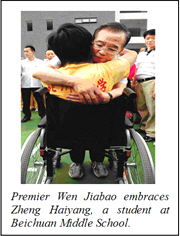
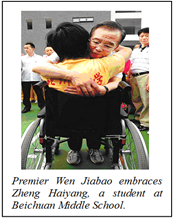
On May 8th, 2011, Premier Wen Jiabao made his 10th visit to Sichuan Province after the earthquake. He visited a lot of middle schools and neighborhoods. At Beichuan Middle School, Premier Wen embraced a student named Zheng Haiyang, who lost both of his legs in the earthquake. The students told Premier Wen that their new school was very beautiful. And they would never forget that it was built with the hearts and strength of people across the whole country.
Premier Wen believes that the people in Wenchuan have a “strong will” and a “bright future”. They will never back down, but stand bravely on this land.
小题1: What is NOT provided for everyone in the earthquake-hit areas?
| A.A home. | B.A job. | C.A computer. | D.Social security. |
| A.Nearly 1,000 schools have been built. |
| B.Dong Xinjun makes about 3,000 yuan every year. |
| C.Zhu Lihu’s new school has a new large gym. |
| D.Zheng Haiyang is a student of Beichuan Middle School. |
| A.5 times. | B.8 times. | C.10 times. | D.12 times. |
| A.Put arms around him in a loving way. | B.Shook hands with him in a friendly way. |
| C.Bowed to him in a very polite way. | D.Smiled at him in a very kind way. |
| A.By giving facts and examples. | B.By comparing different places. |
| C.By describing people’s looks. | D.By using volunteers’ words. |
left millions homeless? On the twelfth day after the earthquake, Premier Wen Jiabao said, "A new Wenchuan
will rise from the ruins (废墟)." Now his words have come true. Three years has passed and the worst-hit
areas in Sichuan have risen from the ruins.
So far, 95% of the reconstruction projects (重建项目) have been completed. Nearly 3,000 schools, 1,000
hospitals and more than 5 million homes have been built. Now everyone has been provided with a home, a job
and social security (社保).
Dong Xinjun, a villager in Qingchuan, said volunteers from Zhejiang taught him how to grow mushrooms
and now he makes about 3,000 yuan more than before every year.
Zhu Lihu, the headmaster of a village primary school in Qingchuan, told us that teaching equipment had
been greatly improved. Now they have new classrooms, a library and a computer room with 20 computers.
On May 8th, 2011, Premier Wen Jiabao made his 10th visit to Sichuan Province after the earthquake. He
visited a lot of middle schools and neighborhoods. At Beichuan Middle School, Premier Wen embraced a
student named Zheng Haiyang, who lost both of his legs in the earthquake. The students told Premier Wen
that their new school was very beautiful. And they would never forget that it was built with the hearts and
strength of people across the whole country.
Premier Wen believes that the people in Wenchuan have a "strong will" and a "bright future". They will
never back down, but stand bravely on this land.
B. A job.
C. A computer.
D. Social security.
B. Dong Xinjun makes about 3,000 yuan every year.
C. Zhu Lihu's new school has a new large gym.
D. Zheng Haiyang is a student of Beichuan Middle School.
B. 8 times.
C. 10 times.
D. 12 times.
B. Shook hands with him in a friendly way.
C. Bowed to him in a very polite way.
D. Smiled at him in a very kind way.
B. By comparing different places.
C. By describing people's looks.
D. By using volunteers' words.
| |||||||||||||||||||||||||||||||||||||||||||||||||||||||||||||||||||||||||