网址:http://m.1010jiajiao.com/timu3_id_2666691[举报]
He isn’t a man who knows _____ to deal with people properly, but he does know _____ to do with all kinds of papers in front of him.
A. what, what B. what, how C. how, what D.how, how
查看习题详情和答案>>
Step 1 Write down the subject that you are interested in on a piece of paper. Just get the main idea down. For example, you might write:
Discover more about robots.
Step 2 Stop and think for a moment about what you have already known about your subject. List what you have already known like the sentences below:
1. The first robot appeared in the USA in 1959.
2. A robot can do housework and act as a teacher.
3. Sometimes a robot catches viruses and causes a lot of problems.
Step 3 What can you do with what you want to learn? By asking questions, start writing down questions about the robots on the paper:
1. What might robots be like in the future?
2. What other things can robots do for people?
3. What kind of power will robots possibly use in five years?
Step 4 Armed with your list of questions, you can now go to the nearest library or computer to begin your research. As you learn more about your subject, you'll probably discover some new questions.
For example, you might discover that robots can help scientists explore dangerous places, like the sea and outer space. How? What happened? Asking new questions can help you research your subject more widely.
The next time you find something interesting to research, take time to organize your thinking by asking good questions. And remember that learning more always brings more questions.
【小题1】What does the writer advise us to do when we’re curious about something?
| A.To read more books about it. | B.To look it up in the dictionary. |
| C.To turn to the teacher for help. | D.To raise questions and find the answers. |
| A.Writing down your list of questions. | B.Discussing your questions with others. |
| C.Taking your list of questions with you. | D.Putting your list of questions under your arm. |
① List what you want to learn. ② Find new problems.
③ List what you’ve already known. ④ Choose a research subject.
| A.④③①② | B.④①③② | C.②③④① | D.③②①④ |
| A.Doing Research onRobots | B.Asking Good Questions While Doing Research |
| C.Having Interesting Answers on Robots | D.Finding Subjects before Doing Research |
Here are some tips on listening. We hope it can help you in one way or another.
●Relax yourself.
Before you start to listen to something, You need to relax.
1 This will help you with your listening.
●Listen carefully to the first sentence.
2 For example, if eyou hear“Many shops in many parts of China have decided to take away all kinds of Japanese goods off their shelves, but some people say it’s not a good idea. Our reporter says…”,you know you will hear a piece of news, not a children’s story or a science report.
●Think when you’re listening.
3 For example, you can think of the following questions: What happened? When , where and how? What was the result and what does the speaker want to tell us? In this way, you may undersrand the passage better.
●Listen for important facts.
4 For example, if the passage is a science report, you should try to remember its findings , and how the scientists got their results.
●Don’t think about one or two words for too long.
You may hear some words that you don’t know. But don’t spend too much time on them.
5 But you can remember some words or sentences that you think are important, and you can use them when you’re answering the questions.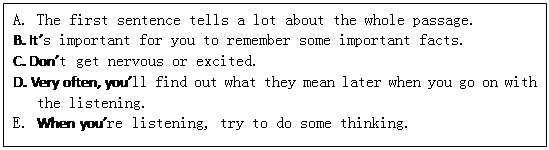
___ a great party! __ delicious the food is!
|
A.What, How |
B.How, How |
C.What, What |
D.How, What |
查看习题详情和答案>>
Did you ever wonder how some of your favorite foods, products or toys came about? Believe it or not, they may have been an accident, or a failure of some other intention. Below, we found three mistakes we’re thankful for turned out to be what they are.

1. Most historians hold that the Chinese invented fireworks in the 9th century when they discovered how to make gunpowder. Story has it that a Chinese cook accidentally mixed together what were then considered common kitchen items and noticed they burnt. When put tightly in a bamboo tube and lit, it blew up.

2. In May of 1886, a law led John Pemberton, a pharmacist(药剂师), to rewrite the formula(配方) for “Pemberton’s French Wine Coca”, his popular headache treatment. Containing sugar instead of wine as a sweetener, the outcome became something for Coke, which was later mixed with carbonated(碳酸) water. His bookkeeper suggested the name Coca-Cola because he thought the two C’s would look good together, which is how what we call Coca-Cola, a world-wide drink came into being.

3. During World WarⅡ, scientists at the University of Birmingham invented the magnetron(磁控管)—an important heat-producing part of the microwave oven. While working for Raytheon Corporation after the war, the American engineer Percy Spencer was testing the magnetron when a chocolate bar in his pocket melted. He went on to test other foods including popcorn kernels(仁), and found it to be a much more efficient way to cook. In 1947 Raytheon came out with the first restaurant microwave oven, which was six feet tall and weighed 750 lbs.
1.The right time order of the three inventions should be ________.
A. fireworks, the microwave and Coca-Cola
B. fireworks, Coca-Cola and the microwave
C. Coca-Cola, fireworks and the microwave
D. the microwave, Coca-Cola and fireworks
2.Percy Spencer found the microwave efficient in cooking when he was ________.
A. looking for a way to melt his chocolate
B. trying to know how a magnetron could cook
C. working to know how the magnetron works
D. asked to invent a restaurant microwave oven
3.The underlined phrase “ blew up” might mean _______ in Chinese.
A. 爆炸 B. 膨胀 C. 升华 D. 蒸发
4.What can we learn from the above invention stories?
A. Experiments make great inventors of our time.
B. Nothing is impossible if one tries each day.
C. Inventors come out of hard work at any time.
D. A small incident may lead to a great invention.
查看习题详情和答案>>