网址:http://m.1010jiajiao.com/timu3_id_2665643[举报]
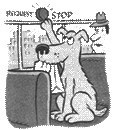 It was Sunday morning. A butcher(屠夫) heard the doorbell(门铃) and thought it must be a customer. But he was surprised to see that a dog was coming into his shop. The dog had $10 and a note in its mouth. The butcher took the note and read it. It said,“10 pork chops(排骨), please.”So the butcher took the money and put a bag of chops in the dog’
 s mouth.
Then he quickly closed the shop because he decided to follow the dog. He found the dog on the street. The dog was waiting for a green light. Then the dog walked across the road. The dog went to a bus stop. When a bus arrived, the dog checked the number and then got on the bus.
After a while, the dog stood up on his back paws(爪子) to push the “stop” button(按钮). The bus stopped and the dog got off. Then the butcher followed it to get off the bus.
The dog ran to a house and dropped the bag in front of the front door. It then began to beat its head against the front door. After a while, a big man opened the door and began shouting at the dog. The butcher ran up and shouted at the man, “What are you doing? Your dog is a genius(天才).”
The owner of the dog said, “Genius? No way! I always tell him to take the keys when he goes to the stores. But he never listens to me!”
56. Who was the customer that Sunday morning?
A. A big man. B. A butcher. C. A dog. D. A little boy.
57. How much did the dog pay for the pork chops?
A. $20. B. $10. C. $5. D. $62.
58. How did the dog take the note?
A. In the bag. B. On its back. C. In its mouth. D. Around its neck.
59. Which is NOT right according to the story?
A. The dog stood up on its back paws to push the “stop” button.
B. The butcher quickly closed the shop to follow the dog.
C. The big man was pleased with his dog.
D. The butcher thought the dog was a genius.
60. What is the story mainly about?
A. A customer. B. A smart dog. C. A butcher. D. A big man.
查看习题详情和答案>>阅读下面短文,掌握其大意,然后从每题所给的A、B、C、D四个选项中选出最佳选项。
One day, a teacher was speaking to a group of students about how to manage time. He gave such an interesting example that his students would never 31 .
He put a wide-mouth jar (罐子) on the table. Then he 32 some rocks and carefully placed them into the jar, one at a time. When 33 rocks would fit inside, he 34 , “Is this jar full?”
Everyone in class shouted, “Yes.” “Really?” The teacher pulled out a bag of small stones. He put 35 small stones in and shook the jar. The small stones went 36 into the spaces between the big rocks. He then asked the group 37 , “Is this jar full?”
“Probably not,” one of them answered. “Good!” the teacher replied. He brought out a box of sand and 38 some sand into the jar and it went between the rocks and small stones. Again he asked the 39 question, “Is this jar full?
“No,” the class shouted. Once more the teacher said, “Good.” He poured a cup of water into the jar 40 it was full. The he asked, “What is the point here?” One student 41 his hand and said, “The point is that if you try really hard, you can 42 put more things in.”
“No,” the teacher replied, “that’s not the 43 . What I want to tell you is that if you don’t put the big rocks in first, you will never get others in at all. 44 are the ‘big rocks’ in your life? Time with your friends, your education or your dreams? Remember to put the 45 in first, or you’ll never get others in at all.?”
31. A. remember B. like C. forget D. think
32. A. handed in B. took out C. gave away D. put away
33. A. no more B. not more C. no many D. not many
34. A. answered B. read C. asked D. said
35. A. no B. few C. any D. some
36. A. up B. out C. down D. away
37. A. no more B. again C. a third time D. a fourth time
38. A. sent B. put C. bought D. collected
39. A. same B. different C. difficult D. common
40. A. since B. till C. while D. because
41. A. offered B. placed C. raised D. shook
42. A. always B. already C. never D. hardly
43. A. point B. example C. promise D. story
44. A. When B. What C. Who D. Why
45. A. sand B. small stones C. big rocks D. water
查看习题详情和答案>>补全对话
A.Ah…Is there anything serious?
B.Thank you, doctor.
C.I've got a bad headache.
D.My temperature seems all right.
E.About two days.
A:What's your trouble?
B: 1
A:How long have you been like this?
B: 2
A:Have you taken your temperature?
B: 3
A:Let me examine you.Open your mouth and say“Ah”.
B: 4
A:You've just got a cold.It's nothing serious.Take this medicine three times a day and drink more hot water.
B: 5
Arms. How you hold your arms shows how open and receptive(能容纳的) you are to people you meet. If you keep your arms to the sides of your body or behind your back, this suggests you are not afraid of anything. Outgoing people generally use their arms with big movements, while quieter people keep them close to their bodies. If someone upsets you, just cross your arms to show you're unhappy!
Head.When you want to appear confident, keep your head level(水平). However, to be friendly in listening or speaking, you must move your head a little.
Legs. Your legs will move around a lot more than usual when you are nervous or telling lies.
Posture(姿势). A good posture makes you feel better about yourself. If you are feeling unhappy, you usually don't sit straight, with your shoulders inwards. This makes breathing more difficult and makes you feel nervous or uncomfortable.
Face.When you lie, you might put on a false face. But that expression would not last long. And your true emotions such as happiness, sadness, fear and so on will come through.
小题1: When someone is keeping his arms behind his back, he tries to tell you that .| A.he is outgoing | B.he is angry |
| C.he is not afraid | D.he is cool |
小题2:If you want to appear confident, you should .| A.move your arms a lot | B.keep your head level |
| C.move your head a little | D.cross your arms |
小题3: Which of the following movements tells you are nervous?| A.Your legs move around a lot more than usual. |
| B.You sit straight and hold your head up. |
| C.You put on a false face |
| D.You keep the arms to the sides of the body. |
小题4:What can we infer(推断) from the passage?| A.Different people in different countries must have the same understanding of the same body movement. |
| B.Body language can express more meanings than words |
| C.We cannot communicate with others without words. |
| D.It's not polite to use body language in communication. |
小题5:Which of the following can be the best title of the passage?| A.Body language, the most powerful language |
| B.Arms tell more than legs |
| C.Facial expressions tell the truth |
| D.Posture shows the mind. |
| 从方框中选择适当的句子完成下列对话。 | |
B: 1______ A: How long have you been like this? B: 2______ A: Have you taken your temperature? B: 3______ A: Let me examine you. Open your mouth and say "Ah". B: 4______ A: You've just got a cold. It's nothing serious. Take this medicine three times a day and drink more hot water. B: 5______ |