网址:http://m.1010jiajiao.com/timu3_id_2656391[举报]
A greeting is a way of saying "Hello" to someone. People in different countries greet each other in different ways. Here are some.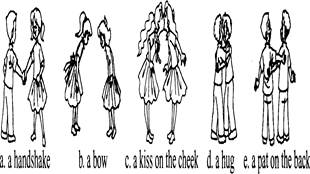
World Greetings
| Philippine | The everyday greeting for friends is a handshake for both men and women. Men sometimes pat each other on the back. |
| Japan | When people meet for the first time, they usually bow. In business, people also shake hands. In formal situations, people often exchange business cards. When you give a business card, give it with two hands. This is polite. Special note: In Japan, a smile can have different meanings. It usually means that the person is happy, or that the person thinks something is funny. But it can also mean that the person is embarrassed. |
| New Zealand | Usually, both men and women shake hands when they meet someone for the first time. Fun fact: If you see two people pressing their noses together, they are probably Maori. The Maori are the native people of New Zealand. This is their traditional greeting. |
| Brazil | Men often shake hands when they meet for the first time. When women meet, they kiss each other on the cheek. Women also kiss male friends to say hello. When you shake hands, look at the person in the eyes. This shows interest and friendliness. |
| A.Kisses. | B.Hugs. | C.Bows. | D.Handshakes. |
| A.a | B.b | C.c | D.d |
| A.Both men and women shake hands in Brazil when they meet. |
| B.Japanese won't smile until they feel very happy. |
| C.The Maori often press their noses together to greet each other. |
| D.In Philippine, people shake hands only when they meet for the first time. |
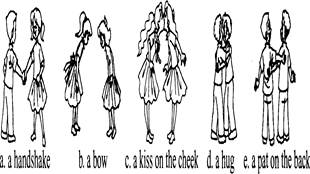
A greeting is a way of saying "Hello" to someone. People in different countries greet each other in different ways. Here are some.
World Greetings
|
Philippine |
The everyday greeting for friends is a handshake for both men and women. Men sometimes pat each other on the back. |
|
Japan |
When people meet for the first time, they usually bow. In business, people also shake hands. In formal situations, people often exchange business cards. When you give a business card, give it with two hands. This is polite. Special note: In Japan, a smile can have different meanings. It usually means that the person is happy, or that the person thinks something is funny. But it can also mean that the person is embarrassed. |
|
New Zealand |
Usually, both men and women shake hands when they meet someone for the first time. Fun fact: If you see two people pressing their noses together, they are probably Maori. The Maori are the native people of New Zealand. This is their traditional greeting. |
|
Brazil |
Men often shake hands when they meet for the first time. When women meet, they kiss each other on the cheek. Women also kiss male friends to say hello. When you shake hands, look at the person in the eyes. This shows interest and friendliness. |
1.In this passage, which of the following is NOT mentioned?
A.Kisses. B.Hugs. C.Bows. D.Handshakes.
2.Of the five pictures above (a, b, c, d and e), which is the same way to greet each other in the four countries?
A.a B.b C.c D.d
3.Which of the following is TRUE according to the passage?
A.Both men and women shake hands in Brazil when they meet.
B.Japanese won't smile until they feel very happy.
C.The Maori often press their noses together to greet each other.
D.In Philippine, people shake hands only when they meet for the first time.
查看习题详情和答案>>

World Greetings
| Philippine | The everyday greeting for friends is a handshake for both men and women. Men sometimes pat each other on the back. |
| Japan | When people meet for the first time, they usually bow. In business, people also shake hands. In formal situations, people often exchange business cards. When you give a business card, give it with two hands. This is polite. Special note: In Japan, a smile can have different meanings. It usually means that the person is happy, or that the person thinks something is funny. But it can also mean that the person is embarrassed. |
| New Zealand | Usually, both men and women shake hands when they meet someone for the first time. Fun fact: If you see two people pressing their noses together, they are probably Maori. The Maori are the native people of New Zealand. This is their traditional greeting. |
| Brazil | Men often shake hands when they meet for the first time. When women meet, they kiss each other on the cheek. Women also kiss male friends to say hello. When you shake hands, look at the person in the eyes. This shows interest and friendliness. |
| A.Kisses. | B.Hugs. | C.Bows. | D.Handshakes. |
| A.a | B.b | C.c | D.d |
| A.Both men and women shake hands in Brazil when they meet. |
| B.Japanese won't smile until they feel very happy. |
| C.The Maori often press their noses together to greet each other. |
| D.In Philippine, people shake hands only when they meet for the first time. |
A very new, young officer(军官) was at a station. He was on his way to visit his mother in another town, and he wanted to telephone her to tell her the time of this train , so that she could meet him at the station in her car. He looked in all his pockets, but found that he did not have the right money for the telephone, so he went outside and looked around for someone to help him.
At last an old soldier (战士) came by, and the young officer stopped him and said, "Have you got change (零钱) for ten pence?"
"Wait a moment, " the old soldier answered. He began to put his hand in his pocket, "I’ ll see whether(是否)I can help you. "
"Don’ t you know how to speak to an officer?" The young man said angrily.(生气). "Now let’s start again. Have you got change for ten pence? "
"No, sir, " the old soldier answered quickly.
56. The young officer and his mother lived ______.
A. in the same town . B. in different places
C. in another town D. in the other town
57.The young officer Wanted to telephone his mother to tell her______.
A.that he was going to visit her
B.where his train would leave for
C.what time his train would arrive at the station
D.that he was then at the station
58. He looked around for help because he ______.
A. had no money to make the phone call
B. did not know where to make the phone call
C. needed some change for the phone call
D. wanted to get change from the old soldier
59. The young officer was angry(生气) because he thought the old soldier ______.
A. was polite to him B. was not polite to him
C. didn’t know how to speak to him D. didn’t like to help him at all
60. Which of the following is not true?
A. Both the young officer and the old soldier were angry.
B. The young officer wanted his mother to meet him at the station.
C. He wanted the old soldier to speak to him in a polite way.
D. He knew the soldier before.
查看习题详情和答案>>
A very new, young officer(军官) was at a station. He was on his way to visit his mother in another town, and he wanted to telephone her to tell her the time of this train , so that she could meet him at the station in her car. He looked in all his pockets, but found that he did not have the right money for the telephone, so he went outside and looked around for someone to help him.
At last an old soldier (战士) came by, and the young officer stopped him and said, "Have you got change (零钱) for ten pence?"
"Wait a moment, " the old soldier answered. He began to put his hand in his pocket, "I’ ll see whether(是否)I can help you. "
"Don’ t you know how to speak to an officer?" The young man said angrily.(生气). "Now let’s start again. Have you got change for ten pence? "
"No, sir, " the old soldier answered quickly.
( )56. The young officer and his mother lived ______.
A. in the same town . B. in different places
C. in another town D. in the other town
( )57.The young officer Wanted to telephone his mother to tell her______.
A.that he was going to visit her
B.where his train would leave for
C.what time his train would get to the station
D.that he was then at the station
( )58. He looked around for help because he ______.
A. had no money to make the phone call
B. did not know where to make the phone call
C. needed some change for the phone call
D. wanted to get change from the old soldier
( )59. The young officer was angry(生气) because he thought the old soldier____.
A. was polite to him B. was not polite to him
C. didn’t know how to speak to him D. didn’t like to help him at all
( )60. Which of the following is not true?
A. Both the young officer and the old soldier were angry.
B. The young officer wanted his mother to meet him at the station.
C. He wanted the old soldier to speak to him in a polite way.
D. He knew the soldier before.
查看习题详情和答案>>