网址:http://m.1010jiajiao.com/timu3_id_2651006[举报]
Are the lives of city kids the same as those in villages? In lots of ways, they are very different. But what are the differences?
Hu Peng and his four friends decided to find them out. Earlier this month, they went to live for a week at Huagui Village near Xishui. They went door to door there and asked kids there lots of questions. They wanted to learn more about village kids’ everyday lives, so they asked questions like these: Do your parents teach you how to do housework? How much money do you usually spend on dinner? What would you do if a thief comes into your houses? They also asked 150 city kids the same question.
On April 12, the team gave a report to their class. They told about lots of differences between children’s lives in cities and those in villages. The biggest difference is independence. Hu’s team say that more than 60 percent of city kids can’t do much housework, but more than 80 percent of village kids can care for themselves.
City kids told Hu they cared about school a lot, and they had no time to wash clothes or make their beds. Village kids said they helped their parents with a lot: they cook, clean houses and feed farm animals, Hu’s team also saw that village kids had less pocket money. Many never use computers. They play in rivers or on mountains. Some don’t really like to make new friends.
Hu’s team said their trip gave them more self-confidence(自信心) because they were doing something by them-selves. But it also worried them a bit because they saw they still had a lot to learn. “When we grow up, our parents can’t take care of us,” Hu said. “We have to learn to take care of ourselves. ”
请根据短文内容完成下表信息:
| Kids in the city | Kids in the country |
| Can’t do much housework | 【小题1】____________________ |
| No time to wash clothes or make bed | 【小题2】____________________ |
| Have pocket money | Have less pocket money |
| Use computers | 【小题3】____________________ |
| 【小题4】____________________ | Don’t like to make new friends |
Hu Peng and his four friends decided to find them out. Earlier this month, they went to live for a week at Huagui Village near Xishui. They went door to door there and asked kids there lots of questions. They wanted to learn more about village kids’ everyday lives, so they asked questions like these: Do your parents teach you how to do housework? How much money do you usually spend on dinner? What would you do if a thief comes into your houses? They also asked 150 city kids the same question.
On April 12, the team gave a report to their class. They told about lots of differences between children’s lives in cities and those in villages. The biggest difference is independence. Hu’s team say that more than 60 percent of city kids can’t do much housework, but more than 80 percent of village kids can care for themselves.
City kids told Hu they cared about school a lot, and they had no time to wash clothes or make their beds. Village kids said they helped their parents with a lot: they cook, clean houses and feed farm animals, Hu’s team also saw that village kids had less pocket money. Many never use computers. They play in rivers or on mountains. Some don’t really like to make new friends.
Hu’s team said their trip gave them more self-confidence(自信心) because they were doing something by them-selves. But it also worried them a bit because they saw they still had a lot to learn. “When we grow up, our parents can’t take care of us,” Hu said. “We have to learn to take care of ourselves. ”
请根据短文内容完成下表信息:
| Kids in the city | Kids in the country |
| Can’t do much housework | 小题1:____________________ |
| No time to wash clothes or make bed | 小题2:____________________ |
| Have pocket money | Have less pocket money |
| Use computers | 小题3:____________________ |
| 小题4:____________________ | Don’t like to make new friends |
Are you ready for the coming festive season? What gifts will you give to make your friends feel special? Here teenagers share their ideas for gifts and look forward to the ones they'll get.
Hu Ziwei, 15, Nanjing Foreign Language School
My class will have a gift exchange party, during which we will put on a small talent show. Many of us had our gifts ready a week ago. I believe that the boys will give magic tools, stationary (文具) or sweets, while girls are likely to give dolls or mobile accessories (挂件).
The biggest fun about these parties is not knowing from whom you'll receive a gift and who will receive your gifts. The computer will decide everything! Our teacher hopes the activity will help us get to know each other better – you see, we've only known each other for three months. I'm looking forward to my surprise gift!
Liu Wei, 17,Beijing No 8 High School
Although my birthday was in November, I'll get a special birthday gift from my classmates this week. A.collective (集体的) birthday party is scheduled for all the students who had birthdays fall in the last six months.
My classroom has been decorated with colorful ribbons and Christmas balls. Someone told me that there will be a huge birthday cake and that a personalized gift sent with best wishes from other students is being prepared for each birthday student. I'm sure we will treasure this event and I'm so looking forward to the big moment!
Yin Zhaohua, 19, Jixi No 1 High School in Heilongjiang
I'm still enjoying the gifts I received on Christmas Eve. Nowadays traditional greeting cards are being replaced with apples and sweets, which symbolize (象征) hope for the year ahead. I got more than 20 apples this Christmas, which means I sent a similar number of apples out. I think apples are healthier, more environmentally and friendly gifts than cards sent through the post.
Wu Shang, 16, Mianyang High School in Sichuan
These last two weeks have been filled with every kind of exam so the atmosphere(气氛) on campus is not at all like a holiday. I miss the days when I got handwritten cards.
In fact, I haven't received or sent holiday cards since the Internet became popular. It's so fast and easy to send an e-card. Also, text messages are fun and convenient (方便的). I'll send warm hugs to my best friends on New Year's D.ay to let them know that I'll be always there for them.
1. Where is Yin Zhaohua from?
A.He is from the east of China B.He is from the capital of China
C.He is from the north of China D.He is from the west of China
2. Before the gift exchange party, Hu Ziwei knows _____________
A.from whom she'll receive a gift B.who will receive her gifts.
C.what gift she will send to her classmates D.that she may get a magic tool
3. In Liu Wei’s classroom we can’t see _____________ during the collective birthday party.
A.some colorful ribbons B.some Christmas balls
C.a huge birthday cake D.some mobile accessories
4. On New Year’s D.ay Wu Shang will _____________.
A.have an important exam B.send some handwritten cards
C.meet and hug her best friends warmly D.send some text messages to her friends
5. From the passage we can infer _____________
A.the kids share the same ideas about gifts
B.the kids will receive and send expensive gifts
C.apples are sent as gifts to keep young kids healthy
D.the kids are trying to show their wishes in different ways
查看习题详情和答案>>阅读理解
Are the lives of city kids the same as those in villages? In lots of ways, they are very different.But what are the differences?
Hu Peng and his four friends decided to find them out.Earlier this month, they went to live for a week at Huagui Village near Xishui.They went door to door there and asked kids there lots of questions.They wanted to learn more about village kids' everyday lives, so they asked questions like these:Do your parents teach you how to do housework? How much money do you usually spend on dinner? What would you do if a thief comes into your houses? They also asked 150 city kids the same question.
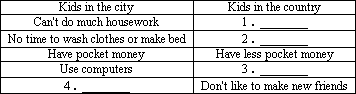
On April 12, the team gave a report to their class.They told about lots of differences between children's lives in cities and those in villages.The biggest difference is independence.Hu's team say that more than 60 percent of city kids can't do much housework, but more than 80 percent of village kids can care for themselves.
City kids told Hu they cared about school a lot, and they had no time to wash clothes or make their beds.Village kids said they helped their parents with a lot:they cook, clean houses and feed farm animals, Hu's team also saw that village kids had less pocket money.Many never use computers.They play in rivers or on mountains.Some don't really like to make new friends.
Hu's team said their trip gave them more self-confidence(自信心)because they were doing something by them-selves.But it also worried them a bit because they saw they still had a lot to learn.“When we grow up, our parents can't take care of us,” Hu said.“We have to learn to take care of ourselves.”
请根据短文内容完成下表信息:
| |||||