网址:http://m.1010jiajiao.com/timu3_id_2638462[举报]
Then they go to work by car. They start their work at 8:30. They are very busy. They have lunch at 12:30. After lunch they work again. They finish their work at 5:30 p.m. In the evening they take Chinese lessons. They want to learn Chinese. They want to talk with Chinese people. They often say "Chinese people are
very friendly". They like to stay in China and they like to work with Chinese people.
B. In Beijing.
C. In Tianjin.
B. No, they don’t.
C. No, they doesn’t.
B. 8:30.
C. 9:00.
B. Watch TV.
C. Take Chinese lessons.
B. Because they like China.
C. Because they want to talk with Chinese people.

B.

C.


B.
C.


B.

C.


B.

C.

B.7:00.
C.6:30.
B.2.
C.1.
B.At someone's home.
C.In a library.
B.Never.
C.Every day.
B.A shopkeeper.
C.A student.
B.He likes pigs very much.
C.He doesn't want a pig as a pet.
Maybe our lack(缺乏) of sleep is because of laziness — I think I’m a rather lazy student — or maybe it’s because we have too much to do in American high schools. I usually go to bed around midnight. If I stayed up past 1:30 am, I wouldn’t get any work done. I’d be falling asleep at my computer. My classes begin at 7:30 am. I’m partly awake in my first class. By the second, I’m a little sleepy. By my third class, I’m sleepy. By midday I’m finally fully awake. But by 3:00 pm, I’m slowing down again. Yet I get more sleep than usual students.
Most American high schools seem to have a similar(相似的) problem with sleepy students. High school classes start at 7:30 am, so students have to get up one and a half hours before that to get ready and catch the bus. It’s believed that lack of sleep can be bad for both grades and health. Some schools are paying attention. Classes in those schools start at 8:30 am.
小题1:What does the underlined sentence “it’s close to the truth” mean?
| A.It doesn’t tell the truth. | B.It is quite true. |
| C.It is impossible. | D.I don’t think it’s right. |
| A.They play computer games. | B.They watch videos late. |
| C.They have to do a lot of housework. | D.They have to do a lot of homework. |
| A.At 7:30 am. | B.At 6:00 am. | C.At 9:00 am. | D.At about 7:00 am. |
| A.The writer usually stays up past 1:30 am. |
| B.The writer usually goes to bed around midnight. |
| C.The writer usually does a survey. |
| D.Many American students don’t get enough sleep, so they can have high grades. |
| A.Something has to be done to solve the problem of students’ lack of sleep. |
| B.Many American high school students are sleepy in class. |
| C.Many kids have too much homework to do. |
| D.Students can’t play computer games. |
The year was 1839. Vice (副……) President Richard M.. Johnson was in New York City on his way to Philadelphia. He was expected(希望) at a meeting at 6:30 that evening. When did he begin his trip? At noon! In 1839, it took six and one-half hours by train and ferry(渡船) to get from New York City to Philadelphia. That wasn't so bad. In 1817, the trip took three days!
If this were a cold winter day, Vice President Johnson would have started much earlier. The Delaware River might freeze over. There would be no ferry and he would have had to walk across the ice.
Today, it's possible to leave New York City on the 9:00 a. m.train and be in Philadelphia at 10:29 a. m. In fact, some people live in New York City and work in Philadelphia. They use the train schedule(时刻表) below.
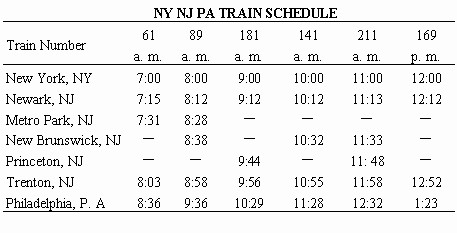
How do you read the train schedule? Suppose(假设) you're in New York City and you want to go to Princeton. Run your finger down the list of cities to find Princeton. Next, move your finger to the right. You will see the times that trains arrive in Princeton. Then run your finger up to the times listed across from New York. That's when the trains leave New York. Make your choice and enjoy the ride !
1.A doctor's office in Philadelphia opens at 9:00 a. m. What time must the doctor leave New York City to get there on time?
[ ]
2.Suppose Vice President Johnson rode today's trains. What time would he have to leave New York to be in Philadelphia by 1:30 p. m. ?
[ ]
3.You board the train in Newark at 8:13. When do you arrive in Trenton?
[ ]
4.Which is the fastest train to Philadelphia?
[ ]
5.Which two trains make the most stops?
[ ]
A student newspaper reports that most students go to sleep at 1:30 am. Even if that’s an overstatement (夸张), it’s close to the truth. Scientists say teens should sleep nine hours each night. But that’s hard. Some are even “pulling all-nighters” (开夜车). These students must hand in their homework the next day but they haven’t done it. In the morning they don’t look healthy and you can tell who’s been doing it. One of my classmates did a survey on the topic. She found that most kids pull all-nighters to finish homework, but some do it for other reasons, such as playing computer games!
Maybe our lack(缺乏) of sleep is because of laziness — I think I’m a rather lazy student — or maybe it’s because we have too much to do in American high schools. I usually go to bed around midnight. If I stayed up past 1:30 am, I wouldn’t get any work done. I’d be falling asleep at my computer. My classes begin at 7:30 am. I’m partly awake in my first class. By the second, I’m a little sleepy. By my third class, I’m sleepy. By midday I’m finally fully awake. But by 3:00 pm, I’m slowing down again. Yet I get more sleep than usual students.
Most American high schools seem to have a similar(相似的) problem with sleepy students. High school classes start at 7:30 am, so students have to get up one and a half hours before that to get ready and catch the bus. It’s believed that lack of sleep can be bad for both grades and health. Some schools are paying attention. Classes in those schools start at 8:30 am.
1.What does the underlined sentence “it’s close to the truth” mean?
A. It doesn’t tell the truth. B. It is quite true.
C. It is impossible. D. I don’t think it’s right.
2.Why do most of the teens have to stay up late?
A. They play computer games. B. They watch videos late.
C. They have to do a lot of housework. D. They have to do a lot of homework.
3.When do students in most American high schools have to get up?
A. At 7:30 am. B. At 6:00 am. C. At 9:00 am. D. At about 7:00 am.
4.Which of the following is TRUE according to the reading?
A. The writer usually stays up past 1:30 am.
B. The writer usually goes to bed around midnight.
C. The writer usually does a survey.
D. Many American students don’t get enough sleep, so they can have high grades.
5.What’s the main idea of the passage?
A. Something has to be done to solve the problem of students’ lack of sleep.
B. Many American high school students are sleepy in class.
C. Many kids have too much homework to do.
D. Students can’t play computer games.
查看习题详情和答案>>