网址:http://m.1010jiajiao.com/timu3_id_2635024[举报]
Over the last 70 years, researchers have been studying happy and unhappy people and finally found out ten factors that make a difference. Our feelings of well-being at any moment are decided to a certain degree by genes. However, of all the factors, wealth and age are the top two.
Money can buy a degree of happiness. But once you can afford to feed, clothe and house yourself, each extra dollar makes less and less difference. Researchers find that, on average, wealthier people are happier. But the link between money and happiness is complex. In the past half-century, the average income has sharply increased in developed countries, yet happiness levels have remained almost the same. Once your basic needs are met, money only seems to increase happiness if you have more than your friends, neighbors and colleagues.
“Dollars buy status (social position), and status makes people feel better,” say some experts, which helps explain why people who can seek status in other ways, scientists or actors, for example, may happily accept relatively poorly-paid jobs.
In his research, Professor Alex Michalos found that the people whose desires, not just for money, but for friends, family, job, health, rose furthest beyond what they already had, tended to be less happy than those who felt a smaller gap. Indeed, the size of the gap predicted happiness about five times better than income alone. “The gap measures just blow away the measures of only income.”says Michalos.
Another factor that has to do with happiness is age. Old age may not be so bad “Given all the problems of aging, how could the elderly be more satisfied?” asks Professor Laura Carstensen. In one survey, Carstensen interviewed 184 people between the ages of 18 and 94, and asked them to fill out an emotion questionnaire. She found that old people reported positive emotions just as often as young people. Some scientists suggest older people may expect life to be harder and learn to live with it, or they’re more realistic about their time running out. Older people have learned to focus on things that make them happy and let go of those that don’t.
“People realize not only what they have, but also that what they have cannot last forever,” she says. “A goodbye kiss to a husband or wife at the age of 85, for example, may bring far more complex emotional responses than a similar kiss to a boy or girl friend at the age of 20.”
【小题1】Some actors would like to accept poorly-paid jobs because the jobs__________.
| A.make them feel much better |
| B.provide chances to make friends |
| C.improve their social position |
| D.satisfy their professional interests |
| A.the gap between reality and desire is bigger |
| B.they have a stronger desire for friendship |
| C.the hope for good health is much greater |
| D.their income is far below their expectation |
| A.would like to have more goodbye kisses than young people |
| B.are used to living a hard life because they are kind to others |
| C.express their positive opinions just as some young people do |
| D.find it easier to feel happy because they are more realistic |
| A.increases gradually with age |
| B.is controlled partly by desires |
| C.has little to do with wealth |
| D.is decided mostly by genes |
| |||||||||||||||||||||||||||||||||||||||||||||||||||||||||||
| |||||||||||||||||||||||||||||||||||||||||||||
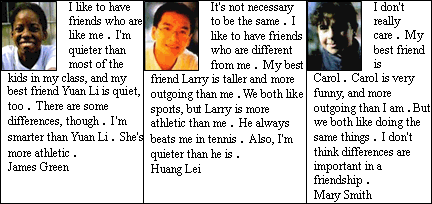
听力(30分)
Ⅰ.听句子,选择正确的图片。
(每小题1分,共5分)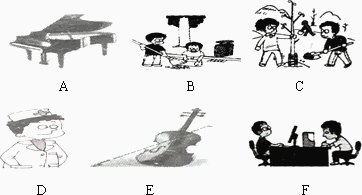
1.________ 2.________ 3.________ 4.________ 5.________
Ⅱ.
听句子,选择恰当的答语。(每小题1分,共5分)6.A.Thank you.
B.Of course not.
C.That's all right.
7.A.Turn off, and you’ll see it on your right.
B.It is very comfortable.
C.Don’t ask me.
8.A.It sounds beautiful.
B.No, I don’t.
C.Yes, I’d love to.
9.A.I like your hair.
B.My hair is black.
C.Yes, I did.
10.A.Because I like you.
B.I like watching TV.
C.Because it’s not a good idea.
Ⅲ.听对话,选择正确答案。
(每小题1分,共10分)听第一段对话,完成第11小题
11.Whom did Kate get her bag from?
A.Her parents.
B.Her uncle.
C.Her friend.
听第二段对话,完成第12小题
12.When will the plane take off?
A.At 10∶05.
B.At 10∶20.
C.At 10∶35
听第三段对话,完成第13小题
13.Where was Simon born?
A.In America.
B.In Australia.
C.In England.
听第四段对话,完成第14-15小题
14.Where are they probably?
A.In a classroom.
B.In a shop.
C.In a hospital.
15.How long has the man been like this?
A.For one day.
B.For two days.
C.For three days.
听第五段对话,完成第16-17小题
16.Who is collecting waste paper?
A.The girl.
B.Lin Tao.
C.Kangkang.
17.What is the advantage of collecting waste paper?
A.Protecting our environment.
B.Raising money.
C.Both A and B.
听第六段对话,完成第18-20小题
18.What does the boy want to know?
A.Chinese culture.
B.Chinese food.
C.Chinese students’ school life.
19.What do the Chinese students do on the morning of the school days?
A.They read Chinese or English.
B.They listen to the English tapes.
C.They do their homework.
20.What will they do after the talk?
A.They will learn English hard.
B.They will learn Chinese hard.
C.They will help each other in language learning.
Ⅳ.听短文,选择最佳答案。(每小题1分,共5分)
21.Life today has ________.
A.many problems.
B.few problems.
C.no problem.
22.One of the biggest problems today is ________.
A.population
B.pollution
C.education.
23.________ is the most serious kind of pollution.
A.Noise pollution.
B.Air pollution.
C.Water pollution.
24.The speaker mentions(提到)________ rules to fight pollution.
A.four.
B.five.
C.six.
25.________ makes us become angry more easily.
A.Air pollution.
B.Water pollution.
C.Noise pollution.
Ⅴ.听短文,完成下面表格。每空一词。(每小题1分,共5分)
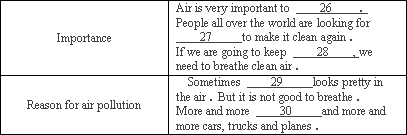
| |||||||||||||||||||||||||||||||||||||||||||||||||||||||||||||||||||||||||