网址:http://m.1010jiajiao.com/timu3_id_2630569[举报]
School uniforms are common in primary and secondary schools in many countries. Here’s a list of countries below.
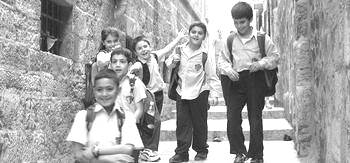 | In Brazil, students wear uniforms in private schools. But in public schools, students don’t have to wear uniforms although they might have one. In general, the uniforms are a pair of blue pants and a white T-shirt with the school symbol printed on it. |
 | School uniforms are used in Cuba. All students wear school uniforms with the color as a symbol of grade level. Children also wear scarves because they are young pioneers(少先队员). |
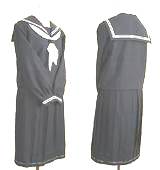 | Japan introduced school uniforms in the late 19th century. Today, school uniforms are very common. Many boys wear white shirts, short pants and caps. Girls’ uniforms might include a gray pleated (褶)skirt and a white blouse. |
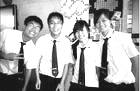 | In Singapore, all students must wear uniforms. Though the colors are different from school to school. The normal uniform for boys is shorts or long pants, with a shirt (often white), while girls wear white pinafores(连衣裙) or skirts. |
【小题1】In Brazil, where is the school symbol?
| A.On the pants | B.On the shoes | C.On the T-shirt | D.On the socks |
| A.grade level | B.cold weather | C.public school | D.young pioneer |
| A.a pair of blue pants and a white T-shirt |
| B.a gray skirt and a white blouse |
| C.a white shirt, short pants and a cap |
| D.a pinafore or a white skirt |
| A.School uniforms are the same as China’s. |
| B.Only the students in private schools wear uniforms. |
| C.Boys’ uniforms are different from girl’s in color. |
| D.Students usually wear white shirts or skirts. |
| A.Brazil | B.Cuba | C.Japan | D.Singapore |
听力部分
I.听录音,找出句中所听到的单词或词组:(5分)
1.A.Christmas
B.Easter
C.the Mid-Autumn Festival
D.Halloween
2.A.some cakes
B.birthday cakes
C.mooncakes
D.big cakes
3.A.come to
B.come on
C.comes after
D.comes into
4.A.from the USA
B.from England
C.from Japan
D.from China
5.A.traditional Japanese food
B.traditional Chinese food
C.traditional Canadian food
D.Halloween chocolates
II.根据录音选择正确的应答句:(5分)
1.A.September 1st.
B.September 10th.
C.March 8th.
D.December 25th.
2.A.Seven.
B.Twelve.
C.Four.
D.Thirty.
3.A.That would be good.B.You're welcome.
C.Be quick!
D.It doesn't matter.
4.A.It is raining.
B.It's cold.
C.Tom is ill!
D.It's fun!
5.A.Good-bye.
B.The same to you.
C.Happy Birthday!
D.You, either.
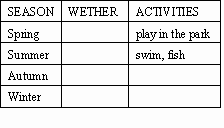
III.对话中在谈论季节,仔细听,完成下面表格:(5分)
IV.根据所听短文及问题,选择正确答案:(5分)
1.A.Class 1, Grade 1.
B.Class 1, Grade 2.
C.Class 2, Grade 1.
D.Grade 1, Class 1.
2.
A.

B.
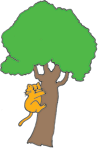
C.
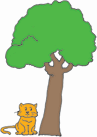
D.

3.A.Yes, it is.
B.No, it's six.
C.No, it is.
D.Six.
4.A.He is eleven.
B.He is twelve.
C.He is thirteen.
D.He is fourteen.
5.A.Mimi and Jim are Chinese.
B.Jim and Li Lei are English.
C.Li Lei and Mimi are Chinese.
D.Mimi is American.
There are some new students in my class this term.John is from Tokyo.He speaks Japanese
very well.Mike comes from New York.He is twelve years old.Kathy’s mother-town is Paris.David
lives in Toronto.He is now in our city with his parents.And the tallest girl,Vicky is from Brazil.
She likes soccer very much.The other forty students are all Chinese.They get on well with each
0ther
1John is from_________ .
A.China B.Japan C.Japanese D.the USA
2Where does Mike come from?
A.He comes from England. B.He is from France.
C.He comes from the USA. D.He is from Japan.
3Which is NOT right?
A.David is a Canadian.
B.David’s parents are in Canada now.
C.David and his parents are all in China now.
D.David can speak English and French very well
4Vicky___________
A.is short B.is from Argentina
C.likes soccer D.doesn’t like China
5There are_________ students in our class.
A.forty B.forty-two C.forty-five D.forty-three
查看习题详情和答案>>Everybody has a home .People have homes. Animals have homes. People live in many different kinds of houses. Animals have different kinds of homes, too.
Some animals live in holes(洞)under the ground . The woodchuck(土拨鼠) lives under the ground .His home has two doors. If any animal comes into one door, the woodchuck goes out through the other . Some animals live in holes in trees. Some squirrels(松鼠)build nests (窝) high in trees. Most of the birds live in nests in trees. But hawks(鹰)build their nests high in the mountains(山).
( ) 1. The story is about____________.
A. some trees B. some people
C. some animals D. the homes of some animals
( ) 2. ___________ live under the ground.
A. All the animals B. All the woodchucks
C. All the squirrels D. All the birds
( ) 3. How many doors are there in the woodchuck’s house?
A. One B. Two C. Three. D. None.
( ) 4. Animals’ homes are____________.
A. not the same B. the same C. in holes D. in trees
( ) 5. People live in ____________.
A. holes B. trees C. different kinds of houses D. mountains
B
Joan is an American girl. She lives in China now. She is in my class. Her parents work in China, too, but her brother works in the U.S.A. He often writes letters to them. Joan likes Chinese class very much, and likes speaking Chinese with us after class. Her father teaches us English well. We all like his class. On Sundays, Joan goes to the People's Park with her father and mother. Sometimes she goes shopping with her mother. They like the Chinese food very much. It's a happy family.
( )6. Joan is from ________.
A. China B. Japan C. the U.S.A. D. Canada
( )7. Joan likes speaking ________with us after class.
A. Chinese B. English C. French D. Japanese
( )8. Joan's ________ is an English teacher.
A. father B. mother C. brother D. father and mother
( )9. How often does Joan go to the shop?
A. Often. B. Never. C. Every Sunday. D. Sometimes.
( )10. Which is not wrong?
A. Joan's mother is a good doctor. B. There are three people in her family.
C. They like to eat the Chinese food a lot. D. The family are all in China.
C
| Country | Capital | Languages(语言) |
| India | New Delhi | Hindi and English |
| Canada | Ottawa | English and French |
| Russia | Moscow | Russian |
| Egypt | Cairo | Arabic |
| Singapore | Singapore City | Malay, Chinese, Tamil and English |
( )11. If you go to ______, maybe some people can understand you.
A. Russia B. Singapore C. Egypt D. India
( )12. Egyptians speak _________.
A. Chinese B. Russian C. Arabic D. French
( )13. If you go to ______, you must learn Russian well.
A. Russia B. Canada C. Singapore D. India
( )14. The capital of Singapore is _______.
A. Moscow B. Cairo C. New Delhi D. Singapore city
( )15. From the form(表格), we can see that ______ is the most important language.
A. English B. Russian C. French D. Tamil
D
Mrs Wilson likes to ask his husband to go shopping with her on Sundays. Her husband pays for the things that she buys. Now they are in a shop.
"Look, Andy. Is it a fancy hair clip?" Mrs Wilson asks his husband.
"All right. And how much is it?" he answers and gives money to the shop assistant. When Mrs Wilson asks him about something good or bad, he often says "All right. And how much is it?" to her.
At about 8 o'clock p.m., Andy is tired and thirsty, and he wants to have a drink. Suddenly (突然地) his wife looks up at moon and says, "Look, Andy. Is the moon so beautiful?"
"All right. And how much is it?" his husband answers quickly.
判断正(T)误(F)
( )16. Mrs Wilson likes to go shopping on Sundays.
( )17. Andy is Mrs Wilson's husband.
( )18 Mrs Wilson pays for all the thing she buys.
( )19 Andy is hungry and wants to buy some food.
( )20 Mrs Wilson wants Andy to buy the moon.
查看习题详情和答案>>In different countries, people have different ways to spend New Year’s Eve(除夕).
In Tokyo, people eat noodles on New Year’s Eve. This food is said to bring long life. Early the next morning, some Japanese families climb Mount Fuji. There they watch the first sunrise of the new year.
In Rome(罗马), Italy, people throw out all the things they don’t like at midnight(午夜) on New Year’s Eve. The streets are full of old chairs, beds, clothes and dishes.
In Madrid(马德里), Spain, the New Year comes more quietly. People come to the main square(主要广场) and each holds a bag of grapes. As the clock strike twelve, the people eat grapes. What do people do on New Year’s Eve in your country?
1. on New Year’s Eve is said to bring long life in Tokyo.
A. Eating rice B. Eating dumplings
C. Eating noodles D. Eating grapes
2. Early the next morning, Japanese climb Mount Fuji to .
A. exercise B. have fun
C. find something lucky D. see the first sunrise of the new year
3. , Italy, people throw out all the things they don’t like at midnight on New Year’s Eve.
A. In Japan B. In Rome C. In Spain D. In Tokjo
4. In Madrid, Spain, people spend New Year’s Eve by on the main square.
A. eating noodles B. eating grapes
C. singing and dancing D. throwing out the old things they dislike
5. In this passage, the writer wants to tell us that .
A. he ever went to Spain
B. he ever climbed Mount Fuji
C. he saw there were many old things in the street in Rome
D. people from different countries have different ways to spend New Year’s Eve
查看习题详情和答案>>