摘要:( )Are you Chinese Japanese? A.to B.and C.or D.to

网址:http://m.1010jiajiao.com/timu3_id_2616742[举报]

阅读下面短文,从每题所给的A、B、C、D四个选项中,选出最佳选项。

  YOU may feel curious about students in other countries:Do they also have so much homework? What do they do in their spare time?

  On April 8, a report came out on the lives of high school students in China, Japan, South Korea and the US.It surveyed around 6, 200 students from the four countries last year.You will find the answers to many of your questions in this report.

  Who studies hardest?

  Chinese students spend the most time studying.Nearly half of Chinese students spend more than two hours on their homework every day.That's much more than students of the US(26.4%), Japan(8.2%)and South Korea(5.2%).

  Who sleeps most often in class?

  Japanese students fall asleep in class most often.About 45% of them said they sometimes doze off in class.In South Korea, it's 32%; in the US, 21%; and 5% in China.

  South Korean students don't like taking notes.About 70% said they write down what the teacher says in class, many fewer than in Japan(93%), China(90%)and the US(89%).

  Who is the most distracted(分心的)?

  American students are the most active in class, but also the most distracted:64.2% said they chat with friends in class; 46.9% said they eat snacks in class; and 38.9% said they send e-mails or read unrelated(无关的)books in class.

  What do they do after school?

  In their spare time, most Chinese students study or surf the Internet.Most American students hang out with their friends.Most Japanese students do physical exercises.Most Korean students watch TV.

(1)

The report is about ________.

[  ]

A.

the countries

B.

the subjects

C.

the students’ lives

D.

the high schools

(2)

What country isn't mentioned in the report?

[  ]

A.

The US

B.

South Korea

C.

Japan

D.

India

(3)

________ of the Chinese students spend more than two hours on their homework.

[  ]

A.

26.4%

B.

8.2%

C.

5.2%

D.

48.6%

(4)

The phrase doze off means ________.

[  ]

A.

be half asleep

B.

get up

C.

eat snacks

D.

send emails

(5)

What of the following sentences is Not true?

[  ]

A.

The survey from the four countries was made last year.

B.

Most Japanese students do physical exercises after school.

C.

About half of the American students chat with freinds in class

D.

The students in South Korean don't like taking notes in class.

查看习题详情和答案>>

阅读理解

阅读下面短文,从每题所给的四个选项(A、B、C和D)中,选出最佳选项。

  Tom: I'm interested in gestures.

  Ellen: Are you? Gestures differ from country to country.

  Tom: Yes. Talking about gestures is a lot of fun.

  Ellen: I've noticed that Japanese women often cover their mouths when they laugh.

  Tom: They think it's impolite to show their teeth.

  Ellen: I once talked to some students from India. They moved their heads up and down when they meant “No”, and from side to side for “Yes”. That looked strange to us.

  Tom: Is that right? I thought nodding meant “Yes” in all parts of the world.

  Ellen: No, not in some parts of India. But those students said their gestures were so natural to them that they couldn't change them.

  Tom: This is one of the most popular comics in my country. Do people in American comics jump this way when they are surprised?

  Ellen: Yes, they do. Comics always use big gestures, you know. (Ellen shows Tom a picture of a man.)

  Tom: I've often seen this picture. He is shrugging his shoulders, isn't he?

  Ellen: Yes, he is. It means I don't care or I give up. How do you gesture with your hand when you mean “Come here” in Japan?

  Tom: We hold out our hands with the palms down, and move it up and down.

  Ellen: That looks like “Sit down”, “Be quiet”, or “Get away” to us. When we mean “Come here”, we hold out our hands with the palms upward, and move our fingers toward our bodies.

1.The main idea of this dialogue is ________.

[  ]

A.Americans, Japanese and Indians have different languages of gestures

B.Americans, Japanese and Indians have one and the same language of gestures

C.Americans, Japanese have one and the same language of gestures

D.Indians and Chinese have one and the same language of gestures

2.Which of the following statements is TRUE?

[  ]

A.Americans nod their heads to mean “No”.

B.Americans shrug their shoulders to show they are interested.

C.American women cover their mouths when they laugh.

D.Japanese women often cover their mouths when they laugh.

3.Which of the following best describes the writer's attitude?

[  ]

A.The Indian students' gestures are unlike the American ones.

B.The Indian students' gestures are quite like the American ones.

C.The Chinese students' gestures are quite like the American ones.

D.The Japanese gestures have something to do with Chinese gestures.

4.In some parts of India, nodding means ________.

[  ]

A.“Yes, I agree.”
B.“No, I don't agree.”
C.“Yes, I do.”
D.“No, I do.”

5.To Americans, shrugging the shoulders means ________.

[  ]

A.“I'm sorry, I don't care (or I give up).”

B.“I'm right.”

C.“Thank you very much.”

D.“That's all right.”

查看习题详情和答案>>

阅读下面短文,从各题A、B、C、D四个选项中选出最佳选项。

  More and more new languages appear on the Internet.We call them "cyber* languages” .Recently “geili” is everywhere.It is a Chinese word in English alphabet*.Since “geili” sounds like “geli” in pinyin, netizens* invented the word “geli” .And Chinese does not have part of speech, so it can be a noun, a verb, an adjective or adverb at the same time.To fit into different parts of speech, they created “gelivable” the adjective, and “gelivability” the noun.It means “giving power” or “cool” .

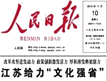
  We have many cyber words like this.Some of these words and expressions were even picked up in serious media* reports.On November 10, the People's Daily, carried a front-page* news story with the title “Jiangsu gelivable cultural province” .

  David Tool, a professor with the Beijing International Studies University, first heard the word “gelivable” from his students.He said it was very interesting to combine Chinese with English to create new words.

  Sergey Dmitriev, a student from Russia studying international politics at Liaoning University, believed the words are a way to learn more about Chinese society.“In Russia, similar words were created, as well, ” he said, adding that creation of the English words showed greater influence and more of an opening of China to the world.

  “Cyber language is more vivid*, ” Wu Zhongmin, a professor at the Party School of the Central Committee of the Communist Party of China, said.A writer, Wang Pei, thinks language is always developing.

  But an unnamed official said that, in fact, many senior* staff from news media were worried that years later, the younger would forget how to use formal* Chinese expressions.

  “My father is Li Gang” is another popular cyber language.What other cyber language do you know? What do you think of them?

(1)

“Geli” is a(n) ________ word in English alphabet.

[  ]

A.

Chinese

B.

English

C.

Russian

D.

Japanese

(2)

Words like “gelivable” were created by ________.

[  ]

A.

professors

B.

netizens

C.

some senior staff

D.

English people

(3)

It's clear that ________.

[  ]

A.

David Tool doesn't think it's good to create new words like “gelivable”

B.

Sergey Dmitriey is a professor at the Party School of the Central Committee of the Communist Party of China

C.

Wu Zhongmin were worried that years later, the younger generation would forget how to use formal Chinese expressions

D.

some serious media also use cyber languages

(4)

The main idea of the passage is ________.

[  ]

A.

people and “gelivable”

B.

how “gelivabe” come into use

C.

cyber languages like “gelivable”

D.

what is “gelivable”

查看习题详情和答案>>

违法和不良信息举报电话:027-86699610 举报邮箱:58377363@163.com

精英家教网