网址:http://m.1010jiajiao.com/timu3_id_2614746[举报]
听力理解(本大题共30小题,每小题1分,共30分)
A.在下列每小题内,你将听到一个或两个句子并看到供选择的A、B、C三幅图画。找出与你所听句子内容相匹配的图画。
1.
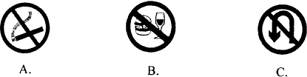
2.
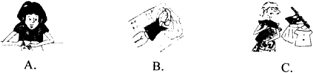
3.
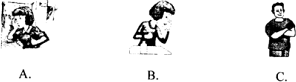
4.
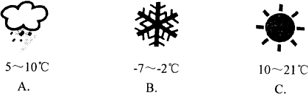
B.在下列每小题内,你将听到一个问句并看到供选择的A、B、C三个答语。找出能回答你所听到的那个问句的最佳选项。
5.A.I’m from Tianjin.
B.Tianjin is a beautiful city.
C.I’m a student.
6.A.It’s white.
B.It’s tall.
C.It’s young.
7.A.You’re welcome.
B.That’s a good idea.
C.Don’t mention it.
8.A.I like the school.
B.The school is far away.
C.I go by bus.
9.A.I was born in a small town.
B.I came here yesterday.
C.I had lunch at home.
10.A.I like holidays.
B.I went to Qingdao.
C.I stayed there for 2 weeks.
11.A.Since 1998.
B.Next year.
C.Last week.
12.A.I’m in Class One.
B.My name’s John.
C.I’m fifteen.
13.A.Her classes are interesting.
B.She is strict.
C.She is 26 years old.
14.A.Yes, go straight ahead.It’s opposite a school.
B.The hotel is very big.
C.People like going there.
C.下面你将听到十组对话,每组对话都有一个问题。根据对话内容,从每组所给的A、B、C三个选项中找出能回答所提问题的最佳选项。
15.What’s Harry’s favourite sport?
A.Football.
B.Table tennis.
C.Basketball.
16.When did the man come to China?
A.In August 1989.
B.In October 1999.
C.In October 2002.
17.Is Betty going to play the piano tomorrow morning?
A.No, she isn’t.
B.Yes, she is.
C.Yes.She likes playing the piano.
18.In Tom’s opinion, what’s the population of Shanghai?
A.10 million.
B.13 million.
C.15 million.
19.Where does the woman want to go?
A.Australia.
B.Africa.
C.Europe.
20.Who gave the man the advice?
A.The woman’s teacher.
B.The man’s pen friend.
C.The woman’s pen friend.
21.What haven’t they got at home?
A.Oranges.
B.Bananas.
C.Apples.
22.How many times has the woman been to the United States?
A.Three times.
B.Four times.
C.Five times.
23.What does Sam do on his birthday?
A.Have a party.
B.Make a cake.
C.Go dancing.
24.When is Charlie’s chemistry lesson?
A.At half past one.
B.At half past two.
C.At half past three.
D.听下面长对话或独白。每段长对话或独白后都有几个问题,从题中所给的A、B、C三个选项中选出最佳选项。
听下面一段材料,回答第25至第27题。
25.Where is Mary now?
A.At school.
B.At home.
C.On the Great Wall.
26.What are the students getting together for?
A.Having a school trip.
B.Having a swim.
C.Having a meeting.
27.Who is writing postcards?
A.Tony.
B.Wang Hui.
C.Lingling.
听下面一段材料,回答第28至第30题。
28.What does David like doing in the evening?
A.Staying at home.
B.Watching television.
C.Going out with his friends.
29.Where does David’s brother work?
A.In a school.
B.In a bank.
C.In a hospital.
30.What’s the difference between the two brothers?
A.The character.
B.The colour of eyes.
C.The colour of hair.
听力(20分)
A)从A、B、C三幅图中找出与你所听内容相符的选项。听两遍。
1.What's the weather like in Jiangyan today?

2.How does David usually go to school?

3.What will Tony give his father?

4.Where is the boy's soccer?

5.Which sign is mentioned in the conversation?

B)听对话,根据所听对话及问题选择正确答案。听两遍。
6.Who wanted to borrow the dictionary?
A.Daniel.
B.Kitty.
C.Millie.
7.What are the boys doing?
A.They're having a meeting.
B.They're playing a game.
C.They're making too much noise.
8.What did the girls do last Sunday?
A.They visited a museum.
B.They saw an interesting film.
C.They visited a large factory.
9.What time do you think they got to the supermarket?
A.9∶00
B.11∶00
C.17∶15
10.Where did the dialogue take place?
A.In a bookshop
B.In a library.
C.In a classroom.
C)听下面两段对话,每段对话后有几个小题,从题中所给的A、B、C三个选项中选出最佳选项。每段对话读两遍。
听第1段对话,回答第11-12题。
11.Where does this dialogue happen?
A.At home.
B.At school.
C.In the open air.
12.What does Jack like to eat?
A.A chicken sandwich.
B.A tomato sandwich.
C.A potato sandwich
听第2段对话,回答第13至15题。
13.Where does the man want to go?
A.The post office.
B.The railway station.
C.The Olympic Village.
14.Is it far from here?
A.Yes, it is.
B.No, it isn't
C.I don't know.
15.How is he going there?
A.On foot.
B.By bus.
C.By train.
D)听短文 根据所听到的短文,选择最佳答案(听两遍)。
16.Who sent George to work when he was 8 years old?
A.His uncle.
B.His father.
C.His teacher.
17.When did George learn to read?
A.In 1992.
B.In 1994.
C.In 1996.
18.Where were the adult classes?
A.Near his home.
B.Far from his home.
C.In another city.
19.What is George's book about?
A.Poor children in different counties.
B.How to read fast.
C.Stories from his life.
20.What is the main idea of this story?
A.Life is so good.
B.Reading is important.
C.Never too late to learn.