网址:http://m.1010jiajiao.com/timu3_id_2601541[举报]
The Mandarin Chinese word for “cha” is pronounced “t'e” in certain Chinese dialects(方言). Also the Malay word for the leaf is“the”. This word “the” was used to describe both the drink and the leaf. The Japanese character for tea is written exactly the same as the Chinese, though pronounced with a slight difference; so these may be the origins of our word tea in the western world.
Tea may have been discovered in 2737 BC by Shen Nong, a Chinese Emperor of the San Huang Period(3,000 - 2,700 BC). He was a scholar, the father of agriculture and the inventor of Chinese herbal medicine. One summer day, while visiting a distant place, he and the court stopped to rest and his servants began to boil water for the court to drink. Dried leaves from the nearby bush fell into the boiling water, and made it a brown liquid. The Emperor was interested in the new liquid, drank some, and found it very refreshing. The tree was a wild tea tree, and so, tea was created.
The first samples(样品) of tea reached England between 1652 and 1654. Tea was referred to as the China drink, tcha, chaw, tay, tee, and tea and was at first regarded more as a medicine than a fashionable drink. The original English pronunciation of the word tea was “tay” and can be traced back to around 1655 when the Dutch introduced both word and beverage(饮料)to England. The pronunciation “tee” also originated in the 1600's but only gained predominance(主导地位)after the late 18th century.
By 1650 the Dutch were actively involved in trade throughout the Western world. During that year Peter Stuyvesant brought the first tea to America to the colonists(殖民地定居者)in the Dutch settlement of New Amsterdam (later re-named New York).
1.The following information is true EXCEPT ________.
A. The Japanese write the character for tea the same way as we Chinese.
B. It was a Chinese Emperor who first found tea very refreshing.
C. The word “the” was used to describe only the leaf.
D. Tea was discovered quite by chance in history.
2.Paragraph 2 mainly tells us ________.
A. that Shen Nong, was a famous inventor of Chinese herbal medicine
B. why the Emperor was brave and dared to run risks
C. whether Shen Nong liked drinking boiled water outside the court
D. the way in which tea was created outdoors
3.Which of the following information is FALSE according to the text?
① Tea was at first regarded just as a fashionable drink in England.
② Tea had different names during the early days it reached England.
③ The pronunciation “tee”originated in 1600.
④ Peter Stuyvesant introduced both word “tay” and beverage(饮料)to England.
⑤ The pronunciation“tee”became popular after the late 18th century.
A. ①② B. ②③ C. ④⑤ D. ①④
4.From Paragraph 3 we know ________.
A. that the leaf tea should be put in hot water for drinking
B. that tea was called the China drink, tcha, chaw, tay, tee, t'e and tea in England
C. what the early situation of tea was like in the Western world
D. that tea was first brought to America in the late 16th century
查看习题详情和答案>>
The Mandarin Chinese word for “cha” is pronounced “t'e” in certain Chinese dialects(方言). Also the Malay word for the leaf is“the”. This word “the” was used to describe both the drink and the leaf. The Japanese character for tea is written exactly the same as the Chinese, though pronounced with a slight difference; so these may be the origins of our word tea in the western world.
Tea may have been discovered in 2737 BC by Shen Nong, a Chinese Emperor of the San Huang Period(3,000 - 2,700 BC). He was a scholar, the father of agriculture and the inventor of Chinese herbal medicine. One summer day, while visiting a distant place, he and the court stopped to rest and his servants began to boil water for the court to drink. Dried leaves from the nearby bush fell into the boiling water, and made it a brown liquid. The Emperor was interested in the new liquid, drank some, and found it very refreshing. The tree was a wild tea tree, and so, tea was created.
The first samples(样品) of tea reached England between 1652 and 1654. Tea was referred to as the China drink, tcha, chaw, tay, tee, and tea and was at first regarded more as a medicine than a fashionable drink. The original English pronunciation of the word tea was “tay” and can be traced back to around 1655 when the Dutch introduced both word and beverage(饮料)to England. The pronunciation “tee” also originated in the 1600's but only gained predominance(主导地位)after the late 18th century.
By 1650 the Dutch were actively involved in trade throughout the Western world. During that year Peter Stuyvesant brought the first tea to America to the colonists(殖民地定居者)in the Dutch settlement of New Amsterdam (later re-named New York)
- 1.
The following information is true EXCEPT ________
- A.The Japanese write the character for tea the same way as we Chinese
- B.It was a Chinese Emperor who first found tea very refreshing
- C.The word “the” was used to describe only the leaf
- D.Tea was discovered quite by chance in history
- A.
- 2.
Paragraph 2 mainly tells us ________
- A.that Shen Nong, was a famous inventor of Chinese herbal medicine
- B.why the Emperor was brave and dared to run risks
- C.whether Shen Nong liked drinking boiled water outside the court
- D.the way in which tea was created outdoors
- A.
- 3.
Which of the following information is FALSE according to the text?
① Tea was at first regarded just as a fashionable drink in England.
② Tea had different names during the early days it reached England.
③ The pronunciation “tee”originated in 1600.
④ Peter Stuyvesant introduced both word “tay” and beverage(饮料)to England.
⑤ The pronunciation“tee”became popular after the late 18th century- A.①②
- B.②③
- C.④⑤
- D.①④
- A.
- 4.
From Paragraph 3 we know ________
- A.that the leaf tea should be put in hot water for drinking
- B.that tea was called the China drink, tcha, chaw, tay, tee, t'e and tea in England
- C.what the early situation of tea was like in the Western world
- D.that tea was first brought to America in the late 16th century
- A.
A strong wind can be a dangerous thing — sometimes it is powerful enough to knock you off your feet. But to plants, the wind is a source of new life, carrying them or their spores (孢子) thousands of miles.
A NASA satellite called QuikSCAT has discovered highways of wind over the Earth's oceans. Scientists believe these invisible roads may explain why many nonflowering plants, such as mosses (苔) and lichens (地衣), grow where they do.
The satellite is able to send microwaves (微波) from space to the surface of the ocean. The pattern of signals that come back shows which way the winds are blowing.
Using this data, the scientists studied a group of islands in the southern hemisphere (半球), near Antarctica.Winds tend to blow anticlockwise (逆时针) in this region, but there are lots of local differences.
When the researchers compared these local patterns to botanical (植物学) data, they found that the wind had an important effect on where species of mosses, lichens, and other nonflowering plants grow.
For example, Bouvet Island and Heard Island, share 30 per cent of their moss species, 29 per cent of liverworts (叶苔), and 32 per cent of lichens — even though they are 4,430 kilometers apart. In contrast, Gough Island and Bouvet Island, separated by just 1,860 kilometers of sea, share only 16 per cent of mosses and 17 per cent of liverworts. They have no lichens in common.
Ferns (蕨类植物) and flowering plants don't travel as well in the wind, so they don't show the same kinds of distribution (分布) patterns.
This story is about _____.
A.the discovery of wind highways B.how wind travels
C.how wind affects different plants D. one function of the wind
The underlined word "data" in the fourth paragraph means _____.
A.signal B.pattern C.information D. research
Which of the following is wrong?
A.Bouvet Island, Heard Island and Gough Island are all in the southern hemisphere.
B.Winds in the researched area blow anti-clockwise.
C.The scientists shouldn't base this research on how winds affect where ferns grow.
D. Without the discovery of QuikSCAT, the research wouldn't have made sense.
Which of the following diagrams shows the correct position of the islands?
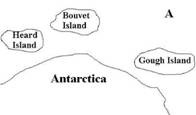
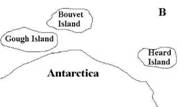
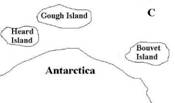
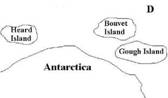
根据短文内容,从短文后的选项中选出能填入空白处的最佳选项。选项中有两项为多余选项。
Most drinks stating that they are fruit-flavored(水果味道的)contain no fruit at all, while most of the rest contain only a small quantity of fruit, according to a study carried by the British Food Commission.
“Shoppers need to check the labels(标签)before buying drinks, though sometimes the actual content can be non-existent,” said Food Commission spokesperson Lan Tokelove. “Food production is highly competitive. It will increase profits, and consumers won’t always realize they are being tricked.”
Flavorings are focused on the flavors of natural food products such as fruits, meats and vegetables, or creating flavor for food products that do not have the desired flavors. Researchers analyzed the contents of 28 strawberry-flavored products sold in stores. Of the 11 products that did contain strawberries, five of them contained less than one percent real fruit. In addition, each juice box contained nearly eight teaspoons of sugar.
Let’s take jam as an example. Some strawberry-flavored jam was labeled as containing no artificial colors, flavors, or sweeteners, but it contained absolutely no strawberries at all.
Consumers have the rights to know clearly about what they have bought. Under current UK law, Food packages do no not have to distinguish between natural and artificial flavoring. “Describing a product as strawberry flavor and covering the surface of the packed with pictures of strawberries is misleading. Unfortunately, it is also legal and widespread,” Tokelove said.
A. The products which contain real fruit are popular with people.
B. Even products advertised as more natural often contained no fruit.
C. They found that about 60 percent of them didn’t contain any fruit at all.
D. If companies can cut their costs by using flavoring, they are likely to do so.
E. It is important and necessary to demand a small amount of flavoring in the products.
F. Actually the product contains just a tiny percentage of strawberry or even no fruit at all.
G. The Food Commission suggested all flavors used in a product should be listed on the packaging.
查看习题详情和答案>>