网址:http://m.1010jiajiao.com/timu3_id_2600864[举报]
Muhammad Yunus and the bank he founded are honored for their work to help the word’s poor. Muhammad Yunus and the Grameen Bank he founded were awarded the Nobel Peace Prize on Friday. They won the award for their efforts to help bring millions of people, especially women, out of poverty.
“Every single individual on earth has both the potential and the right to live a decent life. Across cultures and civilizations, Yunus and Grameen Bank have shown that even the poorest of the poor can work to bring about their own development,” the Nobel Committee said in its citation.
The Peace Prize is one of the biggest honors in the world. Yunus is the first Nobel Prize winner from Bangladesh, a nation of about 141 million people. In 1983, Yunus and the Grameen Bank started a now worldwide system that lets people borrow small amounts of money to start business. Through these loans, called “micro-credit”, the world’s poor have been able to buy much needed to run an egg business, or a cell phone in places where there is on other access to a phone.
Yunus said he would use part of the $1.4 million award money to create a company that will make low-cost, high-nutrition food for the poor. The rest of his share will go toward setting up an eye hospital for the poor in Bangladesh. ”I’m so, so happy, it’s really great news for the whole nation,” Yunus said after hearing of his win.
Since the bank began, it has lent $5.72 billion to more than 6 million Bangladeshis. About 97% of the borrowers are women.
Why does Nobel Peace Prize come to Muhammad Yunus and the Grameen Bank?
A.Because they helped the rich become richer.
B.Because they helped children to finish their education.
C.Because they helped millions of people, especially women, out of poverty.
D.Because they helped millions of people, especially men, out of poverty.
What value have Yunus and Grameen Bank demonstrated to use according to the Nobel Committee’s praise?
A. Poor people have no right to live a rich life
B. Poor people can live a happier life by borrowing money from moneylenders.
C. The poorest of the poor can also have a happier life by working hard.
D. The poor people can only have a right to live a poor life.
It can be inferred that micro-credit system ____.
A. has made all the people in Bangladesh start their own business
B. has a history of about 23 years
C. only loaned money to the people of Bangladesh
D. has spread all over the world for thirty years
It can be inferred that the average amount of micro-credit might be ____.
A. 140 dollars B. 95 dollars
C. 970 dollars D. 572 dollars
查看习题详情和答案>>Banker Wins Nobel Peace Prize
Muhammad Yunus and the bank he founded are honored for their work to help the world’s poor. Muhammad Yunus and the Grameen Bank he founded were awarded the Nobel Peace Prize on Friday. They won the award for their efforts to help bring millions of people, especially women, out of poverty.
“Every single individual on earth has both the potential and the right to live a decent life. Across cultures and civilizations, Yunus and Grameen Bank have shown that even the poorest of the poor can work to bring about their own development,”the Nobel Committee said in its citation.
The Peace Prize is one of the biggest honors in the world. Yunus is the first Nobel Prize winner from
Yunus said he would use part of the $ 1.4 million award money to create a company that will make low-cost, high-nutrition food for the poor. The rest of his share will go toward setting up an eye hospital for the poor in
Since the bank began, it has lent $ 5.72 billion to more than 6 million Bangladeshis. About 97 percent of the borrowers are women.
56.Why does Nobel Peace Prize of 2006 come to Muhammad Yunus and the Grameen Bank?
A.Because they helped the rich to become richer.
B.Because they helped children to finish their education.
C.Because they helped millions of people, especially women, out of poverty.
D.Because they helped millions of people, especially men, out of poverty.
57.It can be inferred that microcredit system .
A.has made all the people in
B.has a history of about 23 years
C.only loaned money to the people of
D.has spread all over the world for thirty years
58.Which statement is true according to the passage?
A.The award money will be used in setting up an eye hospital and a food company for the poor.
B.All the $ 1.4 million award money will be shared by the poor in Banladesh.
C.Muhammad Yunus will loan the money to the poor women in
D.Muhammad Yunus will save the $1.4 million award money in Grameen Bank.
59.According to the passage, we can infer that the average amount of microcredit might be .
A.140 dollars B.95 dollars C.970 dollars D.572 dollars
查看习题详情和答案>>阅读理解
A businessman,who always tried to pay as little as possible for what he needed,fell ill one day.He decided to go to a doctor and asked a friend to recommend(推荐)one.
“
Dr.Smith is an excellent(优秀)one,and he has rich experience in treating various(多种)illness.”the friend told him.“
Is he expensive?”the businessman aske D.“
Yes and no.He charges(索款)five hundred dollars for the visit,but only twenty-five dollars for each visit after that.”“
That seems reasonable(合乎情理),”the businessman said,and went to visit Dr.Smith.As he walked into the consulting(诊所)room,he said,“Well,here I am again,doctor,”and put twenty-five dollars on the table.The doctor looked at him carefully for a moment,then smiled and put the money into his pocket.“Thank you,”he said,“and what can I do for you today?”
“Examine me,of course,”the businessman said,“and tell mw what’s wrong with me.”
“Oh,there’s no need for me to examine you again.”the doctor said,“Just continue taking the medicine I prescribed(开药方)for you when you came to see me last time.”
1.What kind of person was the businessman?
A.He was a person easy to get on with.
B.He was a very rich and successful person.
C.He was a person who always tried to pay as little as possible for what he neede D.
D.He was a person who enjoyed cheating others.
2.Which of the following questions can best take the place of this question.“Is he expensive?”
A.Does he charge his patient a lot of money?
B.Does he cost a lot of money?
C.Is he a valuable person?
D.Is he able to pay all the expenses?
3.Why did the businessman say to the doctor“Well,here I am again”?
A.He had visited the doctor many times before.
B.It was his second visit to the doctor.
C.He had already paid $500 for his visit.
D.He wanted the doctor to think he had visited him before.
4.What did the doctor do for the businessman?
A.He gave him a prescription(药方).
B.He examined him.
C.He gave him a careful treatment.
D.He did nothing for the businessman.
5.Why did Dr.Smith smile as he took the $25?
A.He found the businessman telling a lie(说谎).
B.He was pleased with the pay.
C.They were old friends.
D.Doctors are always polite to their patients.
查看习题详情和答案>>听力(共20题,1.5分1题)
第一节(共5小题。每段对话后有一小题,从题中所给的A、B、C三个选项中选出最佳选项。)
1.Where does this conversation most probably take place?
A.In a hotel
B.At an airport
C.At a railway station
2.How does the man go to work?
A.By bike
B.On foot
C.By car
3.What does Lily dislike doing on Sundays?
A.Reading books
B.Going shopping
C.Going to the cinema
4.Why did the woman go to the hospital?
A.To have a physical examination
B.To find a job
C.To work in the hospital
5.What is the woman going to do on Friday evening?
A.Go to the cinema
B.Visit her new nephew
C.Have a baby
第二节(共15题。听下面五段对话或独白每段对话或独白后有几个小题,从题中所给A、B、C三个选项中选出最佳选项。)
听6段材料,回答第6至8题。
6.What will the speakers NOT do this weekend?
A.Take a boat to the island
B.Go to the river
C.See a play
7.Why does the man suggest phoning the theatre?
A.To book tickets
B.To check if there will be a play
C.To check if it is open this weekend.
8.What’s the phone number?
A.572-860
B.527-860
C.527-816
听第7材料,回答第9至11题。
9.What’s Charlie doing when the conversation takes place?
A.Sleeping
B.Dressing up
C.Having breakfast
10.What time does school begin?
A.At 7∶00
B.At 7∶15
C.At 7∶30
11.What food will Charlie NOT have for his breakfast?
A.Rice
B.Milk
C.Bread
听第8段材料,回答第12至14题。
12.Where is the woman going?
A.To the post office
B.To the museum
C.To the fruit shop
13.How will the woman go there?
A.By taxi
B.By bus
C.On foot
14.What does the woman do now?
A.She’s a teacher
B.She’s an editor
C.She’s a doctor
听9段材料,回答第第15至17题。
15.How much will the man pay for the clothes if the price is 300 dollars?
A.240 dollars
B.150 dollars
C.60 dollars
16.What color does the man prefer?
A.Light color
B.Warm color
C.Dark color
17.What does the man buy?
A.A skirt
B.A skirt and a sweater
C.A shirt
听第10段材料,回答第18至20题。
18.How long did John stay in Japan?
A.For half a year
B.For four months
C.For three months
19.What did John think about his life in Japan?
A.It was hard
B.It was easy
C.It was boring
20.Why did the shopkeeper learn English?
A.He wanted to get a new job
B.He would visit English soon
C.He wanted to communicate with foreign customers
听力(共两节,满分35分)
第一节:听独白或对话(共15小题;每小题2分,满分30分)
听下面5段对话或独白。每段对话或独白后有几个小题,从题中所给的A、B、C三个选项中选出最佳选项。听每段对话或独白前,你将有时间阅读各个小题,每小题5秒钟;听完后,各个小题将给出5秒钟的作答时间。每段对话或独白读两遍。
听第1段对话,回答第1~3题。
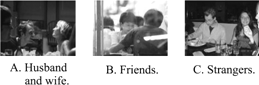
1.What’s the possible relationship between the two speakers?
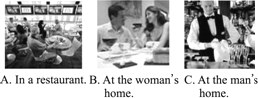
2.Where does the conversation most probably take place?
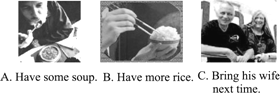
3.What does the woman ask the man to do?
听第2段对话,回答第4~6题。
4.Why shouldn’t the man open the door?
A.Because it was locked.
B.Because it was very hot.
C.Because of the smoke outside.
5.What happened at the hotel?
A.There was no electricity.
B.There was no water.
C.There was a fire.
6.How did the speakers get out of their room?
A.They called the police for help.
B.They climbed out of the window.
C.They covered up in wet sheets and ran away.
听第3段对话,回答第7~9题。
7.What won’t the speakers do this weekend?
A.Take a boat to the islands.
B.Go to the river.
C.See a play.
8.Why does the man suggest phoning the theatre?
A.To book tickets.
B.To check if there will be a play.
C.To check if it is open this weekend.
9.What’s the phone number?
A.527-086.
B.572-860.
C.527-860.
听第4段对话,回答第10~12题。
10.Where does this conversation take place?
A.In a hotel.
B.In a hospital.
C.In a shopping centre.
11.On which floor is the Exhibition Centre?
A.The ninth floor.
B.The third floor.
C.The second floor.
12.Why does the man come to Hong Kong?
A.He is on holiday.
B.He comes for the computer exhibition.
C.He comes to meet Peter Smith from Greece.
听第5段独白,回答第13~15题。
13.Why did Lorraine come to London?
A.To study hospital management.
B.To visit the beautiful parks in London.
C.To study the buildings in London.
14.What’s the weather like in London?
A.Sunny.
B.Windy.
C.Rainy.
15.Which city has a serious traffic problem?
A.London.
B.TrinidaD.
C.Sydney.
第二节:听取信息(共5小题;每小题1分,满分5分)
听下面1段对话。请根据题目要求,从所听到的内容中获取必要的信息,填入标号为16~20的空格中。听录音前,你将有10秒钟的阅题时间,录音读两遍。你有80秒钟的作答时间。