网址:http://m.1010jiajiao.com/timu3_id_2600603[举报]
My father is a smart man. He spent many years of his life listening to people’s arguments, first as assistant district lawyer and then as a judge. My dad knows rubbish rhetoric when he hears it.
One of his favorite phrases is: “If you don’t have anything smart to say, then don’t say it at all.” Yet, for all of his legal training and life experience, he can’t help but keep talking about the Mega Millions jackpot.
We all know the odds(几率)of winning the jackpot this evening with one ticket are extraordinarily low ... 1 in 175, 711, 536, to be exact. Still, people go out and buy hundreds of tickets with the hopes of becoming wealthier beyond their dreams. Why? There are two possible explanations for this “irrationality”(不理智).
One idea is that the way we calculate odds in our heads has nothing to do with mathematical odds in the traditional sense. We don’t go to the mathematical odds table and say, “Well, this would be a terrible investment. I think I’m better off putting my money in the bank!” Rather, it has everything with the ability to picture an event happening.
My father, for instance, watches the news every night and sees people winning the lottery(彩票). Therefore, he thinks the chance of him winning the lottery is much higher than they actually are.
The second thought is that the expected effect of playing cannot be represented merely by the odds. My father and, I’m sure, others get a thrill from the mere idea of winning. He loves imagining what it would be like to actually win and losing doesn’t really affect him. Sure, he’s disappointed, but it’s “better to have loved and lost than never to have loved at all.” When you combine the utility of thinking you can win with the utility of actually winning (no matter how small the chance of that occurring), it’s worth it for many people to spend the one dollar on a ticket.
My analysis is that both factors are at play in taking a chance on the lottery. My father and others really do underestimate the odds of winning, but the thrill of participation is not denied by a realistic assessment of the odds. Still, I would probably put my finger on the scale for the first explanation.
All told, a review of the odds of other events happening confirms that there just aren’t many events that occur with less frequency than your winning the Mega Millions jackpot. Look at the graph below, you may understand some: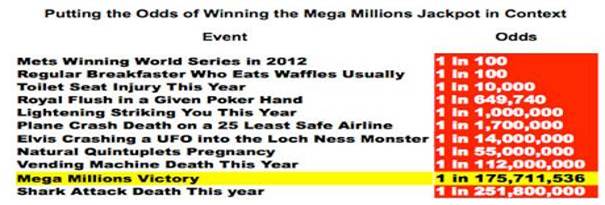
In many ways, it’s like the lottery, something that features often on television and about which people fantasize, but that rarely happens.
So, when you watch, along with my Pa, to see if your lucky number is drawn this evening, keep in mind three things: that your number almost certainly won’t come up; that you are still going to have fun; and that, finally, a lot of other things are more likely to happen—but getting eaten by a shark isn’t one of them.
【小题1】It can be learned from the article that ________.
| A.the Mega Millions jackpot is the last lottery to win in the world |
| B.a judge in that country can’t talk about lottery because it is illegal |
| C.the writer doesn’t buy lottery, for he never hopes to become rich |
| D.In spite of little possibility, a lot of people spend money on lottery |
| A.show chances that those things take place are fewer |
| B.support the writer’s arguments on the lottery tickets |
| C.indicate no one can win the Mega Millions jackpot |
| D.say shark attack death will seldom happen this year |
| A.If one has mathematical odds, he can win the prize more easily. |
| B.Only those who have irrationality buy hundreds of lottery tickets. |
| C.The Mega Millions jackpot is very popular in the writer’s country. |
| D.Winning lottery is a shortcut to achieve the dream of being rich. |
| A.effective | B.ridiculous | C.contradictory | D.astonishing |
| A.The Popular Mega Millions Jackpot | B.Lottery is Merely a Trick |
| C.Mega Million is Like a Shark Attack | D.Be rich, Buy Lottery Soon |
My father is a smart man. He spent many years of his life listening to people’s arguments, first as assistant district lawyer and then as a judge. My dad knows rubbish rhetoric when he hears it.
One of his favorite phrases is: “If you don’t have anything smart to say, then don’t say it at all.” Yet, for all of his legal training and life experience, he can’t help but keep talking about the Mega Millions jackpot.
We all know the odds(几率)of winning the jackpot this evening with one ticket are extraordinarily low ... 1 in 175, 711, 536, to be exact. Still, people go out and buy hundreds of tickets with the hopes of becoming wealthier beyond their dreams. Why? There are two possible explanations for this “irrationality”(不理智).
One idea is that the way we calculate odds in our heads has nothing to do with mathematical odds in the traditional sense. We don’t go to the mathematical odds table and say, “Well, this would be a terrible investment. I think I’m better off putting my money in the bank!” Rather, it has everything with the ability to picture an event happening.
My father, for instance, watches the news every night and sees people winning the lottery(彩票). Therefore, he thinks the chance of him winning the lottery is much higher than they actually are.
The second thought is that the expected effect of playing cannot be represented merely by the odds. My father and, I’m sure, others get a thrill from the mere idea of winning. He loves imagining what it would be like to actually win and losing doesn’t really affect him. Sure, he’s disappointed, but it’s “better to have loved and lost than never to have loved at all.” When you combine the utility of thinking you can win with the utility of actually winning (no matter how small the chance of that occurring), it’s worth it for many people to spend the one dollar on a ticket.
My analysis is that both factors are at play in taking a chance on the lottery. My father and others really do underestimate the odds of winning, but the thrill of participation is not denied by a realistic assessment of the odds. Still, I would probably put my finger on the scale for the first explanation.
All told, a review of the odds of other events happening confirms that there just aren’t many events that occur with less frequency than your winning the Mega Millions jackpot. Look at the graph below, you may understand some:

In many ways, it’s like the lottery, something that features often on television and about which people fantasize, but that rarely happens.
So, when you watch, along with my Pa, to see if your lucky number is drawn this evening, keep in mind three things: that your number almost certainly won’t come up; that you are still going to have fun; and that, finally, a lot of other things are more likely to happen—but getting eaten by a shark isn’t one of them
- 1.
It can be learned from the article that ________
- A.the Mega Millions jackpot is the last lottery to win in the world
- B.a judge in that country can’t talk about lottery because it is illegal
- C.the writer doesn’t buy lottery, for he never hopes to become rich
- D.In spite of little possibility, a lot of people spend money on lottery
- A.
- 2.
The function of the graph is to ________
- A.show chances that those things take place are fewer
- B.support the writer’s arguments on the lottery tickets
- C.indicate no one can win the Mega Millions jackpot
- D.say shark attack death will seldom happen this year
- A.
- 3.
Which of the following do you think the writer would probably agree with?
- A.If one has mathematical odds, he can win the prize more easily
- B.Only those who have irrationality buy hundreds of lottery tickets
- C.The Mega Millions jackpot is very popular in the writer’s country
- D.Winning lottery is a shortcut to achieve the dream of being rich
- A.
- 4.
The underlined phrase “at play” in the 7th paragraph most probably means ________
- A.effective
- B.ridiculous
- C.contradictory
- D.astonishing
- A.
- 5.
What do you think is the best title?
- A.The Popular Mega Millions Jackpot
- B.Lottery is Merely a Trick
- C.Mega Million is Like a Shark Attack
- D.Be rich, Buy Lottery Soon
- A.
He ________ more than 5,000 English words when he entered the university at the age of 15.
A. has learned B. would have learned C. learned D. had learned
查看习题详情和答案>>Where do most writers get their ideas? For Yoshiko Uchida, it all began with Brownie, a five-month-old puppy. So excited was Yoshiko by Brownie’s arrival that she started keeping a journal, writing about all the wonderful things Brownie did and the progress he made.
Soon she was writing about other memorable events in her life, too, like the day her family got their first refrigerator. She also began writing stories, thanks to one of her teachers. Yoshiko wrote stories about animal characters such as Jimmy Chipmunk and Willie the Squirrel. She kept on writing, sharing the kitchen table with her mother, who wrote poems on scraps of paper and the backs of envelopes.
Yoshiko grew up in the 1930s in Berkeley, California. Her parents, both of whom had been born in Japan, provided a loving and happy home for Yoshiko and her sister. They also provided a stream of visitors to their home who later found their way into Yoshiko’s stories. One visitor who later appeared in several of Yoshiko’s stories was the bad-tempered Mr. Toga, who lived above the church that her family attended. Mr. Toga would scold anyone who displeased him. The children all feared him and loved to tell stories about how mean he was and how his false teeth rattled (咯咯响) when he talked.
Yoshiko also included in her stories some of the places she visited and the experiences she had. One of her favorite places was a farm her parents took her to one summer. The owners of the farm, showed Yoshiko and her sister how to pump water from the well and how to gather eggs in the henhouse. They fed the mules that later pulled a wagon loaded with hay while Yoshiko and the others rode in the back, staring up at the stars shining in the night sky. Yoshiko, who lived in the city, had never seen such a sight. As Yoshiko gazed up at the stars, she was filled with hope and excitement about her life. The images of that hayride stayed with her long after the summer visit ended, and she used them in several of her stories.
The experiences Yoshiko had and the parade of people who marched through her young life became a part of the world she created in over twenty books for young people, such as The Best Bad Thing and A Jar of Dreams. Because of such books, we can all share just a little bit of the world and the times in which this great writer grew up.
The author tells about Mr. Toga’s false teeth in Paragraph 3 in order to ____________.
A. show health care was not good enough in Berkeley during the 1930s
B. provide an interesting detail in Yoshiko’s life and stories
C. show Yoshiko’s young life was difficult and frightening
D. tell about a beloved relative who helped Yoshiko learn how to write
In Paragraph 4 “the stars” probably refer to ____________.
A. family relationships B. terrors in the night
C. limitless possibilities D. sacrifices to benefit others
What does the underlined part in the last paragraph mean?
A. Yoshiko loved to write about parades.
B. Yoshiko met many interesting people.
C. Yoshiko liked to go for long walks with others.
D. Yoshiko preferred to talk to her pets instead of to people.
What is the main idea of this story?
A. People who live in the city should spend as much time as they can in the country.
B. Writers like Yoshiko Uchida must communicate with as many writers as possible.
C. Those who move to the United States often miss their homelands for many years.
D. Writers like Yoshiko Uchida look to the richness of their lives for material.
查看习题详情和答案>>完形填空(共20小题;每小题1. 5分,满分30分)
阅读下面短文,从短文后所给各题四个选项(A、B、C和D)中,选出可以填入空白处的最佳选项,并在答题卡上将该项涂黑。
When Dunstan Cass left the cottage, Silas Marner was only a hundred meters away. He was
walking home from the village, where he had 36 to buy what he needed 37 his next day’s work. His legs were tired, but he felt almost happy. He was looking forward to 38 , when he would bring out his gold.Tonight he had an extra reason to hurry home. He was going to eat hot meat, which was 39 for him. And it would 40 him nothing, because someone had given him a piece of meat as a present. He left it 41 over the fire. The door key was needed to hold it safe in place, but Cass was not at all 42 about leaving his gold in the cottage with the door
43 . He could not imagine that a thief would 44 his way through the mist, rain and darkness to the little cottage by the quarry ( 采石场 ).
When he reached his cottage and opened the door, he did not notice 45 anything was different. He 46 is wet coat, and pushed the meat 47 he fire. 48 he was warm again, he began to think about his gold . It seemed a long time to wait until after super, when he usually brought out coins to look at. 49 he decided to bring out his gold immediately, while the meat was still cooking.
But when he 50 he floorboards near the loom, and saw the 51 hole, he did not understand 52 . His heart beat violently as his trembling hands felt all round the hole. There was 53 !he put his hands to his head and tried to think . Had he put his gold in a different place, and forgotten about it? He 54 every corner of this small cottage, until he could not pretend to himself any more. He had to accept the truth----his gold had been 55 !
36.A.arrived B.been C.left D.gone
37.A.to B.in C.for D.with
38.A.holiday B.old C.supper-time D.meat
39.A.ordinary B.unusual C.normal D.common
40.A.pay B.spend C.take D.cost
41.A.boiling B.cooking C.smoking D.making
42.A.interesting B.worried C.interested D.worrying
43.A.unlocked B.uncovered C.discovered D.locked
44.A.go B.lead C.find D.lose
45.A.whether B.that C.because D.as
46.A.turned off B.threw into C.threw off D.got off
47.A.away from B.farther on C.on to D.closer to
48.A.As soon as B.As well as C.No sooner D.As long as
49.A.But B.As C.So D.For
50.A.took down B.took after C.took over D.took up
51.A.dark B.empty C.small D.deep
52.A.at last B.at once C.at most D.at least
53.A.everything B.something C.nothing D.anything
54.A.search B.search for C.looked into D.found
55.A.gone B.missed C.lost D.stolen
查看习题详情和答案>>