网址:http://m.1010jiajiao.com/timu3_id_2584549[举报]
Why are medical dramas so popular?
Why are we so fascinated by medical dramas? From the high drama of Casualty and ER to the squeamish reality of Embarrassing Bodies and One Born Every Minute, it is hard to look away. Books with a medical or health theme are equally popular on best-selling lists.
When it comes to how our bodies function and malfunction, we are hooked. Without doubt, medical science is a rich source of stories. The popularity of all forms of medical-based drama suggests that we love to watch and read about people dealing with pain and discomfort, facing problems we fear we might face too at some point in our lives. Prof George Ikkos, president of the Royal Society of Medicine’s psychiatry section, says it is more to do with learning about ourselves from other people. The integrity of our body is extremely important. We should be concerned about our own body and that lies at the heart of it. Programmes like Casualty are dramatic and exciting—they involve a lot of ordinary people we can relate to directly. "It’s not like watching something about nuclear physics or stamp collecting."
Prof Ikkos says: "Well-informed programmes can be helpful but people engage at different levels, from the highbrow to the lowbrow, depending on how people relate to what they are watching." There is, of course, no research to confirm whether these dramas improve our understanding of medical matters or change our knowledge of health issues. Some fly-on-the-wall medical shows may simply be a popular form of voyeurism(窥探者). "But they do give information that is helpful. I would not want to discourage them," Prof Ikkos adds.
The themes of health, medicine and science are also at the heart of many works of popular fiction and non-fiction. Best-selling novels such as Before I Go To Sleep by SJ Watson and Me Before You by Jojo Moyes tackle the subjects of long-term memory loss and life as a paraplegic(高位截瘫的人). Thomas Wright, whose new book Circulation—a biography of the 17th Century physician William Harvey—won the Wellcome Trust Book Prize this week, does not need to be convinced about the power of medical history. He was attracted to the story behind Harvey’s discovery that the heart was the principal organ of the body, pumping blood through veins and arteries with an incredible force. During an experiment, Wright says, Harvey cut the aorta(主动脉) of an animal and the blood dashed out with such force and quantity that it splattered the room. "It was so shocking to people who thought blood flowed slowly around the body. It’s an image that stayed in my mind."That dramatic scene opens Wright’s book and he returns to it at the end too. Back then, people did not have much faith in physicians and many did not believe that medicine would be able to help or cure them, if they could afford to go to them in the first place. As a result, Harvey had a tough time convincing people of his theories.
Wright says how we view doctors and their methods has changed greatly since then and that could explain the popularity of medical dramas."Now we look to doctors and scientists for answers—we hope that they can overcome illness and death. We put them on a pedestal. Just the act of going to a doctor makes me feel better, but that builds expectations and pressure too."Wright hopes his book will appeal to the same audience who watch the blood-stained medical dramas on TV.
63. People like to watch and read medical drama because________.
A. they want to form of medical-based drama
B. they want to read a rich source of stories.
C. they want to deal with pain and discomfort
D. they might face the similar situation in their life
64. According to prof Ikkos, which statement is right?
A. We can cure ourselves from dramas.
B. Pro Ikkos will improve medical drama show.
C. Different people can learn from the medical dramas.
D. There is no specific research to confirm medical matters.
65. Harvey’s experiment of cutting the aorta tells us_________.
A. the heart was the principal organ of the body
B. the heart in the animal can press the blood dash
C. in the 17th century, medical knowledge was convinced
D. in the 17th century, animal was used in medical operation
66. Which of the following shows the structure of the passage?
A. 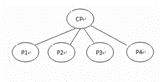 B.
B. 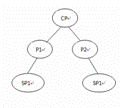
C. 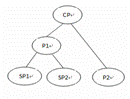 D.
D. 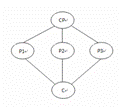
CP: central Point P: Point SP: Sun-point (次要点) C: Conslusion
查看习题详情和答案>>
The food we eat seems to have profound effects on our health. Although science has made enormous steps in making food more fit to eat, it has, at the same time, made many foods unfit to eat. Some research has shown that perhaps eighty percent of all human illnesses relate to diet and forty percent of cancer relates to the diet as well, especially cancer of the colon. Different cultures are more likely to cause certain different illnesses because of the food that is characteristic in these cultures.
That food is connected with illness is not a new discovery. In 1945, about 35 years ago, government researchers realized that nitrates, commonly used to preserve color in meats, and other food additives, caused cancer. Yet, these carcinogenic additives remain in our food, and it becomes more difficult all the time to know which things on the packaging labels of processed food are helpful or harmful. The additives which we eat are not all so direct. Farmers often give penicillin to beef and living animals, and because of this, penicillin has been found in the milk of treated cow. Sometimes similar drugs are given to animals not for medical purposes, but for financial reasons. The farmers are simply trying to fatten the animals in order to obtain a higher price on the market. Although the Food and Drug Administration (FDA) has tried repeatedly to control these procedures, the practices continue.
1. What is the best possible title of the passage?
A. Drug and Food B. Cancer and Health
C. Food and Health D. Health and Drug
2. Which of the following statements is NOT true?
A. Drugs are always given to animals for medical reasons.
B. Some of the additives in our food are added to the food itself and some are
given to the living animals.
C. Researchers have known about the potential dangers of food additives for over
thirty-five years.
D. Food may cause forty percent of cancer in world.
3. How has science done something harmful to mankind?
A. Because of science, diseases caused by polluted food haven’t been virtually
eliminated.
B. It has caused a lack of information concerning the value of food.
C. Because of the application of science, some potentially harmful substances
have been added to food.
D. The scientists have preserved the color of meat, but not of vegetables.
4. What are nitrates used for?
A. They preserve flavor in packaged foods.
B. They preserve the color of meats.
C. They are the objects of research.
5. The word ‘carcinogenic’ most nearly means ‘_________’.
A. trouble-making B. color-maintaining
C. money-making D .cancer-causing
查看习题详情和答案>>
Each member country of WTO must ________ its laws and regulations and compete on the principle of fairness and cooperation.
A. submit to B. cater to C. correspond to D. relate to
查看习题详情和答案>>
The matter your fate cannot be taken for granted.
|
A.in relation to |
B.has relation to |
|
C.has relations with |
D.to relate to |
查看习题详情和答案>>
The average person learns most of the 30 000~40 000 words whose meanings he or she recognizes by hearing them or getting familiar with them in the context or simply absorbing them without conscious(意识到的) effort. The best way to build a good vocabulary, therefore, is to read a great deal and to participate in a lot of good talks. There are relatively few words that we learn permanently(永久的)by purposefully referring to dictionaries or keeping word lists. However, even those extra few are of value, and no one will make a mistake by working on developing a larger vocabulary. Here are some suggestions of how to do it.
Read plenty of good books. When you come across a new word, or a new meaning of an old word, stop and see if you can understand it from its context. If you can't, and if you can manage without interrupting the thought of the book too much, look it up in a dictionary or ask somebody and then repeat its meaning to yourself a couple of times. If you are really conscientious(认真的), write the word and its meaning in a personal vocabulary list — preferably using it in a sentence, or you can keep a special vocabulary notebook. Go over the list from time to time. Further, try to use a new word in writing or conversation a few times over the next several days.
Listen to good talks and be alert to new words you hear or to new meanings of words you already know. Then treat them just as you treat the new words you read.
Learn and be alert to the parts of words: prefixes, suffixes and roots. Knowing them enables you to make intelligent guesses about the meaning of words.
If you are studying a foreign language, be alert to words in that language which relate to words in English. English has inherited(继承) or borrowed much of its vocabulary of 500 000~600 000 words from Latin, Greek, French, Spanish and German.
When you meet a new word in reading, what should you do?
A. Guess its meaning. B. Ask somebody.
C. Look it up in a dictionary. D. All of the above.
According to this passage, the best way to build a good vocabulary is _______.
A. to remember a lot B. to read a great deal
C. to take part in a lot of good talks D. both B and C
The phrase “be alert to” in the third paragraph may best be replaced by “_______”.
A. look at B. pay attention to
C. write down D. learn by heart
In the fourth paragraph, the word “them” refers to _______.
A. the parts of words B. prefixes C. suffixes D. roots
查看习题详情和答案>>