网址:http://m.1010jiajiao.com/timu3_id_2581114[举报]
听力
第一节
听下面5段对话。每段对话后有一个小题,从题中所给的A、B、C三个选项中选出最佳选项。听完每段对话后,你都有10秒钟的时间来回答有关小题和阅读下一小题。每段对话仅读一遍。
W:Oh, Michael…I didn’t tell you.My sister phoned yesterday.She wants to get married.
M:Married! She’s only seventeen.
1.What does Michael think of the woman’s sister?
A.She is not old enough to get married.
B.She is too old to get married.
C.She is married.
M:Waitress! I’d like the menu, please.
W:Here you are, sir.
2.Where is the man?
A.In a bookstore.
B.In a train station.
C.In a restaurant.
M:Has the TV been repaired?
W:Yes.We’d expected the repairs to cost us about dollars, but they charged us twice as much.
3.How much did the lady pay?
A.$15.
B.$20.
C.$30.
M:Hello, Jane.How lucky to run into you.Can you and Tom come to dinner tomorrow evening?
W:I think so.I don’t think we’re going out.
4.How does the woman respond?
A.She refuses to go to dinner.
B.She agrees to go to dinner.
C.She is angry.
M:I have to go to class because I have a test, but if I could, I’d go with you to the cinema.
W:That’s too bad.I wish that you could come along.
5.Where is the man going?
A.To class.
B.To the cinema.
C.To the doctor’s office.
第二节
听下面5段对话或独白。每段对话或独白后有几个小题,从题中所给的A、B、C三个选项中选出最佳选项。听每段对话或独白前,你将有时间阅读各个小题,每小题5秒钟;听完后,各小题将给出5秒钟的作答时间。每段对话或独白读两遍。
听第6段材料,回答第6~8题。
M:Hello, Mrs Smith.How are you?
W:Fine, thanks, Mr Downs.How’s your boy, Jack?
M:He is a bit tired.You know, he goes to school at eight o’clock every morning.He doesn’t get home till after four.Then he does his homework after ten.It often takes him a couple of hours to finish it.
W:Poor boy.Children work hard at school nowadays, don’t they? Does he like it?
M:School, you mean? Yes, he does.He likes his teachers, and that always makes a difference.
W:Yes, it does.Does he go to school by bus?
M:No, he walks.He likes walking.He meets some of his friends at the corner and they go together.
W:What does he do when it rains?
M:His uncle takes him in the car.He passes the school on the way to the office.
6.What are the two talking about?
A.Mrs Smith.
B.Mr Downs.
C.Mr Downs’ son.
7.How long does a school day last?
A.At least 8 hours.
B.About 6 hours.
C.Nearly 7 hours.
8.How does Jack usually go to school?
A.By bus.
B.On foot.
C.By car.
听第7段材料,回答第9~11题。
M:Hello! Can I speak to Susan, please?
W:Speaking.Is that you, Tom?
M:Yes, it is.I am going to New Zealand in two weeks’ time, and my wife is going with me.
W:Oh, how lucky you are! How long are you going for?
M:For a couple of months, maybe half a year.My boss wants me to help set up a branch company there.Well, Susan, you have been to New Zealand several times.Can you give us some suggestions, or just tell us about that country?
W:I’d love to.We can have a talk sometime.
M:Why not come over to dinner in my house this weekend.My wife wants to meet you as well.
W:All right.What about Saturday?
M:OK.See you at 6∶00 p. m., this coming Saturday.Goodbye!
9.Who answered the phone?
A.Tom.
B.Tom’s wife.
C.Susan.
10.When are they going to New Zealand?
A.In half a year.
B.In a couple of months.
C.In two weeks.
11.Where are they going to meet?
A.At Susan’s.
B.At Tom’s.
C.In New Zealand.
听第8段材料,回答第12~14题。
M:As you can see, Maria, the railway station is very crowded during rush hours.
W:How many people do you suppose ride into New York every day to work?
M:I don’t know.Must be several hundred thousand at least.Maybe a million.
W:I’m glad they’re not all taking this train.
M:Oh, they come from all directions, and by many different means, by railroads, ferries and subways.Then of course, some people drive in.
W:I’m a little afraid I’ll get lost.
M:You’ll soon learn that New York is a very easy city to get around.
W:Let’s see, the “Avenues” run north and south and the “Streets” run east and west, don’t they?
M:That’s right.You won’t get lost when you travel alone.
W:I hope not.
12.What can Maria see?
A.Many trains.
B.Many planes.
C.Many people.
13.What’s the woman afraid of?
A.Driving in.
B.Taking ferries(摆渡).
C.Getting lost.
14.What kind of city is New York, according to the man?
A.An easy city to get around.
B.A city full of subways.
C.A city difficult to get around.
听第9段材料,回答第15~17题。
W:Good afternoon.
M:Good afternoon.My name’s William Turner.I want to make an appointment to see Dr Smith please.
W:Yes, of course, Mr Turner.May I have your address please?
M:108 Park Road, London.
W:Yes, we have you on our records.Can you manage this afternoon at 3:00?
M:Fine.
W:Will 3:00 be all right?
M:Well, yes, but I prefer a later time so I can come along after work.
W:Then what about 5:30?
M:Well, that’s fine.Thank you.Goodbye.
W:Goodbye.
15.Who is William Turner?
A.A close friend of Dr Smith’s.
B.A patient of Dr Smith’s.
C.Both A and B.
16.When will Mr Turner go to see Dr Smith?
A.At 4∶00 p. m.
B.At 5∶00 p. m.
C.At 5∶30 p. m.
17.What’s the main idea of this dialogue?
A.Mr Turner wants to make an appointment with Dr Smith.
B.Mr Turner will go to see Dr Smith at 5∶30 p. m.
C.Mr Turner is a patient of Dr Smith’s.
听第10段材料,回答第18~20题。
If a Chinese comes to England and wants to drive his car there, he must know the English rules of the road and the English traffic signs.One rule is that he must always drive on the left.Another rule is that he mustn’t drive faster than thirty mph through town and villages.If he does not pay attention to this speed limit, the police will soon be after him.The third rule is that cars on the main road have right of way.It is not easy to drive in London, because the traffic is so busy and buses and trucks sometimes block the roads.It is much less difficult to find your way if you go by one of the red buses or the underground.There are bus stops at every street corner.And if you cannot find one, ask a policeman.He will help you at once.
18.On which side of the road are cars driven in England?
A.On the left.
B.On the right.
C.The passage doesn’t tell about that.
19.What can we know from the passage?
A.We know police in England are often after you.
B.We know police in England are often helpful.
C.We know police in England are often impolite.
20.What’s the best title for this passage?
A.English Traffic
B.Come to England
C.Traffic Rules
Part I Listening Comprehension(30 marks)
Section A(22.5 marks)
Directions:In this section, you'll hear six conversations between two speakers.For each conversation, there are several questions, and each question is followed by three choices marked A, B and C.Listen carefully and then choose the best answer for each question.You will hear each conversation TWICE.
Conversation 1
1.How long does the woman need to work every day?
A.Three hours.
B.Four hours.
C.Five hours.
2.How much can the woman earn each day?
A.5 dollars.
B.10 dollars.
C.20 dollars.
Conversation 1
M:Do you have any work experience?
W:No, I’ve never worked in a restaurant before.
M:Do you think you can get along will with customers?
W:Yes, I think so.
M:Can you make sure to be here from four to eight in the afternoon?
W:Yes, I'm always on time.
M:Then you can start tomorrow.Monday through Friday.Five dollars an hour.
W:That's fine.
Conversation 2
3.What's the possible relationship between the speakers?
A.Boss and employee.
B.Mother and son.
C.Teacher and student.
4.When will the man come back?
A.This Monday.
B.This Wednesday.
C.This Friday.
Conversation 2
M:Mrs.Sharon, I say…, I have to …
W:What's the matter, Richard?
M:Er, I'd like to take two days off.My mother's ill.I need to stay with her.
W:I'm sorry to hear that.You mean you will be back here this Wednesday?
M:Yes, I hope I can come back earlier.
W:That's all right.By the way, don't worry about your lessons.I'll certainly help you with them.
Conversation 3
5.What can we know about Nancy and Steve?
A.They will divorce soon.
B.They have two daughters.
C.They divorced last year.
6.Who will help Nancy out in the woman's opinion?
A.Her daughter.
B.Her parents.
C.Her friends.
Conversation 3
M:Kate, Nancy and Steve are breaking up.
W:It's really a shame.I’ve heard that they quarrel, but they’ve always made up afterward.
M:Things are not working out this time.They are getting a separation soon.
W:What will happen to their daughter, Bonnie?
M:Nancy is going to take her.
W:The cost of living is so high.It will be difficult for her to take te responsibility.
M:She seems to have made up her mind.She said she would rather be a single parent than cope with an unhappy marriage.
W:Well, I hope her parents will be able to help her out.
Conversation 4
7.How often does the woman pay the tax?
A.Once a month.
B.Twice a year.
C.Once a year.
8.Why does the woman have to pay more taxes?
A.The government has raised the tax rate.
B.She didn't pay taxes last year.
C.She has got extra money.
9.What can we know about the woman?
A.She is an accountant.
B.She taught in a night school.
C.She lives upon a small income.
Conversation 4
W:Henry, our income tax is due soon.Did you call our accountant?
M:He's figuring out our taxes right now.I gave him all the records on our income and expenses last week.
W:The government has taken away taxes from our paychecks all year.I hope we get some of that money back or at least that we won't have to pay more.
M:Remember the money your aunt left us when she died, and the money you made when you taught in a night school?
W:Yes.
M:Well, that's all taxable income.That money has put us in a higher tax bracket.
W:What does that mean?
M:It means we have to pay more taxes.
W:Well, it looks like we'll have to make more money this year just to pay last year's taxes.
Conversation 5
10.What can we know about the kid from Haiti?
A.He doesn't get on well at school.
B.He is often late for school.
C.He doesn't speak much English.
11.How many countries are mentioned in the conversation?
A.Six.
B.Five.
C.Four.
12.How does the woman help the immigrant kids?
A.She has spent much time with them after class.
B.She gives them more lessons than other kids.
C.She pays more attention to them at class.
Conversation 5
M:Kate, how's the new student in your class doing?
W:The kid from Haiti? He's having a rough time communicating since he doesn't speak much English.However, the other kids seem to involve him pretty well.
M:Our students are used to new kids who don't speak much English since we have had so many new immigrant families moving into our school district.
W:Don't I know it! This year I have had a Vietnamese, an Ethiopian, a Cuban and the kid from Haiti in my class.I spend a lot of time with them after class so that they can catch up.
M:It must have been hard for you since you have to give them special attention in order to help them.
W:It has been.Nevertheless, it's really rewarding to see them progress and make friends.
Conversation 6
13.When will the speakers have the exams?
A.In one week.
B.In two weeks.
C.In three weeks.
14.What will the woman do this summer?
A.Teach English.
B.Find a job.
C.Study Chinese.
15.How did the man learn Chinese?
A.By speaking.
B.By reading.
C.By listening.
Conversation 6
M:Well, Jenny.The school year is almost over.We just have two weeks before exams.What are you going to do this summer?
W:I'm going to teach English to some immigrants in the university's community service program.
M:That sounds interesting.Don't you need to speak a foreign language for the job?
W:No.You just have to present the language simply and give the students a chance to practice speaking.
M:But that's the way I was taught to speak Chinese.But speaking Chinese didn't help me learn to read and write Chinese.
W:My students don't want to read and write English.They are more interested in speaking.
M:You sound very knowledgeable about all this.How do you know so much?
W:I took teaching English as a second language course last year when you were in China.I’ve also talked with the program administrators quite a lot.I think I would like to be an ESL teacher when I graduate.
SECTION B
Directions:In this section, you'll hear a mini-talk.Listen carefully and then fill in numbered blanks with the information you’ve got.Fill each blank with NO MORE THAN 3 WORDS.
You'll hear the mini-talk TWICE.
About friendship
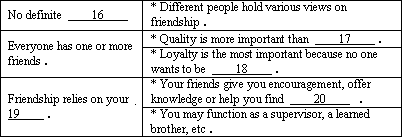
Section B
We often say, “A friend in need is a friend indeed.” But what is the exact meaning of friendship? No one can really offer a definite concept, because different people hold various views on friendship.
Everyone has his own friendship and some have a lot of friends.But in fact, quantity is not so important as quality.Loyalty is the most important for friendship.No one wants to make friends with those who will betray them.
No matter whether you are married or not, no matter where you live and work, your friends are your friends.It is not based on bloodline.It relies on your intention.To you, some friends are fun-loving, some give encouragement, some offer knowledge, and others help you to find your own identity.Before your friends, you may act as a supervisor, a learned brother, a lovely child, a gentleman or a playmate.In a word, friendship helps you to be a full person.So friendship can benefit.
Keys:
Texting in the street—your funeral
Millions of people are putting their lives at risk by texting their friends as they walk along busy streets, reported the Daily Mail.
One in ten 41 users has already been 42 because they are so lost in their phones that they fail to 43 lamp-posts or cars, according to Joanna Lumdsen of Aston University.
To test the danger of texting while 44 , Lumdsen did an experiment in which volunteers followed a 45 path while trying to 46 in a message on the phone.
Around them, screens 47 up instructions to avoid stepping on 48 colors on the floor.
She found that people missed one in five 49 because they were so busy with their phones.
“In 50 life this means that one in five lamp-posts or moving cars is 51
to go unnoticed by people 52 and walking,” she said.
Her research is looking for ways cell phone makers could improve the 53
of phones to make texting on the move 54 . That could 55 easier-to-use voice operated phones, or phones that respond to gestures.
“The safest thing is 56 people not to text while they walk along,” she said. “ 57 a lot of people in business are 58 to carry a mobile phone and be in 59 24 hours a day, seven days a week. They are under pressure to reply to calls 60 , and to respond to text messages and emails straight away.
|
1. |
2. |
3. |
4. |
5. |
6. |
7. |
8. |
9. |
10. |
11. |
12. |
13. |
14. |
15. |
16. |
17. |
18. |
19. |
20. |
【答案】 21.C 22.A 23.B 24.D 25.A 26.C 27.B 28.A 29.A 30.C 31.D 32.B 33.D 34.B 35.A 36.B 37.A 38.A 39.C 40.A 【解析】 略 【题型】完型填空 【适用】较难 【标题】20102011学年吉林省长春十一中高一下学期期末考试英语题 【关键字标签】Texting in the street, 社会现象类 【结束】 13【题文】“Hurry, Mommy! Let’s go trick-or-treating!” My daughter waited by the door in her pink princess skirt while I prayed in the living room. Usually I liked taking her out on Halloween, but this year I was sad. I was worried about my mother, who was in China on vacation. I got a call that afternoon that she had slipped and fallen on the hard floor of her hotel and broken her leg. She was taken to a hospital in Beijing. Mom was nervous because she couldn’t understand any of the doctors. If only I could do something to help her! I knew I couldn’t let my worries spoil my daughter’s fun. There was nothing I could do for Mom except pray, I thought. We left the house and went down the block. I was so upset that I hardly took notice of the kids around me. There came the man to whose son I’d once given piano lessons. “Hello there,” I said, greeting him and the boy at his side. “Hello,” the father answered. “Having fun?”“I’m trying,” I said. “Why, what’s wrong?” he asked. I told him the whole story. “My mother, in China, broke her leg and didn’t understand any of the doctors. And I’m too far away to do anything!” I said. He raised his eyebrows. “Beijing, you said?” he asked. I nodded. He smiled. “Believe it or not, my sister is a doctor at an English-speaking hospital there. If you want, I’ll make a call right away and we’ll try and get your mom transferred (转移).” A few days later I sat in the living room with my daughter as she finished the last of the candy. “Mommy, how far away is China?” she asked. “Not as far as I thought,” I said. 41.What did the author’s daughter want to do?
42.What was the author’s mother worried about most?
43.The author hardly took notice of the kids around because _____ .
44. We can infer from the text that _____ .
【答案】 45.B 46.D 47.B 48.A 【解析】 略 【题型】阅读理解 【适用】较难 【标题】20102011学年吉林省长春十一中高一下学期期末考试英语题 【关键字标签】my mother,家庭生活类 【结束】 14【题文】It is winter in many parts of the world. For some areas, that means snow. Maybe even lots of snow. If you don’t have to drive in it or remove it, snow can be very beautiful. When snow covers everything around you, the world looks like a “winter wonderland”. That is the name of a very popular song about winter. Richard Smith and Felix Bernard wrote the song back in 1934. There are hundreds of recordings of this happy song. But winter is not always such a beautiful and happy time. It’s cold outside. You try hard to keep warm. The days are darker and shorter. The sun rarely shines. The leaves on the trees are brown. It isn’t surprising that some people are sad in winter. And some people dream about being somewhere else where it’s warm and pretty—like the state of California. The Mamas and the Papas recorded this famous song “California Dreaming”. During the 1960s, many other famous rock groups released songs about winter. Here is a poetic song by Simon and Garfunkel called “A Hazy Shade of Winter”. They sing about life and hope and possibilities. In 1968, the group Blood, Sweat and Tears recorded this gentle, sad song about winter. They sing about a lost love and forgotten memories in “Sometimes in Winter”. In the early 1990s, Tori Amos wrote and recorded the beautiful song called “Winter”. She enjoyed singing about winter when she was a child. Finally, on a happier note comes this song written and recorded by Fountains of Wayne in 2003. They sing about a snowstorm in a New England town. Nothing unusual there. But instead of being sad or tense about the snow, they write a song about it. 49. The underlined sentence “For some areas, that means snow.” probably means _____ .
50. According to the second paragraph, winter is _____ .
51.Which of the songs can bring us hope of life?
52.What does the passage mainly talk about?
【答案】 53.B 54.D 55.C 56.C 【解析】 略 【题型】阅读理解 【适用】较难 【标题】20102011学年吉林省长春十一中高一下学期期末考试英语题 【关键字标签】winter,自然类 【结束】 15【题文】A number of scientific studies have suggested that repeatedly heading a football could increase the risk of developing dementia (痴呆症) in later life. In 2002, former England international footballer Jeff Astle died aged 59. A coroner (验尸官) said that Astle died from a brain disease likely to have been caused by “repeated small damages to the brain” related to heading a heavy leather football. Dr. Scott Delaney, research director of emergency medicine at McGill University Health Center in Montreal, Canada, has also researched soccer-related head injury and agrees that head-to-head or elbow-to-head blows are the real risk. In 2007, Delaney carried out a study on footballers aged between 12 and 17 that showed they were half as likely to be concussed (使脑部受到震荡) wearing headgear (帽) than without. He said youngsters have a higher risk of head injury than adults because their heads are thinner and less able to absorb shock. To make matters worse, their neck muscles aren’t as well developed and they often lack the correct heading technique that can help throw away the force of the ball. Delaney recommends that children wear headgear when playing football and says his two eldest children wear head protection playing the sport. But he admits that children can be unwilling to be the first to wear head protection—especially when their football heroes play without it. While headgear can protect footballers from being concussed during a match, no one knows the long-term effects of repeated “sub-concussive” blows to the head. Delaney says that while there is indirect evidence that a career in soccer can lead to dementia, no one has yet found a sure link between the two. He says proving a link would mean monitoring hundreds of footballers for three or four decades—and that would take a lot of funding. 57.Which might be the best title of the passage?
58.According to Delaney’s research, what is the most risky injuries to head?
59. Children are unwilling to wear headgear because they think _____ .
60.It can be inferred from the last paragraph that _____ .
【答案】 61.A 62.D 63.C 64.C 【解析】 略 【题型】阅读理解 【适用】较难 【标题】20102011学年吉林省长春十一中高一下学期期末考试英语题 【关键字标签】the risk of developing dementia 痴呆症,医学类 【结束】 16【题文】根据短文内容,从短文后的选项中选出能填入空白处的最佳选项。选项中有两项为多余选项。 Are You Ready for College? Before you send in your college applications, keep this in mind: it’s not the norm (准则) in every culture for students to go to college right out of high school. 65. So if you find yourself applying for college simply because it’s the thing to do after high school, think again. Going to college right after high school may be the norm in your community, but it’s not the norm everywhere and it may not be the best decision for you. 66. Yes, higher education often gives young people a big advantage in the working world, but not always. A solid technical or business school application can give you an advantage as well, and if the environment seems like a better one for you than a traditional college campus, this might be your best choice. A lot of people lead successful lives with a high school education and years of work experience. The price of a college or university education has become a serious burden for young people and their families. 67. In some cases, putting off college for a year or two while a student earns money full time can make sense. 68. 69. Almost all students suffer from homesickness, but for some students, the transition may be too much to deal with.
E. So students take massive amounts of loans, which can take decades to pay off. F. Many young people have other choices, like military service, work experience, community service or travel. G. The transition from high school to college is an emotional challenge for almost everybody, especially if you move away from home. 【答案】 70.F 71.C 72.E 73.D 74.G 【解析】 略 【题型】其他 【适用】较难 【标题】20102011学年吉林省长春十一中高一下学期期末考试英语题 【关键字标签】Are You Ready for College?,学习类 【结束】 17【题文】阅读下列每个句子,根据空白处的汉语提示,填入适当词汇。每空仅限一词。 75.Now the government is paying more attention to _____ (农业). 76.W out! There is a car coming! 77. felt so sleepy that I couldn’t stop _____ (打哈欠). 78. From her (面部)expression we can read her dissatisfaction. 79.Customs officers examined all (行李) at the airport. 80. It’s an old t for Chinese to get together and eat dumplings on the eve of the Spring Festival. 81.They didn’t fight, but stood there _____ (怒视) at each other. 82.You should receive a reply w seven days. 83.They are having a heated a over whether drinking is bad for health. 84. The lake (包围) by trees is a nice place to visit. 85.After his wife died, the man often d his sadness in wine. 【答案】 86.agriculture 87.Watch 88.yawning 89.facial 90.baggage/ luggage 91.tradition 92.glaring 93.within 94.argument 95.surrounded 96.drowned 【解析】 略 【题型】单词拼写 【适用】较难 【标题】20102011学年吉林省长春十一中高一下学期期末考试英语题 【关键字标签】单词拼写 【结束】 18【题文】每个句子有且仅有一处错误,或错一词, 或多一词,或少一词。 如本句错一词,在错词下划一横线,并在横线下写出修改后的词; 如本句多一词,把多余的词用斜线(﹨)划掉; 如本句缺一词,在缺词处加一漏字符号(∧),并在其下面写上该加的词。 注意:未按照要求答题不得分。 97. He loved the novel so many that he read it for three times. 98.Canada is the second most largest country in the world. 99.Parents react strong to the program of quality education. 100.It is clear is that the moon is smaller than the earth. 101. With the baby well cared for, the parents will free of worries at work. 102.When I was driving to work, my car suddenly broke up and I had to repair it by myself. 103.Tony approached Julia, touched her shoulder and kissed her on cheek. 104.He injured his leg; however, he couldn’t play in the game. 105. The soldiers fought in defend of their country’s safety. 106.You’d better take the old bridge as the new one is built. 【答案】 107.He loved the novel so many that he read it for three times. much 108.Canada is the second most largest country in the world. ﹨ 109. Parents react strong to the program of quality education. strongly 110.It is clear is that the moon is smaller than the earth. What 或 ﹨ 111.With the baby well cared for, the parents will ∧ free of worries at work. be 112.When I was driving to work, my car suddenly broke up and I had to repair it by myself. down 113.Tony approached Julia, touched her shoulder and kissed her on ∧ cheek. the 114.He injured his leg; however, he couldn’t play in the game. therefore/ hence 115.The soldiers fought in defend of their country’s safety. defense/ defence 116.You’d better take the old bridge as the new one is ∧ built. being 【解析】 略 【题型】短文改错 【适用】较难 【标题】20102011学年吉林省长春十一中高一下学期期末考试英语题 【关键字标签】单句改错 【结束】 19【题文】假如你是某所中学的一名学生,3月22日(世界水日)你参加了你们班开展的一系列节水宣传活动。请根据以下提示,以日记的形式记录当天的活动内容. 1)上午开班会,讨论节水宣传活动; 2)下午2点,去社区发宣传材料(leaflets); 3)下午3点,邀来的专家在社区做相关演讲; 4)演讲后,与邻居们讨论,提出节水建议. 注意:① 词数100左右。开头已为你写好,不计入总词数。 ② 可适当增加内容以使行文连贯. March 22, 2011 Tuesday Sunny Today is World Water Day._________________________________________ __________________________________________________________________________________________________________________________________________________________________________________________________________________________________________________________________________________________________________________________________________________________________________________________________________________________________________________________________________________________________________________________________________________________________________________________ 【答案】 March 22, 2011 Tuesday Sunny Today is World Water Day.In the morning, we had a class meeting talking about what to do on this special day. Finally, we reached an agreement and immediately began to make preparations for the afternoon’s activities. At 2:00 p.m., we went to the neighboring community to hand out leaflets, calling on people to save water. Around 3 o’clock, the expert we invited gave an excellent speech on the current water crisis in China. He talked about the drought in the Southwest and the severe shortage of water in our city. The speech had a strong appeal to all the people present, including me. After the speech, we had a discussion with our neighbors about various ways of saving water in our daily life. I suggested turning off the water tap immediately after using it, and a granny came up with the ideas of reusing the water from kitchen, for example, the water after washing fruits and vegetables can be used to water flowers and so on. Today, I have had a better understanding of the importance of saving water and really learnt a lot about saving water. 【解析】 略 【题型】书面表达 【适用】较难 【标题】20102011学年吉林省长春十一中高一下学期期末考试英语题 【关键字标签】世界水日 【结束】 |
查看习题详情和答案>>