网址:http://m.1010jiajiao.com/timu3_id_2563412[举报]
“The more time you spend on study the better you learn.” Is that true ? Below is a graph showing the amount a person learns against the number of hours he works in a day.
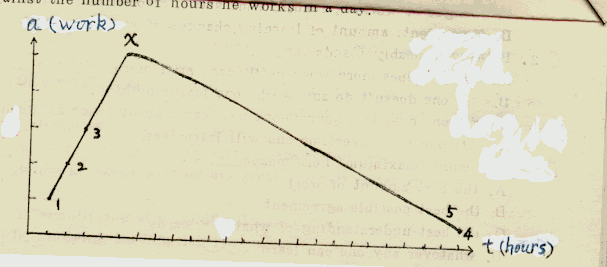
If one doesn’t do any work, one learns nothing. If one does an hour’s work, one learns a certain amount (point 1). If one does two hours’ work, one learns about twice as much. If one does more work , he’ll learn still more . Now if one tried to do 23 hours’ work in 24, one will be so tired that one will hardly remember anything;what one learns will be little (point 4). If one did less work, one would learn more . Point X is the very maximum anyone can learn in a day. It is the optimum. It is the best amount of work to do. It is the best possible agreement between the time spent and the overtiredness as a result.
Overtiredness is a 100% real thing, which no one can escape or try to pay no attention to or try not to see. If one does, if one forces oneself to work past the optimum (and any fool can keep his eyes open 14 hours a day without any sleep), one can only get on this downward slope in this graph and achieve less than the best and then get overtired and lose one’s power to fix any attention on anything one studies.
It is hard to say what the optimum is. When one reaches one’s optimum depends on many things such as one’s health and the kind of work one does. But when you find yourself repeatedly reading over the same paragraph and not taking it in, that shows you have reached the optimum. Most ordinary students find their optimum at about five hours a day.
1. Line A, Line T and the up-and-down slope stand for _____.
A. amount of learning, time spent, changes of working result
B. time spent, change of working result, amount of learning
C. changes of working result, time spent, amount of learning
D. time spent, amount of learning, changes of working result
2. Point 2 probably stands for _________ .
A. “ If one does more work he’ll learn still more.”
B. “ If one doesn’t do any work, one learns nothing.”
C. “ If one does two hours’ work, one learns about twice as much.”
D. “ If one works overtime one will learn less..”
3. The word “maximum” here means _____ .
A. the best amount of work
B. the best possible agreement
C. the best understanding of what one learns
D. whatever anyone can learn
4. Point 5 shows the result of ____ .
A. doing less work after getting past the optimum
B. doing 23 hours’ work in 24
C. forcing oneself to work past the optimum
D. not doing any work at all
5. After reaching one’s optimum, one will have to _____.
A. force one’s eyes open to work overtime
B. lose one’s power to fix one’s attention
C. repeat what one is reading
D. take a rest and do less work.
查看习题详情和答案>>51阅读下列短文,从每题所给的A、B、C和D项中,选出最佳选项,并在答题卡上将该项涂黑。
My elder brother Steve, in the absence of my father who died when I was six, gave me important lessons in values that helped me grow into an adult.
For instance, Steve taught me to face the results of my behavior. Once when I returned in tears from a Saturday baseball game, it was Steve who took the time to ask me what happened. When I explained that my baseball had soared through Mrs. Holt’s basement window, breaking the glass with a crash, Steve encouraged me to confess to her. After all, I should have been playing in the park down Fifth Street and not in the path between buildings. Although my knees knocked as I explained to Mrs. Holt, I offered to pay for the window from my pocket money if she would return my ball.
I also learned from Steve that personal property is a sacred thing. After I found a shiny silver pen in my fifth-grade classroom, I wanted to keep it, but Steve explained that it might be important to someone else in spite of the fact that it had little value. He reminded me of how much I’d hate to lose to someone else the small dog my father carved from a piece of cheap wood. I returned the pen to my teacher, Mrs. Davids, and still remembered the smell of her perfume as she patted me on the
shoulder.
Yet of all the instructions Steve gave me, his respect for life is the most vivid in my mind. When I was twelve, I killed an old brown sparrow in the yard with a BB gun. Excited with my accuracy, I screamed to Steve to come from the house to take a look. I shall never forget the way he stood for a long moment and stared at the bird on the ground. Then in a dead, quiet voice, he asked, “Did it hurt you first, Mark?” I didn’t know what to answer. He continued with his eyes firm, “The only time you should ever think of hurting a living thing is if it hurts you first. And then you think a long, long time.” I really felt terrible then, but that moment stands out as the most important lesson my brother taught me.
What is the main subject of the passage?
A. The relationship between Mark and Steve.
B. The important lesson Mark learned in school.
C. Steve’s important role in Mark’s growing process.
D. Mark and Steve’s respect for living things.
In the story about the pen, which of the following lessons did Steve teach his brother?
A. Respect for personal property. B. Respect for life.
C. Sympathy for people with problems. D. The value of honesty.
According to the writer, which was the most important lesson Steve taught his young brother?
A. Respect for living things. B. Responsibility for one’s actions.
C. The value of honesty. D. Care for the property of others.
The underlined word “knocked” in the second paragraph means ______.
A. tapped B. beat C. struck D. trembled
查看习题详情和答案>>
C.
After blogging regularly for two months, people felt they had better social support and friendship networks than those who don’t blog. Blogging can help you feel less isolated, more connected to a community and more satisfied with your f riendships, both online and face-to-face, new Australian research has found.
Researchers James Baker and Professor Susan Moore from Swinburne University of Technology in Melbourne have written two papers investigating the psychological benefits of blogging, regularly updating personal web pages with information that invites others to comment.
The first, published in the latest issue of the journal Cyber Psychology & Behavior, compares the mental health of people intending to blog with that of p eople not planning to blog. Moore says the researchers messaged 600 My Space users personally and directed them to an online survey. A total of 134 completed the questionnaire; 84 intended to blog and 50 didn’t.
“We found potential bloggers were less satisfied with their friendships and they felt less socially integrated, and they didn’t feel as much part of a community as the people who weren’t interested in blogging…” Moore says. “It was as if they were saying ‘I’m going to do this blogging and it’s going to help me.’”
And it seemed to do the trick, as the researchers’ second study shows. This study, which is yet to be published, was conducted two months later. The researchers sent out questionnaires to the same group of My Space users; this time 59 responded. Bloggers reported a greater sense of belonging to a group of like-minded people and feeling more confident for they could rely on others for help. All respondents, whether or not they blogged, reported feeling less anxious, depressed and stressed after two months of online social networking.
“So going onto My Space had lifted the mood of all participants in some way,” Moore says. “Maybe they’d just made more social connections.” Moore acknowledges this early research and hopes to follow a larger group of people for a longer period time to test some of the research findings.
46. What does the passage mainly tell us?
A. The mental health of bloggers B. Blogging improves one’s social life.
C. What kind of people are likely to blog D. Blogging has become more popular.
47. It can be inferred from the fourth paragraph that ______.
A. those who were not interested in blogging didn’t have good mental health.
B. people were likely to become bloggers if they felt  socially isolated
C. potential bloggers were those who had mental health problems
D. potential bloggers usually held a wrong view about blogging
48. The purpose of the second study is to find out ______.
A. what people do on My Space
B. how many people became bloggers
C. how people felt after blogging for two months
D. how many people kept blogging after two months
49. The second study shows that ______.
A. online social networking can do people good
B. only bloggers benefit from online social networking
C. not many potential bloggers became real bloggers
D. not all bloggers found the help they needed
50. The main purpose of people going on My Space is probably to ______.
A. exchange goods B. entertain themselves
C. seek help D. exchange views
To err is human. To blame the other guy is even more human.
Common sense is not all that common.
Why tell the truth when you can come up with a good excuse?
These three popular misquotes(戏谑的引语)are meant to be jokes, and yet they tell us a lot about human nature .To err, or to make mistakes, is indeed a part of being human, but it seems that most people don’t want to accept the responsibility for the problem. Perhaps it is the natural thing to do .The original quote about human nature went like this:” To err is human, to forgive, divine(神圣的).”This saying mirrors an deal people should be forgiving of others’ mistakes. Instead, we tend to do the opposite –find someone else to pass the blame on to. However, taking responsibility for something that went wrong is a making of great maturity.
Common sense is what we call clear thought. Having common sense means having a good general plan that will make things work well, and it also means staying with the plan. Commonsense tells you that you take an umbrella out into a rainstorm, but you leave the umbrella home when you hear a weather forecast for sunshine.Common sense does not seem to be common for large organizations, because there are so many things going on that one person cannot be in charge of everything. People say that in a large company,”the right hand does not know what the left hand is doing.”
And what is wrong with a society that thinks that making up a good excuse is like creating a work of art? One of the common problems with making excuses is that people, especially young people. get the idea that it’s okay not to be totally honest all the time. There is a corollary(直接推论)to that: if good excuse is “good”even if it isn’t honest, then where is the place of the truth?
1. According to tile passage, which of following seems the most human?
A. To search for truth. B. To achieve one’s ideal
C. To make fun of others’mistakes. D. To criticize others for one’s own error.
2.According to the author, what is a sign of a man’s maturity?
A.Doing things his own way.
B.Bearing responsibility for his mistakes.
C.Making as few mistakes as possible.
D.Thinking seriously about his wrongdoing.
3.Which of the following is N0T based on common sense?
A.A man tries to take charge of everything in a large company.
B.A student goes out with an umbrella in stormy weather.
C.A company’s next move follows a good plan.
D.A lawyer acts on fine judgments.
4. What is the author’s opinion about a good excuse?
A. Making a good excuse is sometimes a better policy.
B. Inventing a good excuse needs creative ideas.
C. A good excuse is as rewarding as honesty.
D. Bitter truth is better than a good excuse.
5. What would be the best title for his passage?
A. A Mirror of Human Nature B. To Blame or to Forgive
C. A Mark of Maturity D. Truth or Excuse
查看习题详情和答案>>
第二节:完形填空(共20小题;每小题1. 5,满分30分)
阅读下面短文,从短文后各题所给的四个选项(A、B、C和D)中,选出可以填入空白的最佳选项,并在答题卡上将该项涂黑。
Facial expressions carry meanings, which depends on situations and relationships. For instance, in American culture the smile is typically an expression of 36 .Yet it has other functions. A smile may 37 love, politeness, or 38 true feeling. It is also a source of confusion across 39 . 40 , many people in Russia 41 smiling at strangers in public to be unusual or even suspicious. Yet many Americans 42 freely at strangers in public places. Some Russians believe that Americans smile in the wrong 43 ; some Americans believe that Russians don't smile enough. In Southeast Asian cultures, a smile is frequently used to cover emotional pain or mental difficulty, discomfort or anxiety.
Our faces make our emotions and attitudes known, 44 we should not try to "read" people from another culture 45 we would "read" someone from our own culture. The degree of facial expressiveness one shows changes 46 persons and cultures. The fact that members of one culture do not 47 their emotions as openly as members of 48 does not mean 49 they do not 50 emotions. Rather, their cultures 51 them expressing their emotion and attitudes freely.
If we 52 people whose 53 of showing emotion are not the same according to 54 own cultural patterns, we may make the 55 of "reading" the other persons incorrectly.
36. A. worried B. surprise C. excitement D. pleasure
37. A. show B. tell C. sound D. seem
38. A. cover B. cultures C. include D. suggest
39. A. countries B. cultures C. nations D. oceans
40. A. In a word B. As a result C. For example D. On the contrary
41. A. keep B. enjoy C. continue D. consider
42. A. stare B. smile C. look D. shout
43. A. direction B. manner C. time D. place
44. A. and B. so C. but D. or
45. A. as B. though C. unless D. since
46. A. among B. into C. between D. about
47. A. find B. form C. express D. control
48. A. the others B. others C. the other D. another
49. A. whether B. that C. if D. why
50. A. experience B. use C. bring D. carry
51. A. feel B. keep C. prevent D. make
52. A. think B. observe C. judge D. watch
53. A. hopes B. ways C. thoughts D. means
54. A. your B. their C. one's D. our
55. A. answer B. mistake C. promise D. use
查看习题详情和答案>>