网址:http://m.1010jiajiao.com/timu3_id_2557555[举报]
The World Trade Organization(WTO), established on January 1, 1995, is an open, non-discriminatory trading system. As a successor to the GATT, established in the wake of the Second World War, it is to help world's trade flow freely, fairly and predictably.
While the WTO is still young, the multilateral(多边的)trading system that was originally set up under GATT is already 50 years old. The system celebrated its golden jubilee(50周年纪念)in Geneva on 19 May, 1998, with many heads of states and government leaders attending.
The past 50 years have seen an exceptional(罕见的)growth in the world trade. Merchandise exports grew on average by 6% annually(每年地). Total trade in the WTO has helped to create a strong and prosperous trading system contributing to unprecedented growth.
China was an original member of GATT, but for historical and political reasons it was withdrawn from GATT by the government in Taibei in 1950. But over the last several years, China hopes to be seeking to resume(恢复)its contracting party status. China has become a member of the WTO before the body starts a new round of negotiations(谈判)late this year. Premier Zhu Rongji paid a nineday US visit from April 6, 1999. He is the first Chinese Premier to visit US. President Clinton agreed to have talks on China's entry into the WTO with a new round of negotiations in Beijing.
Now China has joined the WTO. China's entry into the WTO is not only of economical but also of political importance. China has made attracting progress since its reform and opening up to the outside world. It is growing more and more powerful in economy. China cannot be without the world just as the world cannot be without China. The entry of China into WTO will further strengthen the comprehensive national power of China; it can also quicken the economic development of the world.
According to the context, the underlined word in the first paragraph can be replaced by ______.
A. ordinary B. fair C. special D. safety
GATT was founded in ______.
A. 1948 B. 1950 C. 1995 D. 1998
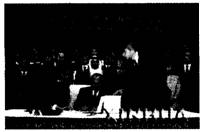
According to the passage and picture when did Shi Guangsheng, Minister of Chinese foreign economy and trade, signed the papers in Doha on China's accession to the WTO?
A. 10,10,2001. B. 11,11,2001. C. 12,11,2001. D. 11,10,2001.
Which of the following is the best title for the passage?
A. A General Introduction of WTO
B. How WTO Came into Being
C. GATT and WTO
D. WTO and China
查看习题详情和答案>>President Clinton’s decision on Apr.8 to send Chinese Premier Zhu Rongji packing without an agreement on China’s entry into the World Trade Organization seemed to be a massive miscalculation. The President took a drubbing from much of the press, which had breathlessly reported that a deal was in the bag. The Cabinet and Whit House still appeared divided, and business leaders were characterized as furious over the lost opportunity. Zhu charged that Clinton lacked “the courage” to reach an accord. And when Clinton later telephoned the angry Zhu to pledge a renewed effort at negotiations, the gesture was widely portrayed as a flip-flop.
In fact, Clinton made the right decision in holding out for a better WTO deal. A lot more horse trading is needed before a final agreement can be reached. And without the Administration’s goal of a “bullet-proof agreement” that business lobbyists can enthusiastically sell to a Republican Congress, the whole process will end up in partisan acrimony that could harm relations with China for years.
THE HARD PART. Many business lobbyists, while disappointed that the deal was not closed, agree that better terms can still be had. And Treasury Secretary Robert E. Rubin, National Economic Council Director Gene B. Sperling, Commerce Secretary William M. Daley, and top trade negotiator Charlene Barshefsky all advised Clinton that while the Chinese had made a remarkable number of concessions, “we’re not there yet,” according to senior officials.
Negotiating with Zhu over the remaining issues may be the easy part. Although Clinton can signal U.S. approval for China’s entry into the WTO himself, he needs Congress to grant Beijing permanent most-favored-nation status as part of a broad trade accord. And the temptation for meddling on Capital Hill may prove over-whelming. Zhu had barely landed before Senate Majority Leader Trent Lott (R-Miss) declared himself skeptical that China deserved entry into the WTO. And Senators Jesse A. Helms (R-N.C.) and Emest F. Hollings (D-S. C.) promised to introduce a bill requiring congressional approval of any deal.
The hidden message from these three textile-state Southerners: Get more protection for the U. S. clothing industry. Hoping to smooth the way, the Administration tried, but failed, to budge Zhu on textiles. Also left in the lurch: Wall Street, Hollywood, and Detroit. Zhu refused to open up much of the lucrative Chinese securities market and insisted on “cultural” restrictions on American movies and music. He also blocked efforts to allow U. S. auto makers to provide fleet financing.
BIG JOB. Already, business lobbyists are blanketing Capitol Hill to presale any eventual agreement, but what they’ve heard so far isn’t encouraging. Republicans, including Lott, say that “the time just isn’t right” for the deal. Translation: We’re determined to make it look as if Clinton has capitulated to the Chinese and is ignoring human, religious, and labor rights violations; the theft of nuclear-weapons technology; and the sale of missile parts to America’s enemies. Beijing’s fierce critics within the Democratic Party, such as Senator Paul D. Wellstone of Minnesota and House Minority leader Richard A. Gephardt of Missouri, won’t help, either.
Just how tough the lobbying job on Capitol Hill will be become clear on Apr. 20, when Rubin lectured 19chief executives on the need to discipline their Republican allies. With business and the White House still trading charges over who is responsible for the defeat of fast-track trade negotiating legislation in 1997, working together won’t be easy. And Republicans—with a wink—say that they’ll eventually embrace China’s entry into the WTO as a favor to Corporate America. Though not long before they torture Clinton. But Zhu is out on a limb, and if Congress overdoes the criticism, he may be forced by domestic critics to renege. Business must make this much dear to both its GOP allies and the Whit House: This historic deal is too important to risk losing to any more partisan squabbling
1. The main idea of this passage is
[A]. The Contradiction between the Democratic Party and the Republican Party.
[B]. On China’s entry into WTO.
[C]. Clinton was right.
[D]. Business Lobbyists Control Capitol Hill.
2. What does the sentence “Also left in the lurch: Wall Street, Hollywood, Detroit” convey?
[A]. Premier Zhu rejected their requirements.
[B]. The three places overdid criticism.
[C]. They wanted more protection.
[D]. They are in trouble.
3. What was the attitude of the Republican Party toward China’s entry into the WTO?
[A]. Contradictory. [B].Appreciative.
[C]. Disapproving. [D]. Detestful.
4. Who plays the leading part in the deal in America?
[A]. White House . [B]. Republicans.
[C]. The Democratic Party. [D]. Businessmen.
5. It can be inferred from the passage that
[A]. America will make concessions.
[B]. America will hold out for a better WTO
[C]. Clinton has the right to signal U. S. approval for China’s entry.
[D]. Democratic party approve China’s entry into the WTO.
查看习题详情和答案>>President Clinton’s decision on Apr.8 to send Chinese Premier Zhu Rongji packing without an agreement on China’s entry into the World Trade Organization seemed to be a massive miscalculation. The President took a drubbing from much of the press, which had breathlessly reported that a deal was in the bag. The Cabinet and Whit House still appeared divided, and business leaders were characterized as furious over the lost opportunity. Zhu charged that Clinton lacked “the courage” to reach an accord. And when Clinton later telephoned the angry Zhu to pledge a renewed effort at negotiations, the gesture was widely portrayed as a flip-flop.
In fact, Clinton made the right decision in holding out for a better WTO deal. A lot more horse trading is needed before a final agreement can be reached. And without the Administration’s goal of a “bullet-proof agreement” that business lobbyists can enthusiastically sell to a Republican Congress, the whole process will end up in partisan acrimony that could harm relations with China for years.
THE HARD PART. Many business lobbyists, while disappointed that the deal was not closed, agree that better terms can still be had. And Treasury Secretary Robert E. Rubin, National Economic Council Director Gene B. Sperling, Commerce Secretary William M. Daley, and top trade negotiator Charlene Barshefsky all advised Clinton that while the Chinese had made a remarkable number of concessions, “we’re not there yet,” according to senior officials.
Negotiating with Zhu over the remaining issues may be the easy part. Although Clinton can signal U.S. approval for China’s entry into the WTO himself, he needs Congress to grant Beijing permanent most-favored-nation status as part of a broad trade accord. And the temptation for meddling on Capital Hill may prove over-whelming. Zhu had barely landed before Senate Majority Leader Trent Lott (R-Miss) declared himself skeptical that China deserved entry into the WTO. And Senators Jesse A. Helms (R-N.C.) and Emest F. Hollings (D-S. C.) promised to introduce a bill requiring congressional approval of any deal.
The hidden message from these three textile-state Southerners: Get more protection for the U. S. clothing industry. Hoping to smooth the way, the Administration tried, but failed, to budge Zhu on textiles. Also left in the lurch: Wall Street, Hollywood, and Detroit. Zhu refused to open up much of the lucrative Chinese securities market and insisted on “cultural” restrictions on American movies and music. He also blocked efforts to allow U. S. auto makers to provide fleet financing.
BIG JOB. Already, business lobbyists are blanketing Capitol Hill to presale any eventual agreement, but what they’ve heard so far isn’t encouraging. Republicans, including Lott, say that “the time just isn’t right” for the deal. Translation: We’re determined to make it look as if Clinton has capitulated to the Chinese and is ignoring human, religious, and labor rights violations; the theft of nuclear-weapons technology; and the sale of missile parts to America’s enemies. Beijing’s fierce critics within the Democratic Party, such as Senator Paul D. Wellstone of Minnesota and House Minority leader Richard A. Gephardt of Missouri, won’t help, either.
Just how tough the lobbying job on Capitol Hill will be become clear on Apr. 20, when Rubin lectured 19chief executives on the need to discipline their Republican allies. With business and the White House still trading charges over who is responsible for the defeat of fast-track trade negotiating legislation in 1997, working together won’t be easy. And Republicans—with a wink—say that they’ll eventually embrace China’s entry into the WTO as a favor to Corporate America. Though not long before they torture Clinton. But Zhu is out on a limb, and if Congress overdoes the criticism, he may be forced by domestic critics to renege. Business must make this much dear to both its GOP allies and the Whit House: This historic deal is too important to risk losing to any more partisan squabbling
1. The main idea of this passage is
[A]. The Contradiction between the Democratic Party and the Republican Party.
[B]. On China’s entry into WTO.
[C]. Clinton was right.
[D]. Business Lobbyists Control Capitol Hill.
2. What does the sentence “Also left in the lurch: Wall Street, Hollywood, Detroit” convey?
[A]. Premier Zhu rejected their requirements.
[B]. The three places overdid criticism.
[C]. They wanted more protection.
[D]. They are in trouble.
3. What was the attitude of the Republican Party toward China’s entry into the WTO?
[A]. Contradictory. [B].Appreciative.
[C]. Disapproving. [D]. Detestful.
4. Who plays the leading part in the deal in America?
[A]. White House . [B]. Republicans.
[C]. The Democratic Party. [D]. Businessmen.
5. It can be inferred from the passage that
[A]. America will make concessions.
[B]. America will hold out for a better WTO
[C]. Clinton has the right to signal U. S. approval for China’s entry.
[D]. Democratic party approve China’s entry into the WTO.
查看习题详情和答案>>A Chinese couple tried to name their baby“@”,saying the character best represents their love for the child, according to an official trying to whip the national language into shape. The unusual name stands out especially in Mandarin(普通话),which has no alphabet and instead uses tens of thousands of multi-stroke(多笔画的)characters to represent words. “The whole world uses it to write emails, and translated into Chinese it meanshe A. None ‘love him’”, the father explained, according to the deputy chief of the
State Language Commission Li Yuming.
While the @ symbol is familiar to Chinese email users,they often use the English word “at” to sound it out. With a drawn-out “t”, this sounds something like “ai ta”, or “love him”, to Mandarin speakers. Li says the name is an extreme example of people's increasingly adventurous approach to Mandarin, as commercialization and the Internet break down conventions(习俗).
Another couple tried to give their child a name that in English sounds like “King Osrina”.
Li did not say if officials accepted the“@”name. But earlier this year the government announced a ban on names using Arabic numerals and foreign languages. Sixty million Chinese face the problem that their names use ancient characters so uncommon that computers cannot recognize them and even fluent speakers are left scratching their heads, said Li, according to a transcript on the government website. One of them is the former Premier Zhu Rongji, whose name has a rare “rong” character that gives newspaper editors headaches.
56. Why did the Chinese couple try to name their baby“@”?
A. Because they wanted their baby to have a special narne.
B. Because they wanted their baby to haw an international name.
C. Because the @ symbol is familiar to email users all over the world.
D. Because die@symbol sounds something like “ai ta”,which means “love him” in Chinese.
57. It can be inferred that .
A. Li Yuming is in favor of the baby's name
B. many Chinese people use Arabic numerals in their names
C. a majority of the Chinese people are having longer names
D. there is little possibility for the“@”name to be officially accepted
58. The underlined part in the passage probably means“ ”.
A. even native speakers find it hard to accept these strange names
B. even native speakers can't find these characters in their computers
C. even those who are expert at Chinese can't recognize these characters
D. even those who are expert at Chinese find it hard to accept these names
查看习题详情和答案>>