网址:http://m.1010jiajiao.com/timu3_id_2553957[举报]
The Donkey Mobile Library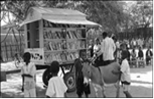
It is a bright morning in the Ethiopian countryside. Yohannes walks beside a pair of donkeys that are pulling a two-wheeled cart. They arrive at the agricultural town of Awassa where Yohannes opens the sides of the cart to display, not the usual vegetables or tools, but children’s books. This is the Donkey Mobile Library, the first of its kind in Ethiopia and one of only a few in the world.
Yohannes was born in Ethiopia, North Africa, but trained to be a librarian in the USA and returned to Ethiopia years ago. The cart is full of picture books donated by American libraries, teachers and school children.
Yohannes arranges small painted benches in the shade of the trees, and suddenly Ethiopian children come shouting and racing down every road and path. It’s mobile library day! They circle the bookshelves with great excitement. Until the Donkey Mobile Library began its regular two-monthly visits, many of these children had never seen a book.
“Without books, education is very dull, like food without salt. You can survive but you can’t really come alive,” says Yohannes. “The ability to read is the basis for greater productivity, better health and longer life. Even though the children lack material goods, with books they can imagine a world of possibilities.”
Yohannes first worked in the children’s section of the main library in America. Surrounded by books he had never seen before, he realized how joyful and imaginative children’s literature is. He says, “I always thought of Ethiopia. But how could I bring children’s books to my home country when it had almost no libraries to keep the books in?”
He contacted Jane Kurtz, a writer born in America but brought up in Ethiopia, and together they created the Donkey Mobile Library. The children say that the Library has given them ideas about what they might do in the future. A child called Dareje wants to be a scientist and find a cure for life-threatening diseases. An eleven year-old girl, Fikerte, wants to do research about the moon and discover new facts about outer space. Tamrat, aged 10, comes every time.
“What brings you back here time and time again?” the librarian asks him.
“The stories,” Tamrat replies instantly.
【小题1】How do the children feel when they see the Donkey Mobile Library?
| A.Excited. | B.Surprised. | C.Interested. | D.Curious |
| A.Ethiopian children have no idea about their future |
| B.Yohannes and Kurtz share similar life experiences |
| C.most books in the Donkey Mobile Library were bought in America |
| D.donkey carts in Awassa usually carry vegetables and tools |
| A.visits the countryside every day | B.was created by Yohannes himself |
| C.benefits Ethiopian children a lot | D.was the first of its kind in the world |
| A.A book review.. | B.A news report | C.A historical story. | D.An advertisement. |
The Donkey Mobile Library
It is a bright morning in the Ethiopian countryside. Yohannes walks beside a pair of donkeys that are pulling a two-wheeled cart. They arrive at the agricultural town of Awassa where Yohannes opens the sides of the cart to display, not the usual vegetables or tools, but children’s books. This is the Donkey Mobile Library, the first of its kind in Ethiopia and one of only a few in the world.
Yohannes was born in Ethiopia, North Africa, but trained to be a librarian in the USA and returned to Ethiopia years ago. The cart is full of picture books donated by American libraries, teachers and school children.
Yohannes arranges small painted benches in the shade of the trees, and suddenly Ethiopian children come shouting and racing down every road and path. It’s mobile library day! They circle the bookshelves with great excitement. Until the Donkey Mobile Library began its regular two-monthly visits, many of these children had never seen a book.
“Without books, education is very dull, like food without salt. You can survive but you can’t really come alive,” says Yohannes. “The ability to read is the basis for greater productivity, better health and longer life. Even though the children lack material goods, with books they can imagine a world of possibilities.”
Yohannes first worked in the children’s section of the main library in America. Surrounded by books he had never seen before, he realized how joyful and imaginative children’s literature is. He says, “I always thought of Ethiopia. But how could I bring children’s books to my home country when it had almost no libraries to keep the books in?”
He contacted Jane Kurtz, a writer born in America but brought up in Ethiopia, and together they created the Donkey Mobile Library. The children say that the Library has given them ideas about what they might do in the future. A child called Dareje wants to be a scientist and find a cure for life-threatening diseases. An eleven year-old girl, Fikerte, wants to do research about the moon and discover new facts about outer space. Tamrat, aged 10, comes every time.
“What brings you back here time and time again?” the librarian asks him.
“The stories,” Tamrat replies instantly.
【小题1】How do the children feel when they see the Donkey Mobile Library?
| A.Curious. | B.Surprised. | C.Interested. | D.Excited. |
| A.Ethiopian children have no idea about their future |
| B.Yohannes and Kurtz share similar life experiences |
| C.donkey carts in Awassa usually carry vegetables and tools |
| D.most books in the Donkey Mobile Library were bought in America |
| A.visits the countryside every day | B.benefits Ethiopian children a lot |
| C.was created by Yohannes himself | D.was the first of its kind in the world |
| A.A news report. | B.A book review. | C.A historical story. | D.An advertisement. |
The Donkey Mobile Library

It is a bright morning in the Ethiopian countryside. Yohannes walks beside a pair of donkeys that are pulling a two-wheeled cart. They arrive at the agricultural town of Awassa where Yohannes opens the sides of the cart to display, not the usual vegetables or tools, but children’s books. This is the Donkey Mobile Library, the first of its kind in Ethiopia and one of only a few in the world.
Yohannes was born in Ethiopia, North Africa, but trained to be a librarian in the USA and returned to Ethiopia years ago. The cart is full of picture books donated by American libraries, teachers and school children.
Yohannes arranges small painted benches in the shade of the trees, and suddenly Ethiopian children come shouting and racing down every road and path. It’s mobile library day! They circle the bookshelves with great excitement. Until the Donkey Mobile Library began its regular two-monthly visits, many of these children had never seen a book.
“Without books, education is very dull, like food without salt. You can survive but you can’t really come alive,” says Yohannes. “The ability to read is the basis for greater productivity, better health and longer life. Even though the children lack material goods, with books they can imagine a world of possibilities.”
Yohannes first worked in the children’s section of the main library in America. Surrounded by books he had never seen before, he realized how joyful and imaginative children’s literature is. He says, “I always thought of Ethiopia. But how could I bring children’s books to my home country when it had almost no libraries to keep the books in?”
He contacted Jane Kurtz, a writer born in America but brought up in Ethiopia, and together they created the Donkey Mobile Library. The children say that the Library has given them ideas about what they might do in the future. A child called Dareje wants to be a scientist and find a cure for life-threatening diseases. An eleven year-old girl, Fikerte, wants to do research about the moon and discover new facts about outer space. Tamrat, aged 10, comes every time.
“What brings you back here time and time again?” the librarian asks him.
“The stories,” Tamrat replies instantly.
1.How do the children feel when they see the Donkey Mobile Library?
A.Curious. B.Surprised. C.Interested. D.Excited.
2.We can conclude from the passage that .
A.Ethiopian children have no idea about their future
B.Yohannes and Kurtz share similar life experiences
C.donkey carts in Awassa usually carry vegetables and tools
D.most books in the Donkey Mobile Library were bought in America
3.According to the passage, the Donkey Mobile Library .
A.visits the countryside every day B.benefits Ethiopian children a lot
C.was created by Yohannes himself D.was the first of its kind in the world
4.Where is the passage most likely to have been taken from?
A.A news report. B.A book review. C.A historical story. D.An advertisement.
查看习题详情和答案>>
The Donkey Mobile Library

It is a bright morning in the Ethiopian countryside. Yohannes walks beside a pair of donkeys that are pulling a two-wheeled cart. They arrive at the agricultural town of Awassa where Yohannes opens the sides of the cart to display, not the usual vegetables or tools, but children’s books. This is the Donkey Mobile Library, the first of its kind in Ethiopia and one of only a few in the world.
Yohannes was born in Ethiopia, North Africa, but trained to be a librarian in the USA and returned to Ethiopia years ago. The cart is full of picture books donated by American libraries, teachers and school children.
Yohannes arranges small painted benches in the shade of the trees, and suddenly Ethiopian children come shouting and racing down every road and path. It’s mobile library day! They circle the bookshelves with great excitement. Until the Donkey Mobile Library began its regular two-monthly visits, many of these children had never seen a book.
“Without books, education is very dull, like food without salt. You can survive but you can’t really come alive,” says Yohannes. “The ability to read is the basis for greater productivity, better health and longer life. Even though the children lack material goods, with books they can imagine a world of possibilities.”
Yohannes first worked in the children’s section of the main library in America. Surrounded by books he had never seen before, he realized how joyful and imaginative children’s literature is. He says, “I always thought of Ethiopia. But how could I bring children’s books to my home country when it had almost no libraries to keep the books in?”
He contacted Jane Kurtz, a writer born in America but brought up in Ethiopia, and together they created the Donkey Mobile Library. The children say that the Library has given them ideas about what they might do in the future. A child called Dareje wants to be a scientist and find a cure for life-threatening diseases. An eleven year-old girl, Fikerte, wants to do research about the moon and discover new facts about outer space. Tamrat, aged 10, comes every time.
“What brings you back here time and time again?” the librarian asks him.
“The stories,” Tamrat replies instantly.
1.How do the children feel when they see the Donkey Mobile Library?
A.Excited. B.Surprised. C.Interested. D.Curious
2.We can conclude from the passage that .
A.Ethiopian children have no idea about their future
B.Yohannes and Kurtz share similar life experiences
C.most books in the Donkey Mobile Library were bought in America
D.donkey carts in Awassa usually carry vegetables and tools
3.According to the passage, the Donkey Mobile Library .
A.visits the countryside every day B.was created by Yohannes himself
C.benefits Ethiopian children a lot D.was the first of its kind in the world
4.Where is the passage most likely to have been taken from?
A.A book review.. B.A news report C.A historical story. D.An advertisement.
查看习题详情和答案>>
Their critics seem to resent(对...不满) them because they have a gift for self-promotion and because
they have so much money to throw around. 'It's unjust,' they say, 'that this entirely unproductive industry
(if we can call it that) should absorb millions of pounds each year. It only goes to show how much profit
the big companies are making. Why don't they stop advertising and reduce the price of their goods?
After all, it's the consumer who pays…'
The poor old consumer! He'd have to pay a great deal more if advertising didn't create mass markets
for products. It is precisely because of the heavy advertising that consumer goods are so cheap. But we
get the wrong idea if we think the only purpose of advertising is to sell goods. Another equally important
function is to inform. A great deal of the knowledge we have about household goods comes largely from
the advertisements we read. Advertisements introduce us to new products or remind us of the existence
of ones we already know about. Supposing you wanted to buy a washing machine, it is more than likely
you would obtain details regarding performance, price, etc., from an advertisement.
Lots of people pretend that they never read advertisements, but this claim may be seriously doubted.
It is hardly possible not to read advertisements these days. And what fun they often are, too! Just think
what a railway station or a newspaper would be like without advertisements. Would you enjoy gazing
at a blank wall or reading railway byelaws(内部规则) while waiting for a train? Would you like to read
only closely printed columns of news in your daily paper? A cheerful, witty advertisement makes such
a difference to a dull wall or a newspaper full of the daily ration(定量) of disasters.
We must not forget, either, that advertising makes a positive contribution to our pockets. Newspapers, commercial radio and television companies could not subsist (survive) without this source of revenue.
The fact that we pay so little for our daily paper, or can enjoy so many broadcast programmes is due
entirely to the money spent by advertisers. Just think what a newspaper would cost if we had to pay its
full price!
Another thing we mustn't forget is the 'small ads.' which are in virtually every newspaper and
magazine. What a tremendously useful service they perform for the community! Just about anything
can be accomplished through these columns. For instance, you can find a job, buy or sell a house,
announce a birth, marriage or death in what used to be called the 'hatch(giving birth), match and
dispatch' column but by far the most fascinating section is the personal or 'agony' column(读者来信
专栏). No other item in a newspaper provides such entertaining reading or offers such a deep insight
into human nature. It's the best advertisement for advertising there is!
C. Advertisers perform a useful service to communities.
D. The costs of advertisement.
B. trustworthy.
C.critical.
D. dissatisfactory.
B. Because critics think advertisement is a "waste of money".
C. Because customers are encouraged to buy more than necessary.
D. Because customers pay more.
B. We can buy what we want.
C. Good quality products don't need to be advertised.
D. Advertisement makes our life colorful.
B. Description.
C. Criticism.
D. Argumentation.