网址:http://m.1010jiajiao.com/timu3_id_2545241[举报]
阅读下面短文,根据短文内容回答问题。
The Rainmaker
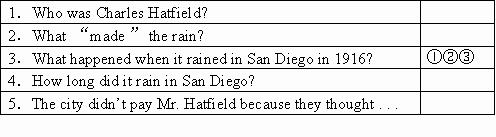
Can a person make it rain? Many people believed that Charles Hatfiled could. In the early 1900s, Mr. Hatfield traveled through the United States, Canada, and Mexico bringing rain to farms and cities that suffered from drought. For 30 years, people considered him the greatest rainmaker in North America. In order to make it rain, he used a secret mixture of chemicals that be placed high on wooden towers in special trays. As the chemicals evaporated, they attracted rain clouds to the area. Over his career, Mr. Hatfield even offered to help clear the fog from London and to water the Sahara Desert.
One of Mr. Hatfiled's most amazing rainmaking accomplishments happened in southern California in 1916. Because he knew that the city of San Diego did not have enough water, Mr. Hatfield offered to give the city a hand with its water problem. He planned to create enough rain to fill the lake behind Morena Dam near the city. Since the time the dam was built, the lake had never been more than half full, but the lake could hold 57 billion liters (15 billion gallons) of water if it were full. Filling the lake would help the city of San Diego with its constant water problems. Mr. Hatfield suggested that if he succeeded in filling the lake with rain water, the city would pay him $10, 000.If no rain fell, the city would pay nothing. The city agreed because they had nothing to lose from the business deal, and only paying $ 10, 000 for that much water seemed to be a steal.
On January 1, 1916, Mr. Hatfield began his rainmaking procedure. It began to rain four days later. The rain continued for the next five days. On January 10, it began to rain more heavily, and the rain continued for the next 10 days The city of San Diego was flooded. Fifty people died. More than 200 bridges were washed away,. and many miles of train tracks were destroyed. However, Mr. Hatfield did succeed in filling the lake. The water was within 12 centimeters of the top of the dam. Mr. Hatfield thought that he had completed his job, so he went to collect his money from the city. However, the city of San Diego backed out of the deal. They said that the rain was an “act of God” and not the work of the rainmaker. Mr. Hatfield tried to sue the city, but he never collected any money for his work.
Please answer the questions below.
Hobbs was an orphan (孤儿). He worked in a factory and every day he got a little money. Hard work made him thin and weak. He wanted to borrow a lot of money to learn to paint pictures, but he did not think he could pay off the debts.
One day a lawyer said to him, “One thousand dollars, and here is the money. ” As Hobbs took the package of notes, he was very dumbfounded. He didn’t know where the money came from and how to spend it. He said to himself, “I could go to find a hotel and live like a rich man for a few days; or I give up my work in the factory and do what I’d like to do: painting pictures. I could do that for a few weeks, but what would I do after that? I should have lost my place in the factory and have no money to live on. If it were a little less money, I would buy a new coat, or a radio, or give a dinner to my friends. If it were more, I could give up the work and pay for painting pictures. But it’s too much for one and too little for the other. ”
“Here is the reading of your uncle’s will (遗嘱), ” said the lawyer, “telling what is to be done with this money after his death. I must ask you to remember one point. Your uncle has said you must bring me a paper showing exactly what you did with his money, as soon as you have spent it. ” “Yes, I see. I’ll do that, ” said the young man.
1. Hobbs wanted to borrow money to ________.
A. study abroad B. work abroad
C. pay off the debts D. learn to paint pictures
2. What does the underlined word “dumbfounded” (in Paragraph 2) probably mean?
A. Surprised. B. Frightened.
C. Satisfied. D. Excited.
3. With the money he got, at first Hobbs _______.
A. planned to have a happy life for a few days
B. decided to give up his work in the factory
C. was to give a dinner to his friends
D. had no idea what to do
4. Hobbs was asked to _________.
A. tell the lawyer what he did with the money after spending it
B. read his uncle’s will
C. tell the lawyer what was to be done with the money
D. buy some pictures
查看习题详情和答案>>
第二部分 阅读(共两节,满分80分)
第一节:阅读理解(共35小题;每小题2分,满分70分)
阅读下面短文,掌握其大意,然后从21~55各题所给的四个选项(A、B、C、D)中,选出最佳选项,并在答题卡上将该项涂黑。
August has always been difficult for me. It is the time when I realize that the books my English teacher assigned to me are not going to read themselves and that I have a difficult month in front of me.
You might think that I don’t want to spend my summer reading, but that’s not the problem: I love reading. On the first day of my summer holidays this year, I went to the library and got “A Gathering of Old Men” by African-American writer Ernest Gaines. I enjoyed it very much. I read all the magazines that my parents subscribe to and spend about 30 minutes every day with the morning paper. So why do I hate summer reading for school? Because the books on summer reading lists are often slow-going and just uninviting. Teachers and librarians don’t understand that summer reading can be entertaining as well as educational. They choose books that a friend of my mother’s calls “spinach books”: good for you, but not much fun to take in. Every summer, I read them, hate them and get bitter about the experience.
This bitterness started three years ago when I was about to begin high school. As preparation, my English teacher told me to read “The Age of Innocence” by American author Edith Wharton. I’m sure there are many people who enjoyed “The Age of Innocence” — some might even say it’s their favorite book.
But I don’t think any of these people read it as a 14-year-old boy on his summer vacation.
“The Age of Innocence” is the story of a forbidden romance in New York 100 years ago. At 14, my only experience with romance was my love for baseball. I couldn’t imagine being in love, much less being in love in 1900. “The Age of Innocence” was totally different to my life.
Most of my required summer reading has been like that — books written in a style that plays up the adjectives and plays down the verbs. I guess teachers don’t think exciting plots make for “good literature”. To me, though, a good writer describes events and characters in a way that makes the reader want to know what happens next.
If I were making up a summer reading list, it would include “The Friends of Eddie Coyle” by George V. Higgins, “The Right Stuff” by Tom Wolfe, and “Into Thin Air” by Jon Krakauer. These are all books that have literary value but, just as important, can also entertain kids on vacation. If the teachers could stand a little fun in the books they assign, my Augusts would be a lot more enjoyable.
1. The author thinks he will have a difficult August because ____________.
A. he doesn’t like reading in summer vacation
B. he is to read the books boring and not right for kids
C. he hates the English teacher assigning homework
D. he hates August
2. What can make students interested in August reading ought to be ___________.
A. romantic B. out of date
C. entertaining and educational D. pure
3. The author listed such books as “The Friends of Eddie Coyle” because he thinks __________.
A. they can change his opinion B. he can learn a lot more from them
C. they are of literary value, and enjoyable D. he has to do as teachers tell him to
4. In the opinion of the author of this passage, a good writer should be ___________.
A. one who describes events and characters in different ways
B. one who is full of imagination
C. one who is learned
D. one who uses a way of describing that makes the reader wish to know what to happen next
5. Which of the following could be the best title of this passage?
A. Why Can’t Teachers Set Us Fun Books?
B. I Don’t Like Reading on the Vacation
C. Teachers, Don’t Set Us Any Reading Assignments
D. Teachers, Set Us Free
| |||||||||||||||||||||||||||||||||||||||||||||||||||||||||||
Forests have always been useful and important to man who makes use of them in many ways. Every day trees are serving man everywhere. Trees supply man with fruits and building materials in the form of wood. Without trees it would be impossible to build houses, boats, bridges and so on. Furniture such as desks, chairs and beds is made of wood. Trees can stop man from terrible heat. They're also useful in preventing good and rich top soil from being washed away during heavy rains.
If there were no trees, heavy rains would wash away the rich top soil that is so important to plants. The result is that the land will become a desert. There are plenty of desert areas in the world. A long time ago these desert areas used to be very rich areas, but man in the past had no enough knowledge about science of nature, they cut down too many trees in the area where they lived and never planted new ones. By and by the rich top soil was blown and washed away by strong winds and heavy rains. In the end the rich land changed into useless deserts where nothing could grow.
According to the passage, ______.
A. a long time ago, man didn't know how to make use of wood
B. trees are not as useful as they were in the past
C. trees were more found in the past than they are today
D. people have always found trees useful
If there were no trees, ______.
A. the land would become better B. heavy rains would be very clean
C. the rich soil couldn't be kept D. there wouldn't be any plants
From the passage, we know that man must ______.
A. do nothing to keep the balance(平衡)of nature
B. take his best to keep the balance of nature
C. try his best to keep the balance of nature
D. do his best to stop the balance of nature
查看习题详情和答案>>