网址:http://m.1010jiajiao.com/timu3_id_2514954[举报]
Tom appeared on the sidewalk with a bucket of whitewash and a long-handled brush. He stopped by the fence in front of the house where he lived with his aunt Polly. He looked at it, and all joy left him. The fence was long and high. He put the brush into the whitewash and moved it along the top of the fence. He repeated the operation. He felt he could not continue and sat down.
He knew that his friends would arrive soon with all kinds of interesting plans for the day. They would walk past him and laugh. They would make jokes about his having to work on a beautiful summer Saturday. The thought burned him like fire.
He put his hand into his pockets and took out all that he owned. Perhaps he could find some way to pay someone to do the whitewashing for him. But there was nothing of value in his pockets —nothing that could buy even half an hour of freedom. So he put the bits of toys back into his pockets and gave up the idea
At this dark and hopeless moment, a wonderful idea came to him. It filled his mind with a great, bright light. Calmly he picked up the brush and started again to whitewash.
While Tom was working, Ben Rogers appeared. Ben was eating an apple as he walked along the street. As he walked along, he was making noises like the sound of a riverboat. First he shouted loudly, like a boat captain. Then he said “Ding-Dong-Dong”, “Ding-Dong-Dong” again and again, like the bell of a riverboat. And he made other strange noises. When he came close to Tom, he stopped.
Tom went on whitewashing. He did not look at Ben. Ben stared a moment and then said: “Hello! I’m going swimming, but you can’t go, can you?”
No answer. Tom moved his brush carefully along the fence and looked at the result with the eye of an artist. Ben came nearer. Tom’s mouth watered for the apple, but he kept on working.
Ben said, “Hello, old fellow, you’ve got to work, hey?”
Tom turned suddenly and said, “Why, it’s you, Ben! I wasn’t noticing.”
“Say —I’m going swimming. Don’t you wish you could? But of course you’d rather work — wouldn’t you? Of course you would.”
Tom looked at the boy a bit, and said “What do you call work?”
“Why, isn’t that work?”
Tom went back to his whitewashing, and answered carelessly.
“Well, maybe it is, and maybe it isn’t. All I know is, it suits Tom Sawyer.”
“Oh come, now, you don’t mean to say that you like it?”
The brush continued to move.
“Like it? Well, I don’t see why I shouldn’t like it. Does a boy get a chance to whitewash a fence every day?”
Ben stopped eating his apple. Tom moved his brush back and forth, stepped back to look at the result, added a touch here and there, and stepped back again. Ben watched every move and got more and more interested. Soon he said,
“Say, Tom, let me whitewash a little.”
Tom thought for a moment, was about to agree; but he changed his mind.
“No —no —it won’t do, Ben. You see, Aunt Polly wants this fence to be perfect. It has got to be done very carefully. I don’t think there is one boy in a thousand, maybe two thousand, that can do it well enough.”
“No —is that so? Oh come, now —let me just try. Only just a little.” “Ben, I’d like to, but if it isn’t done right, I’m afraid Aunt Polly … ”
“Oh, I’ll be careful. Now let me try. Say —I’ll give you the core of my apple.”
“Well, here —No, Ben, now don’t. I’m afraid …”
“I’ll give you all of it.”
Tom gave up the brush with unwillingness on his face, but joy in his heart. And while Ben worked at the fence in the hot sun, Tom sat under a tree, eating the apple, and planning how to get more help. There were enough boys. Each one came to laugh, but remained to whitewash. By the time Ben was tired, Tom sold the next chance to Billy for a kite; and when Billy was tired, Johnny bought in for a dead rat —and so on, hour after hour. And when the middle of the afternoon came, Tom had won many treasures.
And he had not worked. He had had a nice idle time all the time, with plenty of company -and the fence had been whitewashed three times. If he hadn’t run out of whitewash, Tom would have owned everything belonging to his friends.
He had discovered a great law of human action, namely, that in order to make a man or a boy want a thing, it is only necessary to make the thing difficult to get.
【小题1】How many characters are mentioned in this story?
| A.7 | B.6 | C.5 | D.4 |
| A.Because he is tired and wanted to play with his toys. |
| B.Because he wanted to throw his toys away. |
| C.Because he wanted to know if he could buy help with his toys. |
| D.Because he wanted to give his toys to his friends. |
| A.Tom wanted to do the whitewashing by himself |
| B.Tom was afraid Ben would do the whitewashing better. |
| C.Tom was unwilling to let Ben do the whitewashing |
| D.Tom planned to make Ben give up his apple first |
| A.Tom was good at whitewashing the fence, so he looked at the result of his work with the eye of an artist. |
| B.Tom was unwilling to whitewash the fence, but he managed to let other boys do it for him |
| C.Tom had a lot of friends who are ready to help others. |
| D.Tom was interested in whitewashing the fence. |
| A.His curiosity about Tom’s brushing job. |
| B.His warm heart and kindness to friends. |
| C.Tom’s threat. |
| D.Aunt Polly’s idea. |
| A.Tom And His Fellows |
| B.The Happy Whitewasher |
| C.Whitewashing A Fence |
| D.How To Make The Things Difficult To Get |
| |||||||||||||||||||||||||||||||||||||||||||||||||||||||||||||||||||||||||||||||||||||||
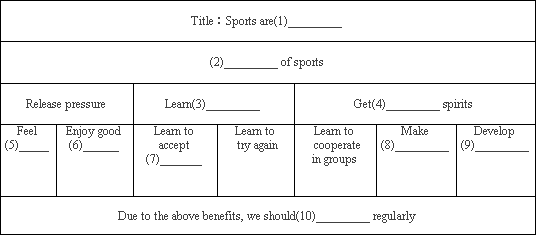
阅读下面短文,根据所读内容在表格中的空白处填入恰当的单词。注意:每个空格只填一个单词。
Some people think adults don't need to do sports, especially those who are strong and healthy.But in fact, sports are necessary.They can release(释放)pressure and teach us survival skills for life.Also they give us pleasure and teach us the spirit of teamwork.
Scientists believe that practicing sports can release pressure.I am used to swimming before exams, and after swimming, I find that I am relaxed and that helps me a lot in doing well in exams.Besides, students need good health.
Playing sports will teach you many skills that you need in life.For example, no one would succeed without competing with others.They also teach you how to accept failure and how to try again until you achieve your goals.These are exactly the things that people practice daily when they play sports.
Being healthy does not mean that you don `t need sports.Playing sports is helpful to us because it teaches us teamwork spirit.For example, I once was a shy and lonely boy.When I met a boy who loved playing basketball, step by step.I became a happy boy full of team spirit.That helps me a lot in my family and career life.
So it is not true that sports do not have advantages for all of us.And to get the most of the benefits, we should practice sports every day.
“How are you?” is a nice question. It's a ___1___ way that people in the United States ___2__ each other. But “How are you?” is also a very _ ___3___ question. It's a question that often ___4___ have an answer. The person who asks “How are you?” hopes to hear the answer“___5___”,even though the person's friend isn't fine, ___6___ “How are you?” isn't really a question, and “Fine” isn't really an answer. They are ___7__ other way of saying “Hello” and“___8___”.
Sometimes, people also don't say just what they ___9___ For example, when someone asks “Do you agree?” the other person ___10____ be thinking, “No, I don't agree. I think you're wrong. ” But it isn't very ___11___ to say so, so the other person might say, “I'm not so ___12___” It's a nice way to say that you don't agree with someone.
People ___13___ don't say just what they are thinking when they ___14___ talking with other people. For example, many talks over the phone ___15___ when one person says,“I've got to go now.” Often, the person who wants to ___16__ gives an excuse:“Someone is at the door.” “I've got to put the things ___17__.” “Something is burning on the fire.” The excuse might be real, or it might not. Perhaps the person who wants to hang up simply doesn't want to talk ____18___, but it isn't very polite to say that. The excuse is more polite, and it doesn't ___19___ the other person's feelings.
When they meet each other, talk about an idea, or end a talk, people often don't ___20___ just what they are thinking. It's an important way that people try to be nice to each other, and it's all part of the game of language!
|
(1) A.funny |
B.friendly |
|
C.strange |
D.useful |
|
(2) A.meet |
B.like |
|
C.know |
D.excuse |
|
(3) A.good |
B.unusual |
|
C.interesting |
D.possible |
|
(4) A.doesn't |
B.mustn't |
|
C.shouldn't |
D.needn't |
|
(5) A.Right |
B.Terrible |
|
C.Fine |
D.True |
|
(6) A.though |
B.when |
|
C.because |
D.unless |
|
(7) A.not |
B.many |
|
C.really |
D.simply |
|
(8) A.OK |
B.Bye |
|
C.Hi |
D.No |
|
(9) A.want |
B.do |
|
C.lose |
D.mean |
|
(10) A.must |
B.might |
|
C.can |
D.will |
|
(11) A.polite |
B.necessary |
|
C.important |
D.easy |
|
(12) A.afraid |
B.well |
|
C.sure |
D.interested |
|
(13) A.also |
B.again |
|
C.only |
D.certainly |
|
(14) A.enjoy |
B.keep |
|
C.finish |
D.miss |
|
(15) A.continue |
B.last |
|
C.stop |
D.end |
|
(16) A.put up |
B.pick up |
|
C.turn up |
D.hang up |
|
(17) A.on |
B.away |
|
C.in |
D.out |
|
(18) A.much |
B.at all |
|
C.at once |
D.any more |
|
(19) A.hit |
B.hurt |
|
C.harm |
D.destroy |
|
(20) A.say |
B.study |
|
C.believe |
D.remember |
“How are you?” is a nice question. It's a ___1___ way that people in the United States ___2__ each other. But “How are you?” is also a very _ ___3___ question. It's a question that often ___4___ have an answer. The person who asks “How are you?” hopes to hear the answer“___5___”,even though the person's friend isn't fine, ___6___ “How are you?” isn't really a question, and “Fine” isn't really an answer. They are ___7__ other way of saying “Hello” and“___8___”.
Sometimes, people also don't say just what they ___9___ For example, when someone asks “Do you agree?” the other person ___10____ be thinking, “No, I don't agree. I think you're wrong. ” But it isn't very ___11___ to say so, so the other person might say, “I'm not so ___12___” It's a nice way to say that you don't agree with someone.
People ___13___ don't say just what they are thinking when they ___14___ talking with other people. For example, many talks over the phone ___15___ when one person says,“I've got to go now.” Often, the person who wants to ___16__ gives an excuse:“Someone is at the door.” “I've got to put the things ___17__.” “Something is burning on the fire.” The excuse might be real, or it might not. Perhaps the person who wants to hang up simply doesn't want to talk ____18___, but it isn't very polite to say that. The excuse is more polite, and it doesn't ___19___ the other person's feelings.
When they meet each other, talk about an idea, or end a talk, people often don't ___20___ just what they are thinking. It's an important way that people try to be nice to each other, and it's all part of the game of language!
|
(1) A.funny |
B.friendly |
|
C.strange |
D.useful |
|
(2) A.meet |
B.like |
|
C.know |
D.excuse |
|
(3) A.good |
B.unusual |
|
C.interesting |
D.possible |
|
(4) A.doesn't |
B.mustn't |
|
C.shouldn't |
D.needn't |
|
(5) A.Right |
B.Terrible |
|
C.Fine |
D.True |
|
(6) A.though |
B.when |
|
C.because |
D.unless |
|
(7) A.not |
B.many |
|
C.really |
D.simply |
|
(8) A.OK |
B.Bye |
|
C.Hi |
D.No |
|
(9) A.want |
B.do |
|
C.lose |
D.mean |
|
(10) A.must |
B.might |
|
C.can |
D.will |
|
(11) A.polite |
B.necessary |
|
C.important |
D.easy |
|
(12) A.afraid |
B.well |
|
C.sure |
D.interested |
|
(13) A.also |
B.again |
|
C.only |
D.certainly |
|
(14) A.enjoy |
B.keep |
|
C.finish |
D.miss |
|
(15) A.continue |
B.last |
|
C.stop |
D.end |
|
(16) A.put up |
B.pick up |
|
C.turn up |
D.hang up |
|
(17) A.on |
B.away |
|
C.in |
D.out |
|
(18) A.much |
B.at all |
|
C.at once |
D.any more |
|
(19) A.hit |
B.hurt |
|
C.harm |
D.destroy |
|
(20) A.say |
B.study |
|
C.believe |
D.remember |