网址:http://m.1010jiajiao.com/timu3_id_2511278[举报]
书面表达:
假如你是李华,在最近的研究性学习当中,受《英语周报》(English Weekly)之邀,你对本校2000(男女生人数各半)名同学进行了使用手机情况的调查。现将调查结果(如下表所示)用英语给报社的编辑写一封信,报道此事以引起大家的关注,并给出你的观点和建议。
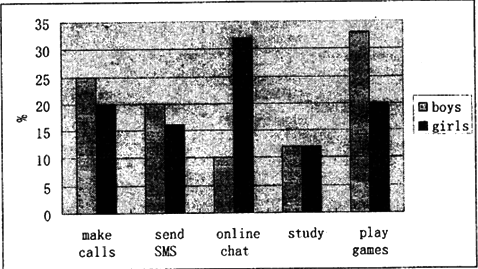
注意:
1、报道应包括图表所示内容,为使行文连贯可适度添加细节。
2、文章的开头与结尾已给出,不计入总词数。
3、词数:100左右
4、参考词汇:调查:make a survey; send SMS(send short messages)
Dear editor,
I have recently made a survey among 2000 students in our school about their purpose of using cell phones.
Yours,
Li Hua
阅读下面的文字,完成下列各题。
高原,我的中国色
乔 良
东亚细亚的腹地,一派空旷辽远,触目惊心的苍黄。连那条从巴颜喀拉的山岩间夺路而来的大河,也暴烈地流泻着一川黏稠的黄色!这就是高原。黄土高原。
浑黄的天地间,走来一个黄皮肤的老者。看不清他的面孔,听不清他的声音,只有那被黄土染成褐色的长髯在被太阳喷成紫色的浮尘中飘拂……老者身后,逶迤着长长、长长一列只在身体的隐秘处裹着兽皮的男人和女人。
一棵巨大的柏树,便在这人群中生下根来。所有黄皮肤的男人女人和他们的后人,都把这巨树唤作轩辕柏。它的根须像无数手指抠进黄土,扎向地心,用力合抱住整个儿的高原。
始皇帝横扫六合的战车,汉高祖豪唱大风的猛士,倚在驼峰上西出阳关的商旅,打着呼哨、浑身酒气的成吉思汗的铁骑,和五午年的岁月一道,从这金子样的高原上骄傲地走过去,走过去,直到……
暮云垂落下来,低矮的天地尽头,走来一个小小的黑点。一个军人。
他站在一架冲沟纵横、褶皱斑驳的山梁上。残阳把他周身涂成一色金黄。他伸出手臂,出神地欣赏着自己的皮肤。金黄的晖光从手臂上滑落下去,掉在高原上。一样的颜色。他想,我的肤色和高原一样。
豪迈的西风从长空飒然而至。他的衣襟和裤角同时低唱起暗哑而粗犷的古歌。刹那间,他获得了人与天地自然,与遥远的初民时代那种无缝无隙的交合。是一种虚空又充实,疏朗又密集,渺小又雄大的感觉。
他不禁微微一笑。然而,只一笑,那难以言喻的快感消退了。渐渐塞满胸壑的,是无边的冷寞,莫名的苍凉。竟然没有一只飞鸟,竟然没有一丛绿草。只有我,他想。我和高原。于是他又想,这冷漠、这苍凉不仅仅属于我,还属于遗落在高原上的千年长史。
畏惧盗寇的商贾们抛离了驼队踩出的丝绸古道。面对异族的武夫们丢弃了千里烽燧和兵刃甲胃。一路凄惶,簇拥着玉辇华盖,偏安向丰盈又富庶的南方。那叫人柔肠寸断的杏花雨呵,竟把炎黄子民们孔武剽悍的魂魄和膂力一并溶化!而历史,却在某个迷茫的黄昏,被埋进深深的黄土。
他感到胸口有一团东西被揪得发疼。他想喊。他想站到最高的那架山梁上去,对着苍茫的穹窿嘶喊:难道华夏民族所有的武士,都走进了始皇陵兵马俑的行列?
没有风。没有声息。高原沉默着。
一块没有精壮和血性汉子的土地是悲哀的。
他想起了他那些戴着立体声耳机、抱着六弦琴横穿斑马线的兄弟们。他们全都身条瘦长,脸色煞白,像一根根垂在瓜架上的丝瓜。他们要去参加这一年中的第三百六十七次家庭舞会了吧?他们的迪斯科跳得真好。他们忧郁的歌声真动人。但,他们只从银幕上见过高原和黄土。他们不知道紫外线直射进皮肤和毛孔时的滋味,更不知道那黄土堆成的高原上埋着的古中国。
可那才是中国,那才叫中国。在病榻上呻吟了八百年,又被人凌辱了二百年的,不是真正的中国。真正的中国是闪着丝绸之光、敦煌之光、修筑起长城,开凿出运河,创造了道教,融合了佛教,同化了一支支异族入侵者的中国。
真正的中国是一条好汉。这裸着青筋、露着傲骨的高原也是一条好汉。
他想,我也该是这样的汉子。
他想,有了这样的男子汉,高原,这金子似的高原便不会死去。因为轩辕柏在这里扎着一根粗大的、深邃的根茎。
这个人,这个军人,就是我。
这篇散文中作者设置的“轩辕柏”有什么象征意义?请结合阅读材料简要分析。
“是一种虚实又充实,疏朗又密集,渺小又雄大的感觉。”作者将褒贬之词同时用来描写这种感觉,这是一种什么样的感觉?“他”为什么会产生这样的感觉?
文章结尾说:“这个人,这个军人,就是我。”一句中与上文哪一句照应?怎样理解其中的“我”?请你谈谈作者在文中如何渲染与张扬着自己的情绪?
下列对文章的赏析,不正确的两项是 ( )
A.“残阳把他周身涂成一色金黄”,他为自己有着与“金子样的高原”同样的颜色而自豪,就是他为做一个中国人而骄傲。
B.“他”站在黄土高原上,看到“竟然没有一只飞鸟,竟然没有一丛绿草”,深感植被破坏严重,内心无比冷寞,苍凉。
C.丰盈富庶的南方,柔肠寸断的杏花雨象征了温柔安逸、没有血性的土地,销磨了一代代中国人慷慨悲歌之气,积极进取之心。
D.“他”想呼喊,仅仅因为现代人的苍白无知,压得他几乎喘不过气来。所以他的大声呐喊是希望唤回高原的血性来。
E.全文语言铿锵有力,掷地有声,在凛然傲气中又渗透着无限的历史苍凉感,如同一幅黄昏时分的画卷,述说着遥远的历史又翘首期待着美好的明天。
查看习题详情和答案>>四、考查阅读理解(共15小题;每小题2分,满分30 分)
阅读下面的短文,从每题所给的四个选项(A、B、C和D)中,选出最佳选项,并在答题卡上将该项涂黑。
Dear Florence,
We arrived in India last week, and the voyage was the worst experience of my entire life. I’m lucky to be alive!
The first part of the journey was terrible, because the ship hit bad weather almost as soon as we left Liverpool. But much, much worse was to come. Later, we were involved in a collision with another boat and we had to abandon ship!
We had been at sea for about two weeks and we were in the Mediterranean. There is now a canal between the Mediterranean and the Red Sea called the Suez Canal, which opened last year. Our boat stopped at Port Said, the Egyptian port at the entrance to the canal. I remember looking through the porthole of my cabin and wishing that I could go ashore and visit this fascinating place, but mummy had ordered that I was to stay in the cabin because I was feeling ill. “you must stay here for at least another two days.” I remember her saying. How wrong she would turn out to be! The ship left the port and headed towards the canal . I was alone in the cabin and I watched the port disappear into the distance. Suddenly there was a loud bang, followed by the most awful crunching(嘎吱的)sound, and the ship shook and turned slightly on its side.
There was an eerie silence for a moment, then people started shouting. Mummy came running into the cabin and told me that we had collided with another boat. She took my hand and we ran along the deck towards the lifeboats. There was a lot of shouting and people were running everywhere, but the crew were all acting calmly, helping people into the lifeboats and telling people not to panic.
Well, clearly we survived, as did all the passengers and crew of the ship. The other boat wasn’t so lucky. It sank and several lives were lost.
I will write about the rest of the journey soon. Please give my love to Aunt Claire and Uncle Eric.
Your loving cousin,
Jane
56.When was the letter written?
A.Before the author went to India. B.In the mid – 19th century.
C.When the author arrived in Egypt. D.Just after the author arrived in India.
57.Why was the journey to India such a bad experience for the author?
A.She was sick when it started and nearly died in Egypt.
B.Her ship left England in bad weather and crashed into another ship near the Suez Canal.
C.She was seasick when her ship sank.
D.She was alone when her ship hit another boat and she got sick.
58.The author’s mother didn’t allow her to go ashore and visit the port city, Said because .
A.she was homesick at that time B.she didn’t feel very well then
C.she could meet some danger ashore D.she could see the city through the porthole on board
59.The underlined phrase “eerie silence” in the sixth paragraph means .
A.pleasant calm silence B.long peaceful silence
C.sudden long silence D.strange uncomfortable silence
查看习题详情和答案>>下面文章中有5处(第1~5题)需要添加小标题。请从以下选项(A、B、C、D、E和F)中选出符合各段意思的小标题,选项中有一项是多余选项。
B. Learn to Speak Clearly and Persuasively
C. Learn to Make Decisions Quickly and Properly
D. Learn to Relax Timely
E. Learn to Use Internet Efficiently
F. Learn to Express Yourself Effectively
Top Tips on How to Succeed in Life
What does it take to succeed in life? Author Dustin M. Wax has compiled a list of the top five skills you
need for a successful life.
1._________
Good writing skills are essential for today's competitive job market. But writing well isn't just a case of
producing grammatically correct sentences - it involves an ability to organize your thoughts, as well as
being able to target your ideas to an audience in the most effective way possible.
2.__________
With so much information out there, you need to be able to sort the potentially valuable data from the
trivial, to analyze its relevance and meaning, and to relate it back to other information.
3. ___________
Analyzing information is all very well, but at some stage you also need to make a decision. Over-analyzing can lead to hesitation, so you need to learn how to respond quickly and effectively, and to know what to
do based on the information available.
4. __________
You don't have to know everything, but you should be able to find out what you need to know quickly
and painlessly. This means learning how to use the internet effectively, how to read productively, and how
to draw on your network of contacts efficiently.
5. __________
Being able to switch off is extremely hard for some people, but you need to find time for exercise or ways of relieving stress and tension, or the pressure could end up literally killing you!
| 阅读理解。 | ||||||
| 下面文章有5处(第61~65题)需要添加小标题.请从以下选项(A、B、C、D、E和F)中选 出符合各段意思的小标题,并在答题纸上将相应选项的标号涂黑.选项中有一项是多余选项.
in general history classes. Most typical history courses concentrate on politics, economics and war. But art history focuses on much more than this because art reflects not only the political values of a people, but also religious beliefs, emotions, and psychology.
our own - can be provided by art. In short, art expresses the essential qualities of a time and a place, and a study of it clearly offers us a deeper understanding than can be found in most history books.
about politics are given, but opinions are not expressed. Art, on the other hand, is subjective: it reflects emotions and opinions. The great Spanish painter Francisco Goya was perhaps the first truly "political" artist. In his well-known painting The Third of May 1808, he criticized the Spanish government for its misuse of power over people. Over a hundred years later, symbolic images were used in Pablo Picasso's Guernica to express the horror of war. Meanwhile, on another continent, the powerful paintings of Diego Rivera, Jose Clemente Orozco, and David Alfaro Siqueiros - as well as the works of Alfredo Ramos Martins - depicted these Mexican artists' deep anger and sadness about social problems.
art was almost the only type of art that existed. Churches and other religious buildings were filled with paintings that depicted people and stories from the Bible. Although most people couldn't read, they c ould still understand biblical stories in the pictures on church walls.
human and animal images. This reflects the Islamic belief that statues are unholy. That's why no figures can be found in or around places of interest in these regions. |