网址:http://m.1010jiajiao.com/timu3_id_2496151[举报]
根据短文内容,从短文后的选项中选出能填入空白处的最佳选项,选项中有两项为多余选项。
(注意:请将本题的答案写在答题卷的最顶端)。
Kids' health: Four steps for fighting stress
Everybody gets stressed from time to time. 1. Some ways of dealing with stress like screaming or hitting someone don't solve(解决)much. But other ways, like talking to someone you trust, can lead you to solving your problem or at least feeling better.
Try taking these four steps the next time you are stressed:
(1) Get support. When you need help, reach out to the people who care about you. Talk to a trusted adult, such as a parent or other relatives. 2. They might have
had similar problems, such as dealing with a test, or the death of a beloved pet.
(2) Don't take it out on yourself. Sometimes when kids are stressed and upset they take it out on themselves. Oh, dear, that's not a good idea. Remember that there are always people to help you. Don't take it out on yourself. 3.
(3) Try to solve the problem. After you're calm and you have support from adults and friends, it's time to get down to business. 4.Even if you can't solve it all,
you can solve a piece of it.
(4) Be positive. Most stress is temporary (暂时的). Remember stress does go away,
especially when you figure out the problem and start working on solving it.
These steps aren't magic, but they do work. And if you can stay positive as you make your way through a tough time, you'll help yourself feel better even faster. 5.
A. Ask for a helping hand to get you through the tough situation.
B. Notice your friends' feelings and find a way to help them.
C. Different people feel stress in different ways.
D. Ah, it feels so good when the stress is gone.
E. You need to figure out what the problem is.
F. And don't forget about your friends.
查看习题详情和答案>>
A reader from Brazil recently wrote to us asking for some advice. He’s planning a trip to the United States, and wanted to know about the best places to travel in America. Today, we are going to give you some information which may help you when choosing your destination.
Each of the 50 states in America has interesting things to offer visitors, but some are more popular than others. Washington, D.C. is famous for its historical places, like the White House and the Lincoln Memorial. Visitors to Los Angeles, California can see the Hollywood Walk of Fame or shop the stores on Rodeo Drive where they may see a star or two. The Grand Canyon in Arizona appeals to hikers, climbers and nature lovers, as does Yellowstone National Park in Wyoming.
TripAdvisor is a website where people can write reviews about their travel experiences. Every year, TripAdvisor makes a list of the top 25 cities to visit in the United States. The results are based on the opinions of visitors to the website.
Brooke Ferencsik of TripAdvisor said the top picks on the list were not surprising. And it’s no secret why New York City was named the number one destination.
New York City is sometimes called “the city that never sleeps” because it can be very busy. It is an exciting place for many people because there is so much to do. But the city might be too busy for travelers looking for rest and calm. They might want something more like Myrtle Beach, in the state of South Carolina, which made it to number 21 on Trip Advisor’s list.
“A lot of people come to Myrtle Beach for great weather, it’s a wonderful family vacation spot, the beaches - got the wonderful Atlantic beaches there - there’s a lot of family-friendly parks and water parks.”
Many people take time off from their jobs in the summer to travel. Because there are many tourists visiting other places, June until August is known as “high season.” Traveling during the high season can be crowded. Hotels, restaurants, and transportation might also be very expensive.
If you want to save money on a trip, it is a good idea to plan to leave before or after the summer months. These times are known as “shoulder seasons” for travel.
“If you’re looking for value, try and think about traveling through the shoulder season if it’s possible - the shoulder season being the fall or the spring. The weather is still very good in some of these destinations, and you can get better prices.”
America’s major cities are still the most popular destinations for visitors. Ferencsik says this is because of the good quality of services they provide tourists.
“They do a great job of giving travelers what they want when they’re on vacation. I think they kind of cater to every type of traveler need. So whether you’re traveling alone, you’re traveling for business, you’re traveling with your family - whatever it is, those destinations are really tuned in to delivering amazing experiences and just a lot of different opportunities when you’re there.”
1.Lily has great interest in nature and American history. She can visit___________.
A. The Grand Canyon and Rodeo Drive
B. California and Los Angeles
C. White House and Arizona
D. Washington, D.C and The Grand Canyon
2.Which of the following is NOT true about Myrtle Beach?
A. People can enjoy a wonderful holiday with their family there.
B. It’s a place where people can have rest and calm.
C. It’s on the list of the top 25 cities to visit in the United States.
D. It’s in North Carolina with great weather that attracts tourists.
3.Why does the author suggest traveling through the shoulder seasons?
A. To enjoy good weather in spring and fall.
B. To have good quality of services.
C. To have better value of traveling .
D. To save money and energy.
4.The author write this passage to ___.
A. give some information about the top 25 cities to visit in USA.
B. talk about some American popular places and advice on traveling
C. advise tourists to visit big cities for their good service and opportunities.
D. give advice on saving money and time when traveling in America.
5.This passage may probably be taken from ____.
A. a travel journal B. a magazine
C. News Weekly D. a website
查看习题详情和答案>>
When Should a Leader Apologize and When Not?
Why Difficult?
When we wrong someone we know, even not intentionally, we are generally expected to apologize so as to improve the situation. But when we’re acting as leaders, the circumstances are different. The act of apology is carried out not merely at the level of the individual but also at the level of the institution. It is a performance in which every expression matters and every word becomes part of the public record. Refusing to apologize can be smart, or it can be stupid. So, readiness to apologize can be seen as a sign of strong character or as a sign of weakness. A successful apology can turn hate into personal and organizational harmony—while an apology that is too little, too late, or too obviously strategic can bring on individual and institutional ruin. What, then, is to be done? How can leaders decide if and when to apologize publicly?
Why Now?
The question of whether leaders should apologize publicly has never been more urgent. During the last decade or so, the United States in particular has developed an apology culture—apologies of all kinds and for all sorts of wrongdoings are made far more frequently than before. More newspaper writers have written about the growing importance of public apologies. More articles, cartoons, advice columns, and radio and television programs have similarly dealt with the subject of private apologies.
Why Bother?
Why do we apologize? Why do we ever put ourselves in situations likely to be difficult, embarrassing, and even risky? Leaders who apologize publicly could be an easy target. They are expected to appear strong and capable. And whenever they make public statements of any kind, their individual and institutional reputations are in danger. Clearly, then, leaders should not apologize often or lightly. For a leader to express apology, there needs to be a good, strong reason. Leaders will publicly apologize if and when they think the costs of doing so are lower than the costs of not doing so.
Why Refuse?
Why is it that leaders so often refuse to apologize, even when a public apology seems to be in order? Their reasons can be individual or institutional. Because leaders are public figures, their apologies are likely to be personally uncomfortable and even professionally risky. Leaders may also be afraid that admission of a mistake will damage or destroy the organization for which they are responsible. There can be good reasons for hanging tough in tough situations, as we shall see, but it is a high-risk strategy.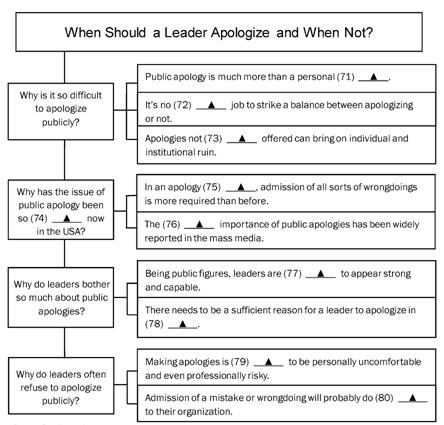
A recent study suggests that teens’ relationship with parents, friends and teachers may have a lot to do with why they don’t get a good night’s sleep.
David Maume, a sociologist and sleep researcher, analyzed federal health data, which interviewed 974 teenagers when they were 12, and then again at 15. He found that family dynamics (动态) have much to do with how well kids sleep. Teens, who had warm relations with their parents and felt like they could talk to them or their parents were supportive of them, tended to sleep better. However, families that were going through a divorce or a remarriage tended to affect teens’ sleep.
And problems at school also affected teens’ sleep. Feeling safe at school and having good relations with teachers tended to promote better sleep. As did good relationships with friends. Kids who took part in sports or other positive social activities or shared similar academic goals with their friends were also more likely to get a good night’s sleep.
These add up to what makes lots of sense: a general feeling of well-being helps teens sleep. If we’re happy and contented, we’re much more likely to sleep better than if we’re sad and anxious.
Now, of course, teens can hardly resist being drawn to their computers and social networking. Maume also found that when parents were strict not only about bedtime, but also about limiting technology, kids slept better. It’s a finding that seems obvious, but parents really do matter when it comes to health habits of their teenagers.
Clearly, teenagers aren’t getting 9 to 10 hours a night, which puts them at risk for all the consequences of lack of sleep, including poor academic performance, colds and stress.
1.What is the passage mainly about?
A. Teens’ sleep is linked to their relationship with people around them.
B. Lack of adequate sleep puts teens at risk of many bad consequences.
C. Modern technology has something to do with teens’ sleep problems.
D. It is necessary for teens to join in sports and positive social activities.
2.According to Maume’s analysis, who will probably have a poor night’s sleep?
A. Teens who feel like talking with their parents.
B. Teens who have friends sharing their dreams.
C. Teens who feel contented about themselves.
D. Teens who lack a sense of security at school.
3. Para 5 functions as .
A. a comparison B. an introduction C. a conclusion D. an addition
4. Parents are supposed to when their kids are growing up.
A. continue their broken marriage
B. allow children to decide when to sleep
C. limit teens’ using new technology
D. force teens to have 10 hours’ sleep daily
查看习题详情和答案>>