网址:http://m.1010jiajiao.com/timu3_id_2490958[举报]
It is not only experts in China who are arguing over whether women should work after marriage or not. Worldwide this question is being discussed as an interestingly large number of married women enter the workplace. Take the United States for example. Since 1960, the percentage of married women in the work force has jumped from 31.9 per cent to 59.4 per cent.
American women first moved into the paid labour force during the World War II, when men left their jobs to fight. In the last fifty years, more and more women have worked outside the home. And over these years of developing, Americans have changed their social values as a result. In 1975, women aged 35 and above made up half of all working women. And by 1980, 60 per cent were women at the age of 45 and above.
Now in Japan, women’s work group is M-shaped with middle-aged women and those aged 20-25 at the two peaks. According to statistics(统计), 37.7 per cent of Japanese women at childbearing age(25-29) still engaged themselves in work in 1980. and the number reached 50 per cent the next year.
Being a housewife has always been regarded as a “graceful occupation” in Japan. Some young Japanese women believe it is good to be a “ professional housewife”. However, old attitudes have been changing everywhere, and sometimes just out of economic necessary. In recent years, a great number of city housewives have poured out of homes to take part time jobs. Even the UN has given its support.. The 34th Congress of the United Nations in 1979 put forward the decision for formal agreement on the getting rid of discrimination(歧视) against women.
So far, most UN members have agreed on it, but some still haven’t, including the United States.
72. From the first passage, we can learn that ________________.
A. experts encourage women to take paying jobs .
B. men encourage women to take paying jobs
C. government encourage women to take paying jobs.
D. more and more people begin to care about women’s life
73. In the United States _________________.
- married women are lazier than their husbands.
- husbands are lazier than their wives
C. few married women used to work outside
D. more married women used to work outside
74. Married women in Japan________________.
A, all work outside their homes
B. seldom work outside their homes
C. have different opinions on their working outside
D. all do housework at their homes
75. More and more women have taken jobs outside for the reason that ________.
A. they have no children to take care of B. they have no housework to do
C. they want to make more friends. D. they want to improve their living conditions
查看习题详情和答案>>When I was a child I never said, "When I grow up, I want to be a CEO," but here I am. When I look back on my career, I realize the road to becoming a CEO isn't a straight, clearly clarified path. In fact, no two paths are the same.But whether you want to be a boss one day or not, there's a lot to learn from how leaders rise to the top of successful companies.
As this series of stories shows, the paths to becoming a CEO may vary, but the people in that position share the qualities of commitment, work ethic(守则)and a strong desire for building something new. And every CEO takes risks along the way — putting your life savings on the line to start a software company or leaving a big business to be one of the first employees at a startup.
I grew up in Minnesota, and learned how to be an entrepreneur(企业家)from my father, who has run a small business for almost 30 years. I went to Georgetown University and tried a lot of business activities in college with varying degrees of success. And I always had a dream job pattern: to walk to work, work for myself and build something for consumers.
I'm only 29, so it's been a quick ride to CEO.Out of college, I worked for AOL as a product manager, then moved to Revolution Health and ran the consumer product team.In mid-2007 I left Revolution Health and started LivingSocial with several other colleagues, where I became a CEO.
Career advice: Don't figure out where you want to work, or even what industry you'd like to work at.Figure out what makes you do so. What gives you a really big rush? Answer why you like things, not what you like doing...and then apply it to your work life. Also, just because you're graduating, don't stop learning. Read more books than you did in college. If you do, and they're not, you're really well-positioned to succeed in whatever you do.
60. What can we know from the first paragraph?
A. The author hasn't achieved his childhood ambition.
B. The author thinks there is some easy way to become a CEO.
C. The author had an ambition of becoming a CEO in his childhood.
D. The author believes success stories of CEOs can be beneficial to everybody.
61. According to the author, successful CEOs should ________.
A. try not to take risks B. stay in the same business
C. have a strong sense of creativity D. save every possible penny
62. What can we know about the author from the passage?
A. He started LivingSocial when he was still a student of Georgetown University.
B. His father had far-reaching influence on him.
C. His business activities at college ended up in more failure than success.
D. He used to run the consumer product team for AOL.
查看习题详情和答案>>The house was quiet at 5 a.m. and Tim’s mother was asleep. Only the sound of the big freezer broke the quiet. He’d dreamt of the cave last night. The purring (轻微颤动声) of the freezer had been the sea.
Tim pulled on a sweater and put some apples into his schoolbag. It was too early for breakfast. He’d eat after he’d been through the cave, sitting on the rocks and staring at the sea.
He wished he had a proper pack. His schoolbag would have to do. What else? Sandwiches ---but his mother might wake up if he started pulling out bread for sandwiches, she’d want to know why he had to leave so early. He settled for some biscuits, and left a note stuck to the table.
Gone to Michael’s Back tonight .Tim.
The sky was high and soft and light outside, though the sun still wasn’t up. Even the highway up the hill was quiet as he made his way down the street. The wind from the sea was fresh and sweet.
The sandhills still breathed heat from yesterday’s sun, though the top of the sand was cool. He ran down to the beach impatiently, but there was no one, just dry sand dancing in the early wind and seabirds marching up and down watching the waves.
The light changed suddenly. The first rays of sunlight stretched across the sea. The sun was pushing its way over the edge of the world.
Over the first rocks, along to the point, Tim glanced back. The beach was still empty. The sun sailed higher in the sky.
He could see the cave now, even darker in the morning light. The sand turned silver then dark gold as the water flowed away from it. He had to force himself to go closer. Why was it so much more mysterious now? But it would be silly to go back now after so much trouble. He needn’t go in all the way …
1.What did Tim do at the beginning of the story?
A.He left the house quietly B. He had breakfast at home.
C. He left a note on the freezer. D. He put a sweater in his schoolbag.
2."He settled for some biscuits” ( in Paragraph 3 ) means that Tim_______.
A. left home looking for some biscuits
B.felt like eating biscuits rather than sandwiches
C. had to take biscuits instead of sandwiches
D. could only find some biscuits in the kitchen
3.What made it possible for Tim to see the entry to the cave?
A. The height of the first rocks
B. The ups and downs of the waves
C. The change in the position of the sun
D. The vast stretch of the sunlit beach
4.Which of the following statements is TRUE according to the story?
A. The sea looked like a piece of gold.
B. Seabirds flew away when Tim arrived.
C. Tim was the only person on the beach.
D. The sky got dark as Tim reached the cave.
5.In the story, Tim’s mood changed from .
A. loneliness to craziness B. anxiousness to excitement
C. helplessness to happiness D. eagerness to nervousness
查看习题详情和答案>>
(2011·湖北卷)A
Honesty, my mum always used to tell me, is the best policy. Of course, this didin’t include her when she told me that if I didn’t eat all my vegetables Father Christmas would find out and wouldn’t give me any presents.
But when it comes to medicine, I had assumed it was important to always be honest with my patients. After all, the doctor patient relationship is based on trust, and therefore honesty is essential, Or so I thought.
I had just started working in geriatrics(老年病科). Mr. McMahon was brought in when his baby was faound very swollen. I took a medical history from his daughter would accompanied him in the ambulance. She’d been his main carer for years. I stood looking at him as she gave a detailed history. “Has he lost any weight recently?” I asked, “Well, it’s funny you should mention that, but yes.” She said slowly. There was silence for a few moments. “Why? What are you worried about?” she asked, I hesitated. She was obviously very involved in his care and it was only fair that I told her the truth. “Well, we need to prove it’s not cancer.” I said and talked briefly about some of the tests I was going to order.
Half an hour later, a nurse called me: “Mr. McMahon’s daughter broke down-she said you told her he had cancer.” My heart sank. By the time I arrived at the ward, my consultant was already there, explaining that we still had to run lots of tests and that it was by no means confirmed that he had cancer. I stood silently at the end of the bed. My consultant was obviously angry with me and as we left Mr. McMahon, she turned to me. “Why on carch did you do that?” she asked to disbelief. I looked at her andbit my hp. “She asked me what I was worried about and I told her.” I said, hanging my head. “And give her more to worry about?” replied my consultant. “You don’t say the word ‘cancer’ until it’s confirmed. Even if you suspect it, think very carefully before you tell people.”
As it turned out, it wasn’t cancer. But I did learn that when somecone is stressed and worried about their loved one they’re sometimes selective in what they hear-and as a doctor it’s important to be mindful of this. In being truthful, I’d made the situation worse.
51.The purpose of the first two paragraphs is to show that the author .
A. misunderstood the doctor-patient relationship
B. was anxious to receive Christmas gifts
C. regarded honesty as the best policy
D. had an unhealthy eating habit
52.The author’s consultant was angry with him because .
A. he told the daughter what he suspected.
B. he delayed running the necessary tests.
C. he failed to confirm the parent’s disease.
D. he forgot what the consultant had advised.
53.The author hung his head (the underlined part in Para.4) because he was feeling .
A. guilty
B. hurt
C. disappointed
D. helpless
54.What lesson has the author learnt from his experience?
A. Learning form parents is necessary.
B. Jumping to a conclusion is dangerous.
C. Telling the truth may not always be the best solution.
D. Selecting pleasant words may not be the perfect policy.
查看习题详情和答案>>
The house was quiet at 5 a.m. and Tim’s mother was asleep. Only the sound of the big freezer broke the quiet. He’d dreamt of the cave last night. The purring (轻微颤动声) of the freezer had been the sea.
Tim pulled on a sweater and put some apples into his schoolbag. It was too early for breakfast. He’d eat after he’d been through the cave, sitting on the rocks and staring at the sea.
He wished he had a proper pack. His schoolbag would have to do. What else? Sandwiches ---but his mother might wake up if he started pulling out bread for sandwiches, she’d want to know why he had to leave so early. He settled for some biscuits, and left a note stuck to the table.
Gone to Michael’s Back tonight .Tim.
The sky was high and soft and light outside, though the sun still wasn’t up. Even the highway up the hill was quiet as he made his way down the street. The wind from the sea was fresh and sweet.
The sandhills still breathed heat from yesterday’s sun, though the top of the sand was cool. He ran down to the beach impatiently, but there was no one, just dry sand dancing in the early wind and seabirds marching up and down watching the waves.
The light changed suddenly. The first rays of sunlight stretched across the sea. The sun was pushing its way over the edge of the world.
Over the first rocks, along to the point, Tim glanced back. The beach was still empty. The sun sailed higher in the sky.
He could see the cave now, even darker in the morning light. The sand turned silver then dark gold as the water flowed away from it. He had to force himself to go closer. Why was it so much more mysterious now? But it would be silly to go back now after so much trouble. He needn’t go in all the way …
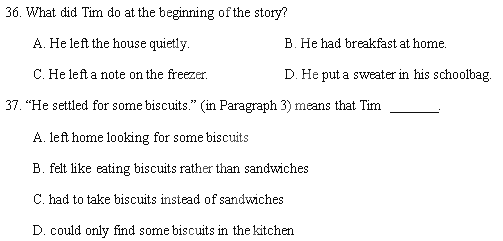
38. What made it possible for Tim to see the entry to the cave?
A. The height of the first rocks. B. The ups and downs of the waves.
C. The change in the position of the sun. D. The vast stretch of the sunlit beach.
39. Which of the following statements is TRUE according to the story?
A. The sea looked like a piece of gold.
B. Seabirds flew away when Tim arrived.
C. Tim was the only person on the beach.
D. The sky got dark as Tim reached the cave.
40. In the story, Tim’s mood changed from .
A. loneliness to craziness B. anxiousness to excitement
C. helplessness to happiness D. eagerness to nervousness
查看习题详情和答案>>