网址:http://m.1010jiajiao.com/timu3_id_2483385[举报]
完形填空
All kinds of people came in to have their shoes shined. Most folks were friendly. But this man was different.
“How much do you make a week, boy?”he asked me. I felt he was __1__ at me.
He kept giving a sharp __2__ around every now and then. All the time I kept __3__ where I'd seen his face. Suddenly I knew. I'd seen his __4__ in the post office many times. He was the big robber: __5__ by the police in three states!
“You know, ”he was saying,“it's imagination people __6__. You'll never get anywhere as a shoeshine boy.”
I kept brushing on his shoes as __7__ as I could. The sooner I finished, the better. He said,“When I was sixteen, I had __8__ $ 2 500 of my own.”
That reminded me of something. Was it $ 2 500 or $ 5 000 or $ 25 000? I wasn't __9__. I knew a big reward was __10__ for him.
But what could I do about it? __11__ him with a can of shoe polish(擦亮剂)? A man his __12__ could grind(压碎)me into the floor. If only someone would come in! He kept talking away(喋喋不休).“Along with __13__, it takes courage. The courage to take a chance. Start something on a shoestring(鞋带).”
Suddenly I saw Officer Dailey __14__ across the street. Then, real fast, I began tightening the man's shoestrings.
The policeman was at the window when I cried out,“Officer Dailey, __15__! This man's a robber.”
“__16__,”the man shouted angrily. He started to jump off the stand. But he didn't go the __17__ he planned. He fell flat on his face and knocked himself out cold.
“That was __18__ clever of you,”the officer said. “You'll get a reward of $ 7 500 for him.”
“Well, it really wasn't my __19__,”I said.“It was his. He told me that __20__ you had courage and imagination, you could start something big on a shoestring.”
|
(1)A.staring |
B.glaring |
C.laughing |
D.pointing |
|
(2)A.look |
B.walk |
C.word |
D.tongue |
|
(3)A.considering |
B.remembering |
C.caring |
D.wondering |
|
(4)A.notice |
B.picture |
C.mail |
D.warning |
|
(5)A.wanted |
B.searched |
C.caught |
D.shown |
|
(6)A.respect |
B.treasure |
C.lack |
D.wish |
|
(7)A.carefully |
B.showly |
C.well |
D.fast |
|
(8)A.made |
B.stolen |
C.borrowed |
D.gathered |
|
(9)A.curious |
B.sure |
C.interested |
D.clear |
|
(10)A.afforded |
B.offered |
C.suggested |
D.received |
|
(11)A.Injure |
B.Warn |
C.Hit |
D.Avoid |
|
(12)A.size |
B.age |
C.height |
D.kind |
|
(13)A.money |
B.support |
C.cleverness |
D.imagination |
|
(14)A.wandering |
B.leaving |
C.coming |
D.speeding |
|
(15)A.help |
B.danger |
C.stop |
D.attention |
|
(16)A.Mind you |
B.Shut up |
C.Hurry up |
D.Hands up |
|
(17)A.method |
B.position |
C.manner |
D.way |
|
(18)A.pretty |
B.much |
C.very much |
D.too much |
|
(19)A.business |
B.idea |
C.reward |
D.praise |
|
(20)A.unless |
B.that |
C.whether |
D.if |
He lived his whole life as a poor man He suffered from a mental illness that led him to cut off part of his left ear in 1888 and to shoot himself two years later. But after his death, he achieved the world fame.
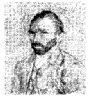
* And the Van Gogh Museum in Amsterdam, home to the biggest collection of his masterpieces, is marking the anniversary with exhibitions throughout the year.
“He is a big fame like Einstein and Beethoven. He is such a great figure. We are always amazed by how popular he is and his popularity seems to be growing.” said Andreas Bluehm, the museum's head of exhibitions.
Van Gogh was the son of a pastor. He left school when he was just 15. By the age of 27, he had already tried many jobs including an art gallery salesman and a French teacher. Finally in 1880, he decided to begin his studies in art.
“Instead of trying to reproduce exactly what I have before my eyes. I use colour more freely, in order to express myself more forcibly,” he wrote in a letter to his brother, Theo, in 1888.
Van Gogh sold only one painting during his short life. But now his works are sold for millions of dollars. His “Portrait of Dr. Gachet” was sold for US  89.5 million in 1990. It is the highest price ever paid for a painting.
1.The second paragraph mainly tells us that ________.
[ ]
A.the Van Gogh Museum is located in Amsterdam
B.the Van Gogh Museum has the biggest collection of Van Gogh'smasterpieces
C.exhibitions will be held in honor of Van Gogh
D.the Van Gogh Museum will hold exhibitions the whole year through for Van Gogh
2.The underlined word “figure” in the third paragraph means “________”.
[ ]
3.The writer cited a part of a letter written by Van Gogh to show Van Gogh's ________.
[ ]
4.Choose the right order of the given events.
a.He worked as a French teacher.
b.He achieved the world fame.
c.He left school. d. He cut off his left ear.
e.He shot himself. f. He began studies in art.
[ ]
It was eleven o'clock that night when Mr. Pontellier returned from his night out. He was in an excellent humor, in high spirits, and very talkative. His entrance awoke his wife, who was in bed and fast asleep when he came in. He talked to her while he undressed, telling her anecdotes and bits of news and gossip that he had gathered during the day. She was overcome with sleep, and answered him with little half utterances.
He thought it very discouraging that his wife, who was the sole object of his existence, showed so little interest in things which concerned him and valued so little his conversation.
Mr. Pontellier had forgotten the candies and peanuts that he had promised the boys. Still, he loved them very much and went into the room where they slept to take a look at them and make sure that they were resting comfortably. The result of his investigation was far from satisfactory. He turned and shifted the youngsters about in bed. One of them began to kick and talk about a basket full of crabs.
Mr. Pontellier returned to his wife with the information that Raoul had a high fever and needed looking after. Then he lit his cigar and went and sat near the open door to smoke it.
Mrs. Pontellier was quite sure Raoul had no fever. He had gone to bed perfectly well, she said, and nothing had made him sick. Mr. Pontellier was too well familiar with fever symptoms to be mistaken. He assured her the child was burning with fever at that moment in the next room.
He reproached his wife with her inattention, her habitual neglect of the children. If it was not a mother's place to look after children, whose on earth was it? He himself had his hands full with his business. He could not be in two places at once; making a living for his family on the street, and staying home to see that no harm done to them. He talked in a dull, repeated and insistent way.
Mrs. Pontellier sprang out of bed and went into the next room. She soon came back and sat on the edge of the bed, leaning her head down on the pillow. She said nothing, and refused to answer her husband when he questioned her. When his cigar was smoked out, he went to bed, and in half a minute was fast asleep.
Mrs. Pontellier was by that time thoroughly awake. She began to cry a little, and wiped her eyes on the sleeve of her nightdress. She went out on the porch, where she sat down and began to rock herself in the chair.
It was then past midnight. The cottages were all dark. There was no sound except the hooting of an old owl and the everlasting voice of the sea, which broke like a mournful lullaby (催眠曲) upon the night.
The tears came so fast to Mrs. Pontellier's eyes that the damp sleeve of her nightdress no longer served to dry them. She went on crying there, not caring any longer to dry her face, her eyes, her arms.
She could not have told why she was crying. Such experiences as had just happened were not uncommon in her married life. They seemed never before to have weighed much against theabundance (充足) of her husband's kindness and a uniform devotion which had come to be self-understood.
An indescribable oppression, which seemed to generate in some unfamiliar part of her consciousness, filled her whole being with vague pain. It was like a shadow, like a mist passing across her soul's summer day. It was strange and unfamiliar; it was a mood. She did not sit there inwardly scolding her husband, expressing sadness about Fate, which had directed her footsteps to the path which they had taken. She was just having a good cry all to herself.
The mosquitoes succeeded in driving away a mood which might have held her there in the darkness half a night longer.
The following morning Mr. Pontellier was up in good time to take the carriage which was to convey him to the ship. He was returning to the city to his business, and they would not see him again at the Island till the coming Saturday. He had regained his calmness, which seemed to have been somewhatweakened the night before. He was eager to be gone, as he looked forward to a lively week in the financial center.
1.Mr.Pontellier comes back home from his night out in a/an ______state of mind.
A.excited B.confused C.depressed D.disappointed
2. Mr. Pontellier criticizes his wife because ______.
A.she is not wholly devoted to her children
B.she does little housework but sleep
C.she knows nothing about fever symptoms
D.she fails to take her son to hospital
3.The writer would most likely describe Mr. Pontellier’s conduct during the evening as ______.
A.impatient and generous B.enthusiastic and responsible
C.concerned and gentle D.inconsiderate and self-centered
4.The underlined sentence suggests that Mr. Pontellier's complaints to his wife are ______.
A.hesitant and confused B.not as urgent as he claims
C.angry and uncertain D.too complex to make sense
5.In paragraphs 8 to 13, Mrs. Pontellier’s reactions to her husband’s behavior suggest that ______.
A.she accepts unquestioningly her role of taking care of the children
B.this is one of the first times she has acknowledged her unhappiness with her husband
C.her relationship with her husband is not what has made her depressed
D.she is angry about something that happened before her husband left
6.The passage shows Mr. Pontellier is happiest when he ______.
A.sits near the open door smoking a cigar and talking
B.makes up with his wife after a heated argument
C.has been away from home or is about to leave home
D.has given his children gifts of candies and peanuts
查看习题详情和答案>>
[1]A long time ago, there was an Emperor who told his horseman that if he could ride on his horse and cover as much land area as he liked, then the Emperor would give him the area of land he covered. Sure enough, the horseman quickly jumped onto his horse and rode as fast as possible to cover 78 . He kept on riding and riding, whipping the horse to go as fast as possible. When he was hungry or tired, he did not stop because he wanted to cover as much area as possible. Finally he came to a point when he had covered a substantial area and he was exhausted and was dying. Then he asked himself, "Why did I push myself so hard to cover so much land area? Now I am dying and I only need a very small area to bury myself."
[2]The above story is similar with the journey of our Life. We push very hard everyday to make more money, to gain power and recognition. We neglect our health, time with our family and to appreciate the surrounding beauty and the hobbies we love.
[3]One day when we look back, we will realize that we don't really need that much, but then we cannot turn back time for what we have missed.
[4]Life is not about making money, acquiring power or recognition. Life is definitely not about work! work is only necessary to keep us living so as to enjoy the beauty and pleasures of life. Life is a balance of work and play, family and personal time. You have to decide how you want to balance your Life. Define your priorities, realize what you are able to compromise but always let some of your decisions be based on your instincts. Happiness is the meaning and the purpose of life, the whole aim of human existence.
[5]So, take it easy, do what you want to do and appreciate nature. Life is fragile, Life is short. Do not take life for granted. Live a balanced lifestyle , and enjoy life!
1.What is the passage mainly about? (no more than 8 words)
____________________________________________________________
2.Complete the following statement with words from Paragraph3.(no more than 5 words)
It is too late to regret ______ when we realize we have wasted so much time on what we really don’t need.
3.Fill in the blank in Paragraph 1 with proper words. (no more than 8 words)
______________________________________________________________
4.List one of the suggestions that the author gives for our life. (no more than 12 words)
______________________________________________________________
5.What does the words “he”(Line 1, Paragraph 1) probably refer to? (no more than 3 words)
查看习题详情和答案>>