网址:http://m.1010jiajiao.com/timu3_id_2482786[举报]
根据短文内容,从下框的选项中选出能概括每一段主题的最佳选项.选项中有一项为多余项.(涂卡时,E涂AB,F涂AC)
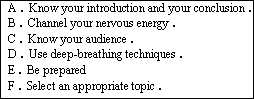
How you calm yourself before giving a speech?Both modern research and centuries of experience from experienced public speakers suggest some practical advice.
1.________
Know to whom you'll be speaking, and learn as much about your audience as you can.The more you can anticipate the kind of reaction your listeners will have to your speech, the more comfortable you'll be in delivering your message.Be audience-centered rather than speaker-centered.
2.________
You will feel less nervous if you talk about something you are familiar with or have some personal experience of.Your comfort with the subject of the speech will be reflected in your delivery.
3.________
The better prepared you are, the less anxiety you will experience.Being prepared means that you have researched your topic and practiced your speech several times before you deliver it.
4.________
You are likely to feel the most anxious during the opening moments of your speech.Therefore, it is a good idea to have a clear plan for how you will start your speech.Being familiar with your introduction will help you feel more comfortable about the entire speech.If you know how you will end your speech, you will have a safe harbour in case you lose your place.If you need to end your speech ahead of time, a well-delivered conclusion can permit you to make a graceful exit.
5.________
One of the symptoms(症状)of nervousness is a change in your breathing and heart rates.Nervous speakers tend to take short, shallow breaths.To help break the anxiety-reduce breathing pattern, consider taking a few slow deep breaths before you rise to speak.
What do Chinese college graduates have in common with ants? The recent 36 Ant Tribes about the life of some young people 37 flock (群集) to Beijing after 38 university,describes the graduates,like ants,as smart but 39 as individuals,drawing strength from living together in communities.
The book,which is based 40 two years of interviews with about 600 low-income college graduates in Beijing, 41 in mid-September,about a month ahead of an announcement by the Ministry of Human Resources and Social Security that 74% of the 6.11 million new graduates from universities and colleges had been 42 by Sept.1.
The book’s chief editor,Lian Sir,tells that piece of statistic says 43 about the real situation for many of these graduates.“I am always 44 how many of these employed college graduates are leading a happy life,” Lian said.“I hope this book could offer a window on these graduates,whose stories are 45 known.”
The setting of the book is several so-called “settlement villages for college students” in the outskirts (市郊) of Beijing,where a large 46 of college graduates 47 .Most of these graduates work for 48 or medium-sized businesses, 49 less than 2,000 Yuan a month.They live together because it’s 50: The rent in these communities is only around 350 Yuan a month.Many of them travel several hours a day for short-term jobs or job interviews.
Tangjialing,a small 51 20 kilometers from Tian’anmen Square,has around 3,000 52 villagers,but has become a 53 for more than 50,000 migrants (移民),most of whom 54 from universities or colleges all over the country.Lian describes the students’ 55 as five or six-storey buildings built by local farmers with 12 rooms on each floor and two or three people crammed (挤) together in each room of about 10 square meters.Up to 70 or 80 people share the same toilet and kitchen.
36.A.film B.story C.book D.magazine
37.A.who B.what C.which D.whose
38.A.leaving B.entering C.visiting D.enjoying
39.A.necessary B.meaningless C.important D.strong
40.A.in B.on C.at D.for
41.A.came up B.came on C.came along D.came out
42.A.fired B.interviewed C.employed D.trained
43.A.much B.little C.some D.more
44.A.wondering B.researching C.studying D.telling
45.A.seldom B.well C.always D.often
46.A.deal B.plenty C.amount D.number
47.A.work B.go C.relax D.live
48.A.small B.big C.famous D.unknown
49.A.earning B.thinking C.shopping D.paying
50.A.expensive B.comfortable C.cheap D.convenient
51.A.city B.town C.community D.village
52.A.original B.young C.rich D.poor
53.A.school B.hotel C.home D.company
54.A.come B.differ C.graduate D.suffer
55.A.lives B.dormitories C.buildings D.restaurants
查看习题详情和答案>>
Fear can be fun. Many young people queue up to ride very fast and scary roller coasters, screaming but enjoying themselves. Other people like to read “goose bumps (鸡皮疙瘩)” books or watch horror movies at night, scared to death but feeling excited. Why do people like being scared?
Fear is an ancient way of surviving. Being scared makes animals, including humans escape from danger and save themselves. It is because of fear that we have lived through millions of years of evolution. Those who lacked a strong fear response were more likely to be killed, leaving the more fearful and careful to pass their genes onto the next generation.
How do scientists explain why shaking over such scary things is fun? “Some kids will go to a scary movie and love it and laugh over it, others will feel anxious and hide their faces and some won’t even set foot in the cinema,” said Ned Kalin, a US scientist. “Which kind of person you are depends partly on experiences you’ve had and partly on your genes.”
What happens in the brain when something frightens you? Nerves that begin at the eyes and ears lead to a part of the brain called the amygdale. When you suddenly see a snake, for example, the amygdale makes you freeze, sweat, have a quickened heartbeat, or run very fast. However, seeing the snake also uses another part of the brain, the cortex. It analyzes the situation, and if it finds that the snake is only made of rubber it tells your heart and the rest of your body to calm down. Think of the amygdale as the engine and the cortex as the brake.
Back to the first question: Why do some people like to make themselves scared? “One reason is that we can play games with fear, find ways to reduce the scariness by looking away or thinking of something else,” Kalin said. “To believe we have control over a situation gives us a feeling of power.” “Scary movies or novels are good practice to prepare young people for the real thing. Thrills such as roller coaster rides also go to the brain’s pleasure centre.”
And there might be some evolutionary advantage to being able to adjust this system that is there to protect people.
72. How many questions are answered in the passage?
A. 2. B. 3. C. 4. D. 5.
73. Some people like to be scared because______.
A. they are afraid that the fear genes will be passed onto their children
B. it’s a good practice to get prepared for the real frightening situation
C. it can help them show their own personalities
D. they will feel powerful after getting rid of fear
74. Which of the following is true about the people who are not easily scared?
A. Their cortex is better at analyzing the situations.
B. They are more likely to suffer from potential danger.
C. They are born unaffected by anything horrible.
D. They lack a strong response towards threat.
75. What is the best title of the passage?
A. Ready to scream? B. How to be scared?
C. Willing to shake? D. Why to be scared?
查看习题详情和答案>>However, the two James were different. They were separated from one another and adopted by different families, called Lewis and Springer, a few weeks after they were born and they did not meet until after 39 years.
When the scientists at Minnesota learnt about the two James, they were naturally invited to come to the University, where investigations revealed the most astonishing similarities about their lives:
* Both married girls called Linds, were divorced and then married women called, Betty.
* Both owned dogs called Toy when they were boys.
* Both had worked for the hamburger chain, McDonald's, and at filling station.
* Both had the habit of biting their fingernails.
* Both have similar sleeping problems.
How can one attempt to explain so many coincidences? Is it possible that twins have some mysterious way of communicating? Or does our gene make us take particular decisions in certain circumstances? In any case, it seems that many more aspects of our behavior are influenced by genetic factors than we had previously imagined.
1. What was the piece of good fortune the scientists enjoyed recently?
A The James twins would accept the invitation to the University.
B The James twins met with each other after 39 years' separation.
C The scientists found many interesting cases about twins.
D The scientists discovered a special pair of long-separated twins.
2. Why were the two James different from other twins according to the passage?
A. They shared a lot of similarities.
B. They lived in different families for a long time.
C. They both worked in the hamburger chain.
D. Their parents died when they were very young.
3. The word "coincidence" (Para.4) may mean things that ______.
A. happen around the same time by chance B. astonish people
C. are likely to cause accidents D. are very funny
4. The two James share all of the following similarities except that
A. both married twice
B. both had at least two jobs
C. both suffered from the same disease
D.both kept dogs when they were children
查看习题详情和答案>>
读写任务 (共1小题,满分25分)
阅读下面的短文,然后按照要求写一篇150词左右的英语短文。
A Little Hero
A group of Italian soldiers led by a captain were advancing slowly toward the position of the enemy. They arrived at a farmhouse, in front of which sat a small boy, cutting a branch of a tree with his knife.
"What are you doing here?" asked the captain. "Why didn't you leave with your family?"
"I don't have any family," said the boy. "I'm an orphan. I used to work  for the family that lived here. They've gone, but I stayed in order to see the fighting."
"Have you seen any Austrians pass by here?"
"Not within the last three days."
"Do you think you could climb that tree and tell me whether you see anything of the Austrians in the distance?"
"Sure!"
In a few minutes the boy was at the top of the tree.
"Look straight ahead," cried the captain, "and tell me what you see."
"Two men on horseback - nothing else."
"How far away?"
"About a mile and a half. They're standing still." ….
"They're shooting at me," said the boy. "but don't worry. Let me tell you what's to the left. Well, there's a church and I think I see... "
A third bullet passed, and the boy was seen to fall suddenly from the tree, dead.
"Poor boy!" said the captain, covering the boy's body with a national flag and saying, "He died like a soldier and we must bury him like a soldier."
Soon it was covered with flowers. He gave his life to his country.
【写作内容】
学校最近组织了一次中美学生交流活动,你参加其中的“童年生活”讨论。听完Joe讲的故事“A Little Hero”之后,你准备写一份发言稿,题目是“After Listening to ‘A Little Hero’”,内容要点包括:
1. 以约30个词概括你听完A Little Hero的故事;
2. 然后以约120个词谈谈你的童年生活,内容包括:
(1) 对自己童年生活的感受;
(2) 你的童年以及现在的生活和故事中那位小英雄的童年生活有什么不同?
(3) 作为一位高中学生,你未来的理想是什么?
【写作要求】
1. 在作文中可以使用自己亲身的经历或虚构的故事,也可以参照阅读材料的内容但不得直接引用原文中的句子;
2. 作文中不能出现真实姓名和学校名称。
【评分标准】
概括准确,语言规范,内容合适,篇章连贯。