网址:http://m.1010jiajiao.com/timu3_id_2480716[举报]
根据对话内容,从对话后的选项中选出能填入空白处的最佳选项,选项中有两项多余选项.
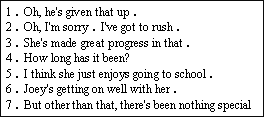
-Well, Bob, what a surprise! It's nice to see you again!
-Hello, Ann!________ 61 ________ Wasn't it a year ago, the last time we saw you?
-You know, I think you are right.How are your wife and the children?
-Oh, they're fine.Billy fell down and broke his leg a few months ago.________ 62 ________
-Wasn't Joey learning to play the violin? Seems to me I remember something about that.
-________ 63 ________ He's all excited about sports now.
①And your wife, what is she doing these days?
②She is going to a night school on Mondays and Thursdays.She's studying French now.But last year she studied typing and sewing.________ 64 ________ Next it'll probably be cooking.
③How nice for her!________ 65 ________ But say hello to Mrs James for me, will you?
④Sure I will, and remember me to your husband.Gookbye.
You must have been troubled by when to say "I love you" because it is one of the greatest puzzles in our life.
What if you say it first and your partner doesn’t love you back? Or if they do say it but you don’t feel they mean it? Being the first to declare your love can be never racking (紧张) and risky and can leave you feeling as vulnerable as a turtle with no shell. But is the person who says it first really in a position of weakness? Doesn’t it pay to hold back, play it cool and wait until the other half has shown their hand faster?
“A really good relationship should be about being fair and being equal,” says psychologist Sidney Crown. “But love is seldom equal.” “All relationships go through power struggles but,” he says, “if a love imbalance continues for years, the rot will set in.” That feeling of “I’ve always loved you more” may be subverted (颠覆,破坏) for a time, but it never goes away completely and it often emerges in squabbling (大声争吵). In love, at least, the silent, withholding type is not always the most powerful. “The strongest one in a relationship is often the person who feels confident enough to talk about their feelings,” says educational psychologist Ingrid Collins. Psychosexual therapist Paula Hall agrees. "The one with the upper hand is often the person who takes the initiative.” In fact, the person who says “I love you” first may also be the one who says “I’m bored with you’ first.” Hall believes that much depends on how "I love you" is said and the motivation of the person saying it. Is it said when they’re drunk? Is it said before their partner flies off on holiday, and what it really means is “Please don’ t be unfaithful to me” ? By saying “I love you”, they are really saying “Do you love me?” If so, wouldn’t it just be more honest to say that. Collins agrees that intention is everything. "It’s not what is said, but how it’s said. What it comes down to is the sincerity of the speaker.”
What is the main idea of this passage?
A. The importance of "I love you" B. The meaning of "I love you"
C. The time of saying "I love you". D. The place of saying "I love you"
In the first sentence the author means that____________.
A. it is easy to say "I love you"
B. it is hard to say "I love you"
C. we have many troubles in our life
D. people usually do not know when to say "I love you"
According to the expert, a good relationship should be _____________.
A. fair and equal B. fair and kind
C. powerful and equal D. confident and fair
In the third paragraph, the phrase "with the upper hand" means __________.
A. being low in spirit B. having only one hand
C. being active D. being passive
What is the most important for you to consider when somebody say "I love you" to you?
A. The intention. B. The place. C. The time. D. The determination.
查看习题详情和答案>>The editor must never forget that the success of any newspaper depends on advertising. He is usually anxious to keep the good will of local businessmen for this reason. But if the newspaper is well written and the news items have been carefully chosen to attract local readers, the businessmen are thankful for the opportunity to keep their products in the public eye.
Local newspapers do not often comment on problems of national importance and editors rarely take sides on political questions. But they can often be of service to the community in expressing public feeling on local issues. A newspaper can sometimes persuade the council to take action to provide better shopping facilities, improve transport in the area and preserve local monuments and places of interest.
These papers often sound rather dull and it seems surprising that they all make a profit, but for many people in small towns and villages the death of someone known to them or the fix of traffic lights at a busy corner nearby can sometimes be more important than a disaster in a foreign country.
1. What should the editor remember according to the first paragraph?
A. Money. B. Newspaper.
C. People. D. Advertising.
2. What is the local newspapers' attitude on national political questions?
A. They seldom have their own ideas.
B. They often express their ideas.
C. They are against one side.
D. They are for another side.
3. Do businessmen like the local newspapers?
A. No, they are for business.
B. Yes, from the advertising on the newspapers they can sell well.
C. Yes, they can write for the newspaper.
D. No, they can't get much money from the newspaper.
4. A local newspaper can persuade the council ________.
A. to provide better shopping facilities
B. to preserve local monuments
C. to improve transport in the area
D. all above
查看习题详情和答案>>
There are two types of people in the world.Although they have equal degree of health and wealth and other comforts of life, one becomes happy, while the other becomes unhappy.This arises from the different ways in which they consider things, persons, events and the resulting effects upon their minds.
People who are to be happy fix their attention on the convenience of things: the pleasant parts of conversation, the well prepared dishes, the goodness of the wine and the fine weather.They enjoy all the cheerful things.Those who are to be unhappy think and speak only of the opposite things.Therefore, they are continually dissatisfied.By their remarks, they sour the pleasure of society, offend(hurt) many people, and make themselves disagreeable everywhere.If this turn of mind was founded in nature, such unhappy persons would be the more to be pitied.The intention of c riticizing and being disliked is perhaps taken up by imitation.It grows into a habit, unknown to its possessors.The habit may be strong, but it may be cured when those who have it realize its bad effects on their interests and tastes.I hope this little warning may be of service to them, and help them change this habit.
Though in fact it is chiefly an act of the imagination, it has serious results in life since it brings on deep sorrow and bad luck.Those people offend many others; nobody loves them, and no one treats them with more than the most common politeness and respect.This frequently puts them in bad temper and draws them into arguments.If they aim at getting some advantages in social position or fortune, nobody wishes them success.Nor will anyone start a step or speak a word to favor their hopes.If they bring on themselves public objections, no one will defend or excuse them, and many will join to criticize their wrong doings.These should change this bad habit and be pleased with what is pleasing, without worrying needlessly about themselves and others.If they do not, it will be good for others to avoid any contact with them.Otherwise, it can be disagreeable and sometimes very inconvenient, especially when one becomes mixed up in their quarrels.
Title: About Two Types of People
| Types of People | Differences | (71)___________________ | |
| The happy | Fixing their attention on the (72)__________ of things | Equal degree of health and wealth and other (73) of life | |
| The unhappy | Think and speak only of the (74) things. | ||
|
(75) about the unhappy | Situation | (77) | (79) ____ |
| Souring the pleasure of society | ●Growing into a habit ●Having bad effects on their interests and tastes ●Nobody loves them ●No one treats them with politeness and (78) | ●Change this bad (80) _______ ●Be pleased with what is pleasing ●Don’t worry needlessly about themselves and others | |
| (76) many people | |||
| Making themselves disagreeable | |||
查看习题详情和答案>>
阅读下面短文,按照句子结构的语法性和上下文连贯的要求,在空格处填入一个适当的词或使用括号中词语的正确形式填空,并将答案填写在答题卡标号为31—40的相应位置上。
I had an unusual conversation with a woman about physical limitations. Nancy suffered 53 a serious disease and she could no longer walk. She spent her 54 (wake) hours in a wheelchair.
“I’m not ‘confined (限制)’ to a wheelchair,” she insisted one day. “It doesn’t confine me but 55 (set) me free.”
She asked me, “Do you want to know 56 reason for living?”
“What is it?” I wondered.
“To liberate people. To set them free. Before I got my wheelchair,” she explained, “I had trouble getting around. Now I can go places! However I can free people, I want to do 57 .”
“People speak of being ‘shut in,’” she continued. “People 58 are confined to a room or a house or a bed are not ‘shut in.’ They’re ‘shut out’ – shut out of activities and shut out of people’s lives. So my aim is to liberate people, to set them free, however I can.”
Because of her disease, Nancy now helps people find ways of gaining more physical 59 (free).
Listen to these words from Darwin P. Kingsley: “You have powers you never dreamed 60 . You can do things you never thought you 61 do. There are no limitations in 62 you can do except the limitations of your own mind.”
查看习题详情和答案>>