网址:http://m.1010jiajiao.com/timu3_id_2442779[举报]
My interest in Chinese food started many years ago, when I had my first job. I was a young reporter for the Daily Journal in San Francisco. Our office wasn’t far from Chinatown. I usually managed to arrange my time so that I could go there at least two or three times a week for a good meal.
The first time I ever ate Chinese food I loved it. And since then, it just tastes better and better to me. The first thing I noticed was the fresh tastes of the meat and vegetable. When I learned more about the food, I began to understand why it has this special feature.
About 5000 years ago, China lost much of its wood because of over population and poor management of its forest. This loss was very bad for the country, of course, but it turned out to be very good for the food. Wood became very expensive and hard to get, so the Chinese had to learn how to use it better.
In order to use less wood in cooking, they started to cut their meat and vegetables into small pieces before they put them in the hot oil. That way, the food cooked faster and they saved their fuel. The food prepared in this manner kept its fresh flavor(风味)—and it’s this flavor that attracts people to the art of Chinese cooking.
I often wonder if the Chinese appreciated their solution to that ancient energy problem as much as I do now –whenever I eat Chinese food.
【小题1】This passage is mainly about _________.
| A.why Chinese food tastes fresh |
| B.what Chinese food tastes like |
| C.how Chinese food is cooked |
| D.what makes Chinese food special |
| A.when he worked as a reporter in China |
| B.from a news story in the Daily Journal |
| C.after he got a taste of it in the Chinatown |
| D.before he got his first job in San Francisco |
| A.keeping its fresh flavor |
| B.saving their hard-to-get wood |
| C.producing a different kind of food |
| D.attracting westerners to their food |
| A.fresh flavor | B.meat and vegetable | C.hot oil | D.firewood |
| A.the wood used to make the cooking fire |
| B.the fast speed (速度) at the cooking |
| C.the high quality of Chinese meat and vegetable |
| D.the well-developed art of Chinese cooking |
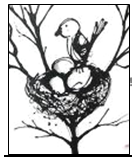
Oriole’s Nest
Picky, Picky
Scientists have no idea exactly why birds choose certain objects to build their nests. But scientists know that the main reason birds build nests is to keep their babies safe, warm and healthy.
Baby birds grow faster and are healthier when they are warm. They also learn to fly and leave the nests sooner than birds without warm homes.
What A Yarn (纱)
Yarn is big on an oriole’s shopping list during nest building. Scientists are still trying to work out why so many birds choose white yarn over other colors for nest building.
Scientists think that the white objects remind birds of cotton fluff (绒毛) they find in the wild.
Do It Naturally
Even though birds can help us recycle some of our junk by using it to build nests, they also need to use lots of natural things. Long grass, dried sticks, spider’s silk and mud are some of the natural ingredients that are good for nests, too.
You can make a collection box of things to leave for birds so they can help themselves. Hang a small plastic box with holes on a tree branch. Fill the box freely with nest building goodies. Hang the box on a tree and watch birds climb on board to pick through the junk to find their treasures.
Warning: Don’t let the birds turn into a tasty treat. Keep your bird station away from places where cats hang out.
For The Birds!
Stop! Don’t throw all that garbage out! Give some to the birds. Look and see how your old junk can help beautify and warm a bird’s new home.
【小题1】The baby birds with warm homes are able to _____.
| A.choose right objects | B.leave the nests sooner |
| C.build good nests | D.learn to fly higher |
| A.Holes on the tree. | B.Food out of the rubbish. |
| C.A warning board. | D.A collection box of things. |
| A.Birds build nests to store things. |
| B.Birds regard white objects as cotton. |
| C.Birds and humans can help each other. |
| D.Birds and cats fight against each other. |
根据句意和汉语提示写出单词,完成句子。
【小题1】 (母亲)Day is on the second Sunday of May.
【小题2】Teachers are usually (严格的) with their students in class.
【小题3】Tom’s (到达) made all of us very excited.
【小题4】Trains (在……之间)cities run faster and faster now.
【小题5】Ang Lee won an Oscar for Best (导演)for the film Life of Pi
Train-spotting
Many people around the world have seen Danny Boyle’s movie Train spotting starring Ewan McGregor, but how many of us really know what train-spotting is all about? Now this is not considered cool in town and the word “train-spotter” in Britain is related to “geek” or “nerd” (someone who seems very ridiculous). But is this reputation really deserved?
First of all, let’s see what train-spotting is. It is said that there are some 100,000 train spotters in the UK. Exactly as the title suggests, they spot trains, that is, they stand in train stations, look at the number of each train that leaves and arrives and write it down. The eventual aim is to have seen every train in the country.
Being crazy about railways and trains is not modern and it dates back to 1804. As the number of trains grew and they got faster and faster, so did the interest in them grow? Is this any stranger than people who love cars?
So, what do you need to be a train-spotter? Well, all you really need is a pen or pencil and a notebook to write down the train numbers. Other equipment(装备) includes hot tea in a thermos, a camera and some sandwiches for those long afternoons spent on train platforms when you don’t want to risk the delights of railway station food.
It’s interesting to note that despite the “bad name” of train-spotting, there have been famous railway lovers in history, such as Alfred Hitchcock, who filmed them regularly, especially The 39 Steps. There is evidence, too, that being a train-spotter is not necessarily a strange phenomenon(现象)in Britain.
One glance at the US train stations should be enough to convince you that train-spotters there are alive and well. In America, they try to call rail lovers “train-fans” and talk of “train-fanning”. Don’t let this fool you—these people are train spotters and there are a lot of them. Each month, two million pages are visited on the website TrainWeb.org.
340words
【小题1】What is train-spotting according to the passage?
| A.A kind of hobby. | B.A type of sport. |
| C.A strange phenomenon. | D.A special job. |
| A.They number each train they see. |
| B.They keep a careful path of every train. |
| C.They count the trains passing in front of them. |
| D.They produce films about trains with video cameras. |
| A.introduce some famous train-spotters |
| B.encourage readers to do more train-spotting |
| C.try to present a true picture of train-spotting |
| D.describe the necessary equipment in train-spotting |
| A.Train-spotters in the UK want to fool people. |
| B.Train-spotting is more acceptable in America. |
| C.Train-spotters are much stranger than car lovers. |
| D.Train-spotting relates to(与…有关)a dangerous lifestyle. |
Where did you go yesterday? Did you hear music at any of those places? Today most shops and restaurants play music.
Scientists believe that music _______ people’s behavior(举止). According to some scientists, the sound of western classical(古典的) music makes people _____ richer. When a restaurant plays classical music, people spend _______ money on food and drinks. When the restaurant plays modern music, people spend less money. With ____ music, people spend even less.
Scientists also ______ that loud, fast music makes people eat faster. In fact, people ______ their food faster when the music gets faster. Some restaurants play fast music during their _______ hours. This gets people to eat faster and leave quickly. Restaurants _______ make people spend even less.
The _______ time you hear music somewhere, be _____. It might change the way you do things.
1.A. changes B. makes C. tells D. takes
2.A. become B. get C. feel D. look
3.A. much B. more C. little D. less
4.A. no B. much C. any D. some
5.A. know B. hope C. realize D. believe
6.A. cook B. order C. eat D. make
7.A. free B. busy C. happy D. sad
8.A. can B. should C. can’t D. needn’t
9.A. first B. second C. next D. last
10.A. quiet B. quick C. happy D. careful
查看习题详情和答案>>