网址:http://m.1010jiajiao.com/timu3_id_2442173[举报]
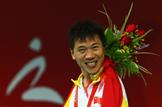
He Junquan is a Chinese swimmer and has won many Paralympic(残奥会) gold medals. Born in Jingmen, Hubei province, He Junquan was a healthy boy. But one day at the age of three, he climbed up to the high-voltage electricity(高压线) box and lost both of his arms forever. He became a disabled boy!
From then on he learnt to do everything with his feet: writing, eating, getting dressed and taking things. Seeing other pupils swimming in the river, he jumped in, too. Without arms, he suffered a lot in the river at the beginning. But he finally learnt to balance himself in water and could swim much faster than the other pupils. Once he even saved a little boy who fell into the water and couldn’t swim. His father was so happy to see that this son had a talent in swimming.
In 1995, He Junquan became a real swimmer. He practices swimming for more than four hours every day. Since 1996, he has won more than twelve gold medals of the world class. At the 2008 Summer Paralympics, he won a silver medal. Reporting on the competition at the 2008 Games, Will Swanton of the Sydney Morning Herald wrote:
“The Water Cube has been a sight for sore(气愤的) eyes. China’s He Junquan, with no arms, was leading the 50m backstroke(仰泳) final. … He came to the finish— and had to crash into the wall with his head. As he slowed down to lessen(减少) the impact(撞击力), Brazilian Daniel Dias hit the wall first with a hand. You’ve never heard a silence like it.”
【小题1】What happened to He Junquan when he was three?
| A.He climbed up the tree but failed onto the ground. |
| B.He saved a little boy who fell into the river and couldn’t swim. |
| C.He climbed up to the high-voltage electricity box and lost his two arms. |
| D.He began to practice swimming in the swimming pool with the other children. |
| A.With his feet. | B.With his mouth. |
| C.With his legs. | D.With his hands. |
| A.Only one. | B.Less than four. | C.About ten. | D.More than twelve. |
| A.He Junquan should not take part in the 2008 Games. |
| B.Daniel Dias didn’t hit the wall first at the 2008 Games. |
| C.The match was a little unfair for He Junquan because he had no arms. |
| D.He Junquan swam a little faster than Daniel Dias but he won a gold medal. |
| A.A Terrible Accident. | B.A Disabled Boy. |
| C.An Unforgettable Experience. | D.A Hero without Arms. |
Lang Lang is a world-class young pianist who grew up in Shenyang. He went to a piano school in Beijing when he was just eight, "You need fortune(运气)," his father said. "But you work hard, no fortune will come."
What made him was that his piano teacher in Beijing didn't like him. "You have no talent(天赋).You will never be a pianist." As an eight-year-old boy, Lang Lang was badly . He decided that he didn't want to be a pianist any more. For the next two weeks, he didn't touch the piano. Wisely(明智的)his father didn't ,but wait.
Luckily the day came when his teacher asked him to play some holiday songs. He didn't want to, but as he placed his fingers on the piano keys, he he could show other people that he had ability to do it well. That day he told his father that he wanted to with a new teacher. From that point on, everything turned around.
He started competitions. In the 1994 International Young Pianists Competition when it was announced that Lang Lang had won, he was too to hold back his tears. Soon it was clear that he couldn't stay in China forever-he had to play on the world's big stages. In 1997 Lang Lang again, this time to Philadelphia, US. There he spent two years practicing and by 1999 he had worked hard enough for fortune to take over.After his performance at Chicago's Raviniu Festival, gigs(演奏会)in Lincoln Center and Camegie Hall started pouring in. Lang Lang finally worked to reach the place where fortune spots(找到)him, and lets him shine.
1.A. if B.unless C. when D.since
2.A. energetic B.happy C. lucky D.sad
3.A.hurt B. ill C. broken D.scared
4.A.hear B. push C. eat D.sleep
5.A.realized B. explained C.forgot D.noticed
6.A. argur B.dance C. study D.interview
7.A. winning B. beating C. watching D.refusing
8.A. annoyed B.mad C. tired D.excited
9.A.started B. left C. moved D.performed
10.A.helpful B.meaningful C. successful D.useful
查看习题详情和答案>>
What made him sad was that his piano teacher in Beijing didn’t like him. “You have no .You will never be a pianist.” As an eight-year-old boy, Lang Lang was badly . He decided that he didn’t want to be a pianist any more. For the next two weeks, he didn’t touch the piano. Wisely, his father didn’t , but waited.
Luckily the day came when his teacher asked him to play some holiday songs. He didn’t want to, but as he placed his fingers on the piano keys, he he could show other people that he had ability to do it well. That day he told his father that he wanted to with a new teacher. From that point on, everything turned around.
He started competitions in the 1994 International Young Pianists Competition. When it was announced that Lang Lang had won, he was too to hold back his tears. Soon it was clear that he couldn’t stay in China forever—he had to play on the world’s big stages. In 1997 Lang Lang again, this time to Philadelphia, US. There he spent two years practicing and by 1999 he had worked hard enough for fortune to take over. After his performance at Chicago’s Ravinia Festival, gigs (演奏会) in Lincoln Center and Carnegie Hall started pouring in. Lang Lang finally worked to reach the place where fortune spots(找到) him, and lets him shine.
| 小题1: |
|
| 小题2: |
|
| 小题3: |
|
| 小题4: |
|
| 小题5: |
|
| 小题6: |
|
| 小题7: |
|
| 小题8: |
|
| 小题9: |
|
| 小题10: |
|
What made him was that his piano teacher in Beijing didn't like him. "You have no talent(天赋).You will never be a pianist." As an eight-year-old boy, Lang Lang was badly . He decided that he didn't want to be a pianist any more. For the next two weeks, he didn't touch the piano. Wisely(明智的)his father didn't ,but wait.
Luckily the day came when his teacher asked him to play some holiday songs. He didn't want to, but as he placed his fingers on the piano keys, he he could show other people that he had ability to do it well. That day he told his father that he wanted to with a new teacher. From that point on, everything turned around.
He started competitions. In the 1994 International Young Pianists Competition when it was announced that Lang Lang had won, he was too to hold back his tears. Soon it was clear that he couldn't stay in China forever-he had to play on the world's big stages. In 1997 Lang Lang again, this time to Philadelphia, US. There he spent two years practicing and by 1999 he had worked hard enough for fortune to take over.After his performance at Chicago's Raviniu Festival, gigs(演奏会)in Lincoln Center and Camegie Hall started pouring in. Lang Lang finally worked to reach the place where fortune spots(找到)him, and lets him shine.
| 小题1: |
|
| 小题2: |
|
| 小题3: |
|
| 小题4: |
|
| 小题5: |
|
| 小题6: |
|
| 小题7: |
|
| 小题8: |
|
| 小题9: |
|
| 小题10: |
|

He Junquan is a Chinese swimmer and has won many Paralympic(残奥会) gold medals. Born in Jingmen, Hubei province, He Junquan was a healthy boy. But one day at the age of three, he climbed up to the high-voltage electricity(高压线) box and lost both of his arms forever. He became a disabled boy!
From then on he learnt to do everything with his feet: writing, eating, getting dressed and taking things. Seeing other pupils swimming in the river, he jumped in, too. Without arms, he suffered a lot in the river at the beginning. But he finally learnt to balance himself in water and could swim much faster than the other pupils. Once he even saved a little boy who fell into the water and couldn’t swim. His father was so happy to see that this son had a talent in swimming.
In 1995, He Junquan became a real swimmer. He practices swimming for more than four hours every day. Since 1996, he has won more than twelve gold medals of the world class. At the 2008 Summer Paralympics, he won a silver medal. Reporting on the competition at the 2008 Games, Will Swanton of the Sydney Morning Herald wrote:
“The Water Cube has been a sight for sore(气愤的) eyes. China’s He Junquan, with no arms, was leading the 50m backstroke(仰泳) final. … He came to the finish— and had to crash into the wall with his head. As he slowed down to lessen(减少) the impact(撞击力), Brazilian Daniel Dias hit the wall first with a hand. You’ve never heard a silence like it.”
小题1:What happened to He Junquan when he was three?
| A.He climbed up the tree but failed onto the ground. |
| B.He saved a little boy who fell into the river and couldn’t swim. |
| C.He climbed up to the high-voltage electricity box and lost his two arms. |
| D.He began to practice swimming in the swimming pool with the other children. |
| A.With his feet. | B.With his mouth. |
| C.With his legs. | D.With his hands. |
| A.Only one. | B.Less than four. | C.About ten. | D.More than twelve. |
| A.He Junquan should not take part in the 2008 Games. |
| B.Daniel Dias didn’t hit the wall first at the 2008 Games. |
| C.The match was a little unfair for He Junquan because he had no arms. |
| D.He Junquan swam a little faster than Daniel Dias but he won a gold medal. |
| A.A Terrible Accident. | B.A Disabled Boy. |
| C.An Unforgettable Experience. | D.A Hero without Arms. |