网址:http://m.1010jiajiao.com/timu3_id_2439370[举报]
Laboratory work is your chance to learn science firsthand. It can be fun but you must be careful to prevent injury. Listen closely when your teacher reads and explains the rules before your first lab lesson.
LABORATORYRULES
Throughout the lesson
·Do not enter the science lab without the teacher’s permission.·No food or drinks are to be alowed in the science lab.
Before the Experiment
·Read al instructions carefuly before every experiment.
·Prepare al apparatus(仪器)and arrange them so that you wil not knock them over while doing the experiment.
During the Experiment
·If you are unsure of how to use any apparatus or how to operate, ask your teacher for help.·Never smel o r taste chemicals unless your teacher gives permission.
After the Experiment
·Wash al apparatus after use and return them to the places where they were.
·Throw waste materials in proper waste baskets. First Aid
·Report al accidents to your teacher immediately.
·If you spil( 溅 出 )any chemicals onto your body or clothing, wash with plenty of water and report to your teacher.
【小题1】 Yo ur teacher wil probably tel you the rules above _____ the first lab lesson.
| A.before | B.since | C.during | D.after |
| A.taste the chemicals first |
| B.clean al the apparatus |
| C.read al instructions carefuly |
D.report al the accident s to the teacher s to the teacher |
A. try them on your own
B. read the rules carefuly
C. ask your teacher for help
d. put them back
【小题4】 It i
 s clear that you can _____.
A. bring food into the lab bring food into the lab | |
| B.enter the lab anytime | |
C.smel chemicals as you like | D.learn science directly in the lab |
| A.Before the Experiment |
| B.First Aid |
| C.During the Experiment |
| D.After the Experiment |
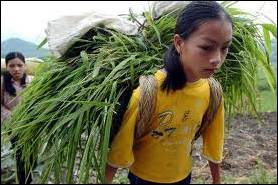
Dear Reader,
Imagine an 11-year old girl whose days are often spent washing clothes, looking after a baby, working hard in the field.
Imagine a little girl who knows there will not be enough food for dinner, who can’t fill her stomach with water because it’s polluted, and who has watched life slip away from her father, little brother and sister because the family is too poor to see a doctor.
Is it hard to believe? For Maria Pastora, these are the real life.
Maria would gladly walk miles to school, but her mother, now alone, needs her badly at home. If Maria grows up without any schooling, what will be her future?
But for just 52 pennies a day, you can sponsor a child like Maria. Through “Save the Children”, you can help Maria’s mother get the tools and ways she needs to turn their poor food into a good dinner and the money she needs to buy clothes and school things for Maria.
To help Maria most, your money is put together with that of other sponsors, so hard-working people can help themselves. Build a school, a hospital…bring in clean water. This is what “Save the Children” has been about since 1932.
For you there are many rewards. Have the chance to write to or hear from your sponsored child. Receive photos or progress reports. Know you are reaching out to another person. Not with a handout(施舍物), but a “handup”. That’s how “Save the Children” works. But without you, it can’t work. Please take a moment now to fill in and post the form below to help a child like Maria and her village.
It can make such a difference in her life and yours.
1.We can most probably read the letter in __________.
A.somebody’s diary B.a newspaper
C.a progress report D.a storybook
2.From the passage, we can infer (推断)that _________
A.Maria is an 11-year-old girl.
B.Maria’s family is very poor.
C.Maria has to do a lot of hard work.
D.Maria is hoping to get schooling.
3.What is “Save the Children”?
A.An organization to help poor children go to school.
B.An office of the government to collect money.
C.A program shown at theatres to help the poor.
D.A group who works for children in poor places.
4.The underlined word “sponsor” means “__________” in Chinese.
A.回报 B.资助 C.感恩 D.抢救
5.What does the last sentence in the letter mean?
A.If Maria goes to school, you will be rewarded.
B.What you give is more than what you take.
C.Both Maria’s life and yours will change a lot.
D.Marie and you can help each other at school.
查看习题详情和答案>>
|
TV PROGRAMMES |
|
|
Channel 1 |
Channel 2 |
|
18:00 Around China 18:30 Children’s programme 19:00 News 19:30 Weather report 19:40 Around the world 20:10 TV play: Sisters 21:00 English for today 21:15 Popular music 21:55 Talk show |
17:45 Computers today 18:10 Foreign arts 18:30 “Modern English” 19:00 Animal world 19:25 In Asia 20:20 Sports 21:00 Sports player: Yao Ming 21:45 English news 22:05 On TV next week |
1.If you want to watch a football game, the best programme for you would be ______.
|
A.TV play |
B.Sports |
C.TV play: Yao Ming |
D.Talk show |
2.The programme of ___ will let you know much about western countries.
|
A.Sisters |
B.Around China
|
C.Around the world |
D.In Asia |
3. If you want to know something about tigers, elephants and monkeys, the best programme for you is ____.
|
A.at 19:40 on Channel 1 |
B.at 19:00 on Channel 2
|
C.at 18:30 on Channel 2 |
D.at 21:15 on Channel 1 |
4.“Modern English”is a programme that ____.
|
A.lets you know something about classroom |
|
B.tells you something about students |
|
C.lets you know something about school life |
|
D.teacher you English |
5.The programme at the end of Channel 2 means ____ on TV next week.
|
A.news |
B.programmes |
C.people |
D.places |
查看习题详情和答案>>
|
TV PROGRAMMES |
|
|
Channel 1 |
Channel 2 |
|
18:00 Around China 18:30 Children’s programme 19:00 News 19:30 Weather report 19:40 Around the world 20:10 TV play: Sisters 21:00 English for today 21:15 Popular music 21:55 Talk show |
17:45 Computers today 18:10 Foreign arts 18:30 “Modern English” 19:00 Animal world 19:25 In Asia 20:20 Sports 21:00 Sports player: Yao Ming 21:45 English news 22:05 On TV next week |
1. If you want to watch a football game, the best programme for you would be ______.
|
A.TV play |
B.Sports |
C.TV play: Yao Ming |
D.Talk show |
2. The programme of ___ will let you know much about western countries.
|
A.Sisters |
B.Around China |
|
C.Around the world |
D.In Asia |
3. If you want to know something about tigers, elephants and monkeys, the best programme for you is
|
A.at 19:40 on Channel 1 |
B.at 19:00 on Channel 2 |
|
C.at 18:30 on Channel 2 |
D.at 21:15 on Channel 1 |
4. “Modern English”is a programme that ____.
|
A.lets you know something about classroom |
|
B.tells you something about students |
|
C.lets you know something about school life |
|
D.teacher you English |
5. The programme at the end of Channel 2 means ____ on TV next week.
|
A.news |
B.programmes |
C.people |
D.places |
查看习题详情和答案>>