摘要:Around the world, people have different i 85 about what good table manners are. In India, for example, people only eat with their r 86 hands. You take food from one dish on the table, usually a kind of bread or rice, mix it with food from a 87 dish and then put it in your m 88 . Your left hand stays still. Eating with your left hand is very rude! In W 89 countries, people don’t usually share the same d 90 . Everyone has his or her o 91 plate of food. You eat with a knife and fork and you shouldn’t wave them around when you aren’t eating. And you should try not to be noisy when e 92 . People think that’s bad table manners! The way people eat food is d 93 around the world, but you can find the same kinds of food in many countries. Chinese and Italian food, for example, are p 94 all over the world.

网址:http://m.1010jiajiao.com/timu3_id_2434210[举报]

My friend Mr. Smith is a famous doctor and has a hospital. So he has enough money to __11__ all over the world. And he’s been to a lot places of interest. He likes to __12__ children and has a lot of little __13__. They often ask him to tell them all kinds of funny things he __14__. It makes them happy and his room is always full __15__ children when he’s free.

It was my little son’s seventh birthday yesterday. The boy wanted to __16__ his old friend Mr. Smith to the party. He __17__ Mr. Smith himself and told him about it. the doctor accepted his __18__ happily. At half past seven the boy was waiting for his coming at the gate. __19__he saw his car, he ran towards him. Mr. Smith __20__ on time, with a nice present in his hand. After dinner the children sat around the traveler and asked him to __21__ them some funny stories. Mr. Smith agreed and his stories made them __22__ again and again. At last th told them the funniest story. He said, “ Once I reached a city __23__a foggy day. The fog was the thickest in the world …”

Please wait a__24__, Mr. Smith,” said my son, “ It’s said the fog in London is the thickest in the world.”

“You’re __25__, my clever boy.” Said the funny doctor. “ The city had much fog that day …” “ What’s it, the?” the boy couldn’t wait to ask again.

“ The fog was so thick that I couldn’t see it at all,” the funny doctor said with a smile.

1.   A. work B. fight C. live D. travel

2.   A. wait for B. look over C. play with D. look after

3.   A. friends B. brothers C. workers D. classmates

4.   A. read B. wrote C. thought D. saw.

5.   A. with B. for C. of D. by

6.   A. send B. ask C. carry D. get

7.   A. knew B. caught C. taught D. called

8.   A. invitation B. things C. car D. money

9.   A. Before B. As soon as C. Until D. Since

10.  A. came B. answered C. said D. played

11. A. speak B. say C. tell D. talk

12.  A. think B. laugh C. cry D. fear

13. A. with B. in C. at D. on

14.  A. moment B. day C. week D. year

15.  A. sorry B. sad C. wrong D. right

查看习题详情和答案>>

Happy New Years!

  Today is March 17th.About two and a half months ago, I said“Happy New Year!”to many of my friends.About fifty days ago, I said the same thing to some other friends.In about four days, I’ll say the same wishes to yet another group of friends.I’ll do the same thing in July and also in September.“How can that be?”you might ask(if you ‘re from Western Europe or the Americas).“Everyone knows that New Year’s Day is in Januare!”

  In fact, the date of New Year’s Day depends on the calendar(日历)-and I have friends who use one or more of five different calendars to keep track of at least part of their lives:

  ●January 1st:New Year’s Day on the Western/international calendar

  ●In January or February(in 2006, January 29 th):New Year’s Day on the Chinese calendar(China, Korea, and a few other places)

  ●March 21st:New Year’s Day on the traditional Persian(波斯)calendar

  ●Mid-July(usually the 16 th):New Year’s Day on the Isamic(穆斯林)calendar

  ●September:New Year’s Day on most Eastern Orthodox Church(东正教)calendars(Central and Eastern Europe)and, usually, on the Jewish calendar

  And these are just the New Year’s Days that I know about!As a matter of fact, there are probably even more!

(1)

The first time the writer said,“Happy New Year!”was about January 1st.The second time was on or after ________.

[  ]

A.

February 28th

B.

the middle of March

C.

January 29th

D.

March 21st

(2)

The writer will say“Happy New Year”around March 21st to some ________ friends.

[  ]

A.

Chinese

B.

Korean

C.

Persian

D.

Eastern Orthodox

(3)

According to the passage, we can infer that the exact(准确的)dates for the two New Year’s Days in September are ________.

[  ]

A.

probably different

B.

not always in September

C.

probably the same

D.

after September

(4)

The meaning of“keep track of”is ________.

[  ]

A.

understand

B.

choose

C.

manage

D.

forget

(5)

The Chinese calendar is used ________.

[  ]

A.

only in China

B.

in several different places

C.

only in China and Korea

D.

all over the world

(6)

The word“Years”in the title of this article ________.

[  ]

A.

means that January 1st is at different times on different calendars

B.

is a mistake and should be“Year”

C.

is used because New Year’s Day is at different times on different calendars

D.

means that the writer was polite

查看习题详情和答案>>

阅读理解

阅读下列短文,从每小题所给的A、B、C、D四个选项中选出一个能回答所提问题或完成所给句子的最佳选项。

  Do you still remember the terrible earthquake in 2008 in Sichuan, which killed at least 87,000 people and left millions homeless? On the twelfth day after the earthquake, Premier Wen Jiabao said, “A new Wenchuan will rise from the ruins(废墟).” Now his words have come true.More than three years has passed and the worst-hit areas in Sichuan have risen from the ruins.

  So far, 95% of the reconstruction projects(重建项目)have been completed.Nearly 3,000 schools, 1,000 hospitals and more than 5 million homes have been built.Now everyone has been provided with a home, a job and social security(社保).

  Dong Xinjun, a villager in Qingchuan, said volunteers from Zhejiang taught him how to grow mushrooms and now he makes about 3,000 yuan more than before every year.

  Zhu Lihu, the headmaster of a village primary school in Qingchuan, told us that teaching equipment had been greatly improved.Now they have new classrooms, a library and a computer room with 20 computers.

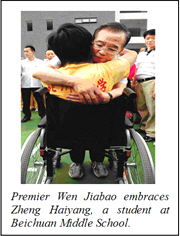
  On March 8 th, 2012, Premier Wen Jiabao made his 10 th visit to Sichuan Province after the earthquake.He visited a lot of middle schools and neighborhoods.At Beichuan Middle School, Premier Wen embraced a student named Zheng Haiyang, who lost both of his legs in the earthquake.The students told Premier Wen that their new school was very beautiful.And they would never forget that it was built with the hearts and strength of people across the whole country.

  Premier Wen believes that the people in Wenchuan have a “strong will” and a “bright future”.They will never back down, but stand bravely on this land.

(1)

What is NOT provided for everyone in the earthquake-hit areas?

[  ]

A.

A home.

B.

A job.

C.

A computer.

D.

Social security.

(2)

Which of the following is TRUE according to the passage?

[  ]

A.

Nearly 1,000 schools have been built.

B.

Dong Xinjun makes about 3,000 yuan every year.

C.

Zhu Lihu's new school has a new large gym.

D.

Zheng Haiyang is a student of Beichuan Middle School.

(3)

How many times has Premier Wen visited Sichuan since the earthquake happened?

[  ]

A.

5 times.

B.

8 times.

C.

10 times.

D.

12 times.

(4)

What does the underlined word “embraced” mean in Paragraph 5?

[  ]

A.

Put arms around him in a loving way.

B.

Shook hands with him in a friendly way.

C.

Bowed to him in a very polite way.

D.

Smiled at him in a very kind way.

(5)

How does the passage show us “Wenchuan has risen from the ruins”?

[  ]

A.

By giving facts and examples.

B.

By comparing different places.

C.

By describing people's looks.

D.

By using volunteers' words.

查看习题详情和答案>>

违法和不良信息举报电话:027-86699610 举报邮箱:58377363@163.com

精英家教网