摘要: Betty speaks French best in our school . else speaks French as as Betty in our school.
网址:http://m.1010jiajiao.com/timu3_id_2431696[举报]
匹配题。
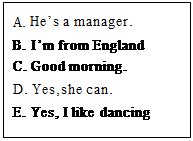
小题1: Where are you from?
小题2:What’s your father’s job?
小题3: Do you like dancing?
小题4:Good morning.
小题5: Can Betty speak Chinese?
小题1: Where are you from?
小题2:What’s your father’s job?
小题3: Do you like dancing?
小题4:Good morning.
小题5: Can Betty speak Chinese?
句型转换。
1. Lily can play the piano.(改为否定句)
Lily _______ ________the piano.
2. Little Mary can play basketball.(改为一般疑问句)
_______little Mary__________basketball?
3. They are from the Beijing International School.(对画线部分提问)
__________ _________they___________
4. Can Betty speak English? (作肯定回答)
________,she__________.
5. Can Tony and Nick swim? (作否定回答)
No,__________ ___________ .
查看习题详情和答案>>
Lily _______ ________the piano.
2. Little Mary can play basketball.(改为一般疑问句)
_______little Mary__________basketball?
3. They are from the Beijing International School.(对画线部分提问)
__________ _________they___________
4. Can Betty speak English? (作肯定回答)
________,she__________.
5. Can Tony and Nick swim? (作否定回答)
No,__________ ___________ .
句型转换。
1. Lily can play the piano. (改为否定句)
Lily _____ _____ the piano.
2. Little Mary can play basketball. (改为一般疑问句)
_____ little Mary _____ basketball?
3. They are from the Beijing International School. (对画线部分提问)
_____ _____ they _____?
4. Can Betty speak English? (作肯定回答)
_____, she _____.
5. Can Tony and Nick swim? (作否定回答)
No, _____ _____ .
查看习题详情和答案>>
1. Lily can play the piano. (改为否定句)
Lily _____ _____ the piano.
2. Little Mary can play basketball. (改为一般疑问句)
_____ little Mary _____ basketball?
3. They are from the Beijing International School. (对画线部分提问)
_____ _____ they _____?
4. Can Betty speak English? (作肯定回答)
_____, she _____.
5. Can Tony and Nick swim? (作否定回答)
No, _____ _____ .
Read the suggestions for making an English speech.
a. Looking at and talking to one person in the audience (观众) helps keep you natural, but it feels foolish talking to only one person. Speak to that person as long as 15 seconds and then change another one.
b. The audience have a hard time understanding what they hear. They need your help. Slow down, pause(停顿) and guide the audience through your talk. Remember that you should help the audience understand what you are saying.
c. Make your voice a little lower than normal. Listeners like to listen to a relatively(相对) deep voice.
d. When you talk, try to be as natural as possible. Don’t try to memorize your words and read or recite(背诵) them to your audience. You can use short notes to help you remember the important points.
e. You should know you and most of the people you talk to are different in many ways. Some of them may not know what you are talking about. Then speak to them on their terms and in their languages.
f. Concentrate on what you want to say. If you are always paying attention to gestures(手势),you will feel uncomfortable.
g. It’s true that there are some differences between American English and British English, but they’ll not cause much difficulty for listeners, so just speak the way you’re used to.
Choose a suggestion for each of the following students according to their problems.b. The audience have a hard time understanding what they hear. They need your help. Slow down, pause(停顿) and guide the audience through your talk. Remember that you should help the audience understand what you are saying.
c. Make your voice a little lower than normal. Listeners like to listen to a relatively(相对) deep voice.
d. When you talk, try to be as natural as possible. Don’t try to memorize your words and read or recite(背诵) them to your audience. You can use short notes to help you remember the important points.
e. You should know you and most of the people you talk to are different in many ways. Some of them may not know what you are talking about. Then speak to them on their terms and in their languages.
f. Concentrate on what you want to say. If you are always paying attention to gestures(手势),you will feel uncomfortable.
g. It’s true that there are some differences between American English and British English, but they’ll not cause much difficulty for listeners, so just speak the way you’re used to.
【小题1】Paul: I don’t think I can talk fluently(流利) because it’s difficult for me to remember all the words.
| A.a | B.b | C.c | D.d |
| A.a | B.c | C.e | D.f |
| A.d | B.e | C.f | D.g |
| A.b | B.d | C.f | D.g |
| A.a | B.b | C.c | D.g |