网址:http://m.1010jiajiao.com/timu3_id_2414531[举报]
听力理解(共30小题;每小题1分,共30分)
(A)在下列每小题内,你将听到一个问句并看到供选择的三个答语。找出能回答你所听到的那个问句的最佳选项。
1.A.Since April.
B.About two months ago.
C.For about three weeks.
2.A.She is John's sister.
B.She is a worker.
C.She is badly hurt.
3.A.As soon as I can.
B.As quick as I can.
C.As fast as I can.
4.A.It's very beautiful.
B.It's a picture of a factory.
C.It's a picture of a farm.
5.A.Thank you all the same.
B.Yes, you can't miss it.
C.Sorry, I'm new here.
6.A.Twelve kilometers.
B.Five days.
C.Very far.
7.A.China.
B.American.
C.Australian.
8.A.Fine, thank you.
B.Quite well.
C.With pleasure.
(B)在下列每小题内,你将听到一个句子并看到供选择的三个句子。找出与你所听到的那个在意思上最接近的选项。
9.A.Lucy visited us yesterday.
B.We visited Lucy yesterday.
C.Lucy didn't visit us yesterday.
10.A.Miss Wang was a Chinese teacher.
B.Miss Wang teaches Chinese now.
C.Miss Wang was an English teacher.
11.A.I have bought a sweater for my brother.
B.I bought a sweater for my brother.
C.I am going to buy a sweater for my brother.
12.A.The sports meeting began the day before yesterday.
B.The sports meeting has been on for four days.
C.The sports meeting started last Friday.
13.A.Tom doesn't like his father.
B.Father and Tom don't look the same.
C.Father doesn't like Tom at all.
14.A.The old man was the first in the queue.
B.The old man was the most important one in the queue.
C.The old man was in charge of the queue.
15.A.The students stopped having a picnic.
B.The students stopped beside a big tree.
C.The students stopped to eat something under a big tree.
16.A.It took me six days to read the storybook.
B.I spent six yuan on this storybook.
C.The storybook is worth reading.
(C)下面你将听到八组对话,每组对话都有一个问题。根据对话内容,从每组所给的三个选项中找出能回答所提问题的最佳选项。
17.What time is it now?
A.9∶15.
B.9∶30.
C.9∶45.
18.What are they talking about?
A.The world's population.
B.The countries in the world.
C.The continents in the world.
19.Where are they talking?
A.In a library.
B.In the clothing shop.
C.In a post office.
20.When did the man take his coat to the washing shop?
A.On Tuesday.
B.On Wednesday.
C.On Thursday.
21.How is the weather?
A.Windy.
B.Rainy.
C.Sunny.
22.What is the woman's idea?
A.She likes English better than French.
B.She thinks French is more interesting than English.
C.She doesn't agree with the man at all.
23.How much should the man pay if he wants to buy two yellow bags?
A.10 yuan.
B.13 yuan.
C.16 yuan.
24.What does the woman tell the man to do?
A.Drink some water.
B.Stay in bed.
C.Take some medicine.
(D)听下面长对话或独白。每段长对话或独白后都有几个问题,从题中所给的A、B、C三个选项中选出最佳选项。
听下面一段材料,回答第25至第27题
25.What are the two speakers doing?
A.Talking about English study.
B.Speaking on the line.
C.Having a talk in the office.
26.When will the man go to see Mr Smith?
A.Tomorrow morning.
B.Tomorrow evening.
C.Tomorrow afternoon.
27.What did the man want to talk about to Mr Smith?
A.Jack's English study.
B.Jack's homework.
C.Jack's maths study.
听下面一段材料,回答第28至第30题。
28.When was Tree Planting Day started?
A.In 1987.
B.In 1971.
C.In 1980.
29.How did they get to the park?
A.By bus.
B.On foot.
C.By truck.
30.How many trees did they plant?
A.Over 250.
B.More than 350.
C.About 550.
听力理解(本大题共30小题,每小题1分,共30分)
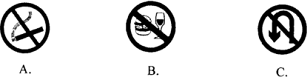
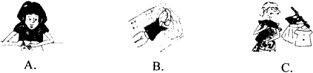
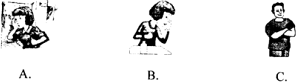
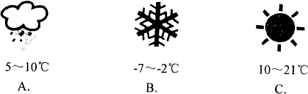
A.在下列每小题内,你将听到一个或两个句子并看到供选择的A、B、C三幅图画。找出与你所听句子内容相匹配的图画。
1.
2.
3.
4.
B.在下列每小题内,你将听到一个问句并看到供选择的A、B、C三个答语。找出能回答你所听到的那个问句的最佳选项。
5.A.I’m from Tianjin.
B.Tianjin is a beautiful city.
C.I’m a student.
6.A.It’s white.
B.It’s tall.
C.It’s young.
7.A.You’re welcome.
B.That’s a good idea.
C.Don’t mention it.
8.A.I like the school.
B.The school is far away.
C.I go by bus.
9.A.I was born in a small town.
B.I came here yesterday.
C.I had lunch at home.
10.A.I like holidays.
B.I went to Qingdao.
C.I stayed there for 2 weeks.
11.A.Since 1998.
B.Next year.
C.Last week.
12.A.I’m in Class One.
B.My name’s John.
C.I’m fifteen.
13.A.Her classes are interesting.
B.She is strict.
C.She is 26 years old.
14.A.Yes, go straight ahead.It’s opposite a school.
B.The hotel is very big.
C.People like going there.
C.下面你将听到十组对话,每组对话都有一个问题。根据对话内容,从每组所给的A、B、C三个选项中找出能回答所提问题的最佳选项。
15.What’s Harry’s favourite sport?
A.Football.
B.Table tennis.
C.Basketball.
16.When did the man come to China?
A.In August 1989.
B.In October 1999.
C.In October 2002.
17.Is Betty going to play the piano tomorrow morning?
A.No, she isn’t.
B.Yes, she is.
C.Yes.She likes playing the piano.
18.In Tom’s opinion, what’s the population of Shanghai?
A.10 million.
B.13 million.
C.15 million.
19.Where does the woman want to go?
A.Australia.
B.Africa.
C.Europe.
20.Who gave the man the advice?
A.The woman’s teacher.
B.The man’s pen friend.
C.The woman’s pen friend.
21.What haven’t they got at home?
A.Oranges.
B.Bananas.
C.Apples.
22.How many times has the woman been to the United States?
A.Three times.
B.Four times.
C.Five times.
23.What does Sam do on his birthday?
A.Have a party.
B.Make a cake.
C.Go dancing.
24.When is Charlie’s chemistry lesson?
A.At half past one.
B.At half past two.
C.At half past three.
D.听下面长对话或独白。每段长对话或独白后都有几个问题,从题中所给的A、B、C三个选项中选出最佳选项。
听下面一段材料,回答第25至第27题。
25.Where is Mary now?
A.At school.
B.At home.
C.On the Great Wall.
26.What are the students getting together for?
A.Having a school trip.
B.Having a swim.
C.Having a meeting.
27.Who is writing postcards?
A.Tony.
B.Wang Hui.
C.Lingling.
听下面一段材料,回答第28至第30题。
28.What does David like doing in the evening?
A.Staying at home.
B.Watching television.
C.Going out with his friends.
29.Where does David’s brother work?
A.In a school.
B.In a bank.
C.In a hospital.
30.What’s the difference between the two brothers?
A.The character.
B.The colour of eyes.
C.The colour of hair.
听力测试(每小题1分,共30分)
第一节 听音辨图
请听句子,选出与所听句子内容相符的图画。每个句子读一遍。
1.

2.

3.

4.

5.

第二节 情景反应
请听句子,选出正确的答语。每个句子读一遍。
6.A.Good morning.
B.Good afternoon.
C.Good evening.
7.A.This is a ruler.
B.It’s a pencil.
C.They are pens.
8.A.Good idea.
B.No, thanks.
C.It’s too hot.
9.A.It’s autumn.
B.It’s June 26th.
C.It’s fine.
10.A.Yes, they are.
B.Yes, he is.
C.Yes, I am.
11.A.Have a good time.
B.Don’t worry.
C.Yes, I do.
12.A.Last week.
B.Yesterday.
C.Tomorrow.
13.A.I’d like a dress.
B.Do it please.
C.That’s all right.
14.A.Yes, I think so.
B.Thank you.
C.I’d like to.
15.A.She is my sister.
B.She is beautiful.
C.She is good at English.
第三节 对话理解
A.请听五组对话,每组对话后您将听到一个问题,请根据对话内容选出正确答案。每组对话和问题读两遍。
16.A.In the office.
B.In the house.
C.In the car.
17.A.Mary’s.
B.Sam’s.
C.Jim’s.
18.A.A dog.
B.A cat.
C.A chick.
19.A.Lipu.
B.Xing’an.
C.Longsheng.
20.A.In a hospital.
B.In a shop.
C.In a cinema.
B.请听一段对话,对话后您将听到五个问题,请根据对话内容选出正确答案。对话和问题读两遍。
21.A.Tiger.
B.Panda.
C.Monkey.
22.A.Guangxi.
B.Yunnan.
C.Sichuan.
23.A.A banana.
B.A pear.
C.An apple.
24.A.Asia.
B.Europe.
C.Africa.
25.A.Two.
B.Three.
C.Four.
第四节 语篇理解
请仔细听短文,并根据短文内容补全以下信息,每空填一词。短文读两遍。

It is the first birthday that Wang Xiaojun has spent with his parents in three years. In the past three years, his parents have worked in Shenzhen to make money. They B. ______ (not see) their son for three years. Tomorrow they have to leave for Shenzhen again.
Wang is not the only left-behind child (留守儿童). In the countryside of China, there are more than 20 million children C. _______ (stay) at home without their parents. Left-behind children face a lot of problems. Most of them stay with their grandparents. They get less care from their parents. D. 他们常感到孤独。Some of the don’t learn well because their parents can’t help them E. _______ their studies.
The Chinese government cares about the children very much and is trying to solve their problems now.
小题1:将A处画线句子译成汉语。
.
小题2:在B、C两处填入所给词的适当形式。
B: C:
小题3:将D处画线句子译成英语。
.
小题4:在E处填入合适的介词。
E:
小题5:根据短文回答问题。
Why don’t many left-behind children learn well?
.
听力
一、听句子,选择与句子情景相关的图。每小题念一遍
0(每小题1分。共5分)1.

2.

3.

4.

5.

二,听句子,选择恰当的答语。每小题念一遍。
(每小题1分,共5分)6.A.Good night. B.Bye-bye. C.Nice to see you, too.
7.A.My pleasure. B.It doesn't matter. C.It's very kind of you.
8.A.I like apples. B.I'm hungry. C.Well done.
9.A.Not at all. B.Thank you. C.That's right.
10.A.I'm Ann. B.I don't agree. C.This is Ann speaking.
三、听对话,选择正确的答案。对话念两遍。(每小题1分,其10分)
听第
l段对话,完成第11小题。11.Whose ruler is this?
A.Betty's. B.Lily's. C.Lucy's.
听第2段对话。完成第12小题。
12.When will Jane go to the party?
A.Next Saturday. B.This Saturday. C.Tomorrow evening.
听第3段对话,完成第13小题。
13.What color is Mary's hair?
A.Red. B.Yellow. C.Black.
听第4段对话,完成第14小题。
14.What does Kate's father do?
A.A driver. B.A teacher. C.An office worker.
听第5段对话,完成第15至17小题。
15.What did Bruce use to do during the summer vacation?
A.Go fishing. B.Go shopping. C.Go camping.
16.Where is Bruce's house?
A.Near the lake. B.Near the sea. C.Near the river.
17.What does the woman think of Bruce?
A.Silly. B.Clever. C.Friendly.
听第6段对话,完成第18至20小题。
18.What is Sam doing?
A.Flying a kite. B.Making a kite. C.Mending a plane.
19.Who is the present for?
A.Sam's mother. B.Sam's sister. C.Sam's friend.
20.What's the relationship between the two speakers?
A.Mother and son. B.Father and daughter. C.Brother and sister.
四、听短文,选择最佳答案。短文念两遍。(每小题1分,共5分)
21.Where is Rose now?
A.In Hainan. B.In Shanghai. C.In Nanjing.
22.Which subject does Rose like best?
A.Math. B.Chinese. C.English.
23.When does Rose go to the English corner?
A.On weekends. B.On Saturday morning. C.On Tuesday afternoon.
24.How often does Rose go to the school library?
A.Every day. B.Once a week. C.Twice a week.
25.How is Rose's school life?
A.Hard. B.Busy. C.Interesting.
五、听对话。完成下面表格。每空一词。对话念两遍(每小题1分。共5分)
