网址:http://m.1010jiajiao.com/timu3_id_2387638[举报]
Their main complaint is that the homework is too much for them to finish.
“As far as ! know, many of my students have to go to all kinds of training classes during the holiday. These lake away much of their time for doing homework.”
But as for the parents who are sending their children to these training classes they also say they've got no choice. Here's a view from a student's father.
"All the other kids in the neighborhood are learning extra things. You know parents sometimes compare their kids. I'm afraid my kid will be less successful than the others in the future."
In order to do with this situation of students copying each other's homework, some schools have even dropped the idea of holiday homework. Instead, they organize some interesting outdoor activities.
Educational experts say students love to learn through games or activities that they can be a part of‘ They suggest schools drop the current (目前的)homework format (设计),and turn to homework that encourages kids to get involved (参与).This way, they would no longer want to copy from each other or buy answers through the Internet.
Answer the following questions according to what you read.
【小题1】Why do students copy or buy homework answers?
【小题2】 What do students spend much time on during the holiday?
【小题3】Most parents want their kids to be successful, don't they?
【小题4】 How do some schools deal with the problem of students copying homework?
【小题5】 List a kind of your favorite holiday homework according to the passage. 查看习题详情和答案>>
 To most of us, school means classes, teachers, schedules,
grades and tests. But for the children at Sudbury Valley School in
Massachusetts, school is very different.
To most of us, school means classes, teachers, schedules,
grades and tests. But for the children at Sudbury Valley School in
Massachusetts, school is very different.
Firstly, there are no lessons. All the children, aged between 4 and 19, do whatever they want. There are no teachers, only “staff members”. The idea behind this is that you do not need to make children learn, because children want to learn anyway. “You do not need to say to a three-year-old, ‘Go explore your environment.’ You can’t stop them!”says Daniel Greenberg, a founder of the school. “But if you make children do what you want all day… they will lose all taste of learning.” At Sudbury Valley School, you will find children talking, reading, painting, cooking, working on computers, studying French, playing the piano, climbing trees, or just running around. Two boys spent three years just fishing!
The other way that Sudbury Valley School is different is that the children can decide the rules. Every week, there is a school meeting where both children and staff have one vote (投票)each—even the four-year-olds. They decide the school rules, how to spend the school money, and even which staff they want and do not want anymore.
When the school first opened in 1968, people said it would never work. But today, the school has 200 students, and 80% of its students go on to college. Even the two boys who went fishing all the time have successful careers today. One of them is a musician and the other is a computer scientist.
1.What's special about the school?
A. There is nobody but students there.
B. All the students are of the same age.
C. There are no classes for the students.
D. There are no rules in the school.
2.What do the students do in the school?
A. They learn everything there from the staff members.
B. They grow up there without learning anything.
C. They spend all the time with their parents.
D. They do whatever they are interested in.
3.The school seems to believe that children________.
A. learn best when they are doing what they want
B. are too young to learn anything by themselves
C. can look after themselves without any help
D. can't go to college without any hard work
4.The last paragraph wants to tell us that_ .
A. the writer doesn't like the idea of the school
B. the school is quite successful in its work
C. most of the parents don't believe in the school
D. younger students learn better there than older ones
5.The underlined word career in the last paragraph most probably means_.
A. family B. money C. lifestyle d. job
查看习题详情和答案>>
Born as the only child in the family, I am the “king” of the family. My parents are both businessmen and they come home every two weeks. Because they don’t spend much time with me, they always feel guilty* and will buy me many expensive things and let me do whatever I want. My grandparents never let me do any chores because they want me to do my schoolwork.
?? I used to take everything for granted*. I never said “thank you” to people. As time went by, I found that my classmates didn’t like me and my best friends left me. one day, I asked Leo, who used to be one of my best friends. He said that I was selfish, rude* and bad-tempered*. “No one wants to make friends with a person who always receives but never gives anything!” he said. I was shocked* at his words. “Oh, no! Please don’t leave me. I need friends! I will be lonely and unhappy without friends!” I locked myself up in the room and cried. “I want my friends back. But how?”
?? Then I noticed that all the popular kids in the class friendly to others. They always smile and say “thank you” to others. They do whatever they can to help when others are in trouble. Other kids like them and always play with them. “I need to change! I will get my friends back,” I said to myself. From then on, I started to change myself. I learned to say “thank you” to others. I smiled and volunteered to help other kids. I tried to be as nice as I could. Gradually, I found that other kids liked to talk with me and they would ask me to play with them and even told me their secrets. My friends came back to me again.
?? Now I have more friends than I used to do and I am happier than I used to be.
1.What’s the boy’s life like at home?
A. His parents spend much time with him.????????????? ????????????? ?????????????
B. He has to do lots of housework.
C. He can do what he wants to do.?????????????
D. He does much more homework than other kids.
2.What did the boy do to change himself?
A. He learned to say “thank you”.
B. He always smiled at others.
C. He helped others as much as he could.?????????????
D. All of the above.
3.The underlined word “gradually” means ___________.
A. To begin with????????????? ????????????? B. Sometimes????????????? ????????????? C. In a word????????????? ????????????? D. Slowly
4.What can we infer(推断)from the passage?
A. To make more friends, you need to try to please them.????????????? ?????????????
B. A person who always received but never gives can still have many friends.
C. The boy lost his friends at first because he didn’t like them.
D. To be a nicer and better person, we need to make some changes.
查看习题详情和答案>>
Among them, a weak boy with ugly teeth and thick glasses kept shaking. I had seen him around, and I knew he was always laughed at. He seemed __37__ of himself, and was so pale that it __38__ us to look at him.
He came up and asked me nervously, “Can you sign this?” I took his yearbook but I didn’t know __39__ to write. I saw that there was the name “Ricky Sanders” written on the front of it. So I wrote:
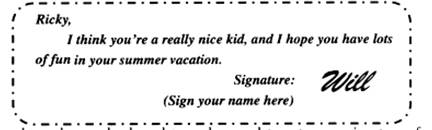
I put down the yearbook and turned around to get some signatures from some of my friends when I __40__ my yearbook was gone. I saw that Ricky had sat down with my yearbook. “What are you doing?” I asked him. He looked up calmly(平静地) and __41__said “Sign!”
My friends broke into a loud laugh, and I saw that he was carefully frying to put a signature in my yearbook. He hadn’t even finished the “R” yet. I thought for a while and __42__ to let him sign.
It took him nearly five minutes to sign and when I got my yearbook back, there was a very shaky “RICKY”. He hugged(紧抱) his yearbook and __43__. I couldn’t help but smile back at him.
In that moment, my __44__ changed completely.
I gave him a high five and suddenly everyone at my table wanted his signature. He was asked politely to write in their yearbooks and the signature __45__ of his yearbook were filled up. He was smiling so big that it lit up the whole room.
I changed school the next year, and I never saw Ricky again. However, I will never forget the day that he became the most __46__ guy in school. Whenever I’m __47__, I still look back at that yearbook.
| 【小题1】 |
|
| 【小题2】 |
|
| 【小题3】 |
|
| 【小题4】 |
|
| 【小题5】 |
|
| 【小题6】 |
|
| 【小题8】 |
|
| 【小题9】 |
|
| 【小题10】 |
|
| 【小题11】 |
|
| 【小题12】 |
|
In Britain ,people often invite friends for a meal , a party or just coffee. People who know each other very well may visit each other’s houses without an invitation(邀请),but if we invite new friends, usually an invitation is needed. When people invite someone to their homes , they often say ,“Would you like to come for dinner on Saturday ?” Answers are, “Thanks, we’d love to. What time?” or “I’m sorry, We’d love to ,but we have tickets for the concert.” However, it is not polite to say,“No, we wouldn’t.”
Sometimes, the British use expressions that sound like invitations but which are not invitations. For example. “You must come over for a drink sometime .” or “Let’s go out for a meal one of these days.” These are usually just polite ways of ending a talk . They are not real invitations because they don’t mention an exact time or day. They just show that the person is trying to be friendly and the answers are ,“Yes , that would be nice .” or “OK, yes ,thanks.”
So next time you hear what sounds like an invitation, listen carefully. Is it a real invitation or is the person just being friendly?
1.It’s always necessary for to visit each other’s houses with an invitation.
A.close friends B.family members
C.neighbours D.new friends
2.It is not polite to answer the real invitation by saying “ “
A.Sorry. We’d love to, but we have tickets for the concert .
B.Thanks. We’d love to, what time?
C.Sure. We’d like to. Thanks a lot.
D.No, we wouldn’t!
3.If the British just want to end a talk politely, they may say,” ”
A.Would you like to come for dinner on Saturday?
B.Let’s go out for a meal one of these days.
C.Let’s go out for a meal on Saturday.
D.Shall we go for a drink this afternoon .
4.The British often use “ ”to answer the invitations that are not real.
A.Yes , what time ?
B.No, that’s not a real invitation.
C.OK, yes , thanks.
D.No, you just want to be friendly.
5.Which is the best title for the passage?
A.Britain.
B.Invitation.
C.A Talk with Friends.
D.A Letter to Friends.
查看习题详情和答案>>