As I drove my blue Buick into the garage. I saw that a yellow Oldsmobile was ___21___ too close to my space. I had to drive back and forth to get my car into the ___22___ space. That left ___23___ enough room to open the door. Then one day I arrived home___24___, and just as I turned off the engine, the yellow Oldsmobile entered its space — too close to my car, ___25___. At last I had a chance to meet the driver. My patience had ___26___ and I shouted at her, “Can’t you see you’re not___27___ me enough space? Park father over.” Banging(猛推) open her door into ___28___, the driver shouted back: “Make me!” ___29___ this she stepped out of the garage. Still, each time she got home first, she parked too close to my ___30___. Then one day, I thought, “What can I do?” I soon found ___31___. The next day the woman ___32___ a note on her windshield(挡风玻璃):

Dear Yellow Oldsmobile,

I’m sorry my mistress(女主人) shouted at yours the other day. She’s been sorry about it. I know it because she doesn’t sing anymore while ___33___. It wasn’t like her to scream ___34___. Fact is, she’d just got bad news and was taking it out on you two. I ___35___ you and your mistress will ___36___ her.

                Your neighbor,

                  Blue Buick

When I went to the___37___ the next morning, the Oldsmobile was gone, but there was a note on my windshield:

Dear Blue Buick,

My mistress is sorry, too. She parked so___38___ because she just learned to drive. We will park much farther over after this. I’m glad we can be___39___ now.

Your neighbor,

Yellow Oldsmobile

After that, whenever Blue Buick ___40___ Yellow Oldsmobile on the road, their drivers waved cheerfully and smiled.

21. A. driven  B. parked       C. stopped      D. stayed

22. A. complete     B. close   C. narrow       D. fixed

23. A. quite    B. nearly C. seldom       D. hardly

24. A. hurriedly     B. first    C. finally D. timely

25. A. as usual       B. as planned  C. as well       D. as yet

26. A. run into       B. run about   C. run out       D. run off

27. A. keeping       B. saving C. offering     D. leaving

28. A. mine    B. hers    C. itself   D. ours

29. A. For      B. With   C. From  D. Upon

30. A. room    B. area    C. front   D. side

31. A. an instruction      B. a result       C. an answer   D. a chance

32. A. put       B. wrote  C. sent    D. discovered

33. A. working      B. driving       C. returning    D. cooking

34. A. on end  B. so long       C. like that     D. any more

35. A. hope    B. know  C. suppose      D. suggest

36. A. comfort       B. help    C. forgive       D. please

37. A. office   B. flat     C. place   D. garage

38. A. crazily  B. eagerly       C. noisily       D. early

39. A. neighbors    B. friends       C. drivers       D. writers

40. A. followed      B. passed C. found  D. greeted

请阅读下面短文,选择最佳答案,将其标号在答题卡上涂黑。

There are many kinds of friends. Some are always        you, but don't understand you. Some say only a few words to you, but understand you. Many people will step in your life, but only        friends leave footprints.

I shall always recall the autumn and the girl with the        . I know she will always be my best friend. I could see the yellow leaves         in the cool wind. In such a        , I liked walking alone in the leaves,         to the sound of them. Autumn is a harvest season. However,         is uninteresting. The free days always get me      . But one day, the sound of a violin       into my ears like a stream flowing in the mountains. A young girl, standing in the wind, was        in playing her violin.  I had        seen her before. The music was so nice that I listened quietly. Lost in the music, I didn't know that I had been     _  there for so long but my existence(存在) did not seem to disturb(打扰)her.

Every day she played the violin in the corner of the building        I went downstairs to watch her performance. The autumn seemed no longer lonely and life became       . Though we didn't know each other, I thought we were already good       .

One day, when I was listening carefully, the sound suddenly       . To my surprise, the girl came over to me. “You must like violin,” she said. “Yes. And you play very well. Why did you stop?” I asked. Suddenly, a        expression appeared on her face and I could feel something unusual. “I came here to see my grandmother, but now I must leave, I once played very badly. It was your listening every day that       me,” she said. “In fact, it was your playing        gave me a meaningful autumn,” I answered, “Let's be friends.” The girl smiled, and so did I.

I never heard her play again in my life. But I will always remember the fine figure(身影) of the girl. She is like a       -so short, so bright, like a shooting star giving off much light that makes the autumn beautiful.

1.A. with                      B.for               C.against                        D.to

2.A. good                      B.true              C.reliable                      D.stubborn

3.A. sound                    B.song             C.partner                      D.violin

4.A. shaking              B.hanging      C.rising                           D.floating

5.A. season               B.situation     C.day                                  D.weather

6.A. watching                     B.listening     C.seeing                        D.hearing

7.A. journey             B.work                     C.life                                        D.view

8.A. bored                   B.determined   C.excited                  D.concerned

9.A. flowed               B.grew                     C.entered                     D.ran

10.A .lost                            B.active                   C.busy                                D.interested

11.A. once                   B.never             C.frequently                 D.usually

12.A. waiting            B.stopping     C.standing                         D.hearing

13.A. because                   B.but              C.when                          D.before

14.A. interesting                B.moving       C.boring                        D.tiring

15.A. partner                     B.listeners     C.players                       D.friends

16.A. stopped                    B.began                   C.gone                               D.changed

17.A. happy                  B.sad                C.strange                       D.calm

18.A. surprised                 B.excited       C.encouraged              D.interested

19.A. that                           B.which                   C.it                                  D.who

20.A. song                     B.dream          C.wind                               D.sister


The Healing

Jim and his wife, Connie, were shocked by the loss of their four-month-old son—Joshua, whose life was taken by SIDS—sudden infant death syndrome.

      Thirty hours ago, Jim drove to the baby-sitter’s home to      Joshua. It was a     trip, like the one he made five days every week. He arrived, and little Joshua could not be        from his nap. The next few hours were a time of life and death: the racing ambulance, swift-moving doctors and nurse. But 12 hours later, at Children’s Hospital,      the doctors had exhausted(用尽) all     , little Joshua was gone. Yes, they wanted       of Joshua’s usable organs to be donated. That was not a      decision for Jim and Connie, a loving and       couple.

      The next morning dawned and many things had to be arranged. Telephone calls and funeral plans.       one point Jim realized he needed a     .When Jim settled into the chair      the barber’s, he began to        the past hours, trying to       some sense of it all.      had Joshua, their first-born, the child they had waited so long for, been taken so soon….He had     begun his life. The question kept coming, and the pain in Jim’s heart just       him.

      While talking with the barber, Jim mentioned the organ donations, looking at his watch, “They are transplanting one of his heart valves(瓣膜)right now.”

   The       stopped and stood motionless. Finally she spoke, but it was only a whisper. “You’re not going to believe this. But about an hour ago the customer sitting in this chair wanted me to hurry       she could get to Children’s Hospital. She       here so full of joy. Her prayers had been answered. Today her baby granddaughter is receiving a     needed transplant—a heart valve.”

   Jim’s healing began.

1.A. pick out               B. pick up           C. set out                             D. set up

2.A. routine                B. annual                     C. average                            D. difficult

3.A. called                            B. disturbed               C. awakened                        D. survived

4.A. though                 B. since                       C. because                           D. as

5.A. medicine             B. strength                  C. attempts                          D. spirits

6.A. part                      B. few                    C. some                       D. wise

7.A. giving                       B. tiring                         C. boring                    D. thinking

8.A. Of                    B. In                C. On                        D. At

9.A. haircut                     B. break                        C. donation                          D. decision

10.A. with                   B. at                   C. by                     D. near

11.A. decide on                  B. reflect on               C. keep on                           D. focus on

12.A. get                B. take                           C. hold                                  D. make

13.A. How                              B. Why           C. Whether                          D. If

14.A. barely                      B. nearly                   C. seldom                    D. almost

15.A. covered         B. drew            C. enveloped                       D. choked

16.A. hairdresser            B. customer           C. father               D. parent

17.A. since                  B. as                 C. so                          D. and

18.A. arrived           B. left              C. stayed               D. sat

19.A. desperately      B. deadly       C. clearly                D. obviously


If a diver surfaces too quickly, he may suffer the bends. Nitrogen (氮) dissolved (溶解) in his blood is suddenly liberated by the reduction of pressure. The consequence, if the bubbles (气泡) accumulate in a joint, is sharp pain and a bent body—thus the name. If the bubbles form in his lungs or his brain, the consequence can be death.

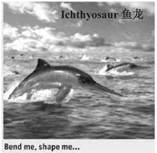
Other air-breathing animals also suffer this decompression (减压) sickness if they surface too fast: whales, for example. And so, long ago, did ichthyosaurs. That these ancient sea animals got the bends can be seen from their bones. If bubbles of nitrogen form inside the bone they can cut off its blood supply. This kills the cells in the bone, and consequently weakens it, sometimes to the point of collapse. Fossil (化石) bones that have caved in on themselves are thus a sign that the animal once had the bends.

Bruce Rothschild of the University of Kansas knew all this when he began a study of ichthyosaur bones to find out how widespread the problem was in the past. What he particularly wanted to investigate was how ichthyosaurs adapted to the problem of decompression over the 150 million years. To this end, he and his colleagues traveled the world’s natural-history museums, looking at hundreds of ichthyosaurs from the Triassic period and from the later Jurassic and Cretaceous periods.

When he started, he assumed that signs of the bends would be rarer in younger fossils, reflecting their gradual evolution of measures to deal with decompression. Instead, he was astonished to discover the opposite. More than 15% of Jurassic and Cretaceous ichthyosaurs had suffered the bends before they died, but not a single Triassic specimen (标本) showed evidence of that sort of injury.

If ichthyosaurs did evolve an anti-decompression means, they clearly did so quickly—and, most strangely, they lost it afterwards. But that is not what Dr Rothschild thinks happened. He suspects it was evolution in other animals that caused the change.

Whales that suffer the bends often do so because they have surfaced to escape a predator (捕食动物) such as a large shark. One of the features of Jurassic oceans was an abundance of large sharks and crocodiles, both of which were fond of ichthyosaur lunches. Triassic oceans, by contrast, were mercifully shark- and crocodile-free. In the Triassic, then, ichthyosaurs were top of the food chain. In the Jurassic and Cretaceous, they were prey (猎物) as well as predator—and often had to make a speedy exit as a result.

1.Which of the following is a typical symptom of the bends?

A.A twisted body.

B.A gradual decrease in blood supply.

C.A sudden release of nitrogen in blood.

D.A drop in blood pressure.

2.The purpose of Rothschild’s study is to see ______.

A.how often ichthyosaurs caught the bends

B.how ichthyosaurs adapted to decompression

C.why ichthyosaurs bent their bodies

D.when ichthyosaurs broke their bones

3.Rothschild’s finding stated in Paragraph 4 ______.

A.confirmed his assumption                 B.speeded up his research process

C.disagreed with his assumption              D.changed his research objectives

4.Rothschild might have concluded that ichthyosaurs ______.

A.failed to evolve an anti-decompression means

B.gradually developed measures against the bends

C.died out because of large sharks and crocodiles

D.evolved an anti-decompression means but soon lost it


违法和不良信息举报电话:027-86699610 举报邮箱:58377363@163.com

精英家教网