Recently there was a major discovery in the scientific research — the mapping of all DNA in a human gene(基因) is complete. Couple of years ago, this seems an impossible task for scientist to accomplish. All this progress in science leads us to believe that the day, when the human being will be cloned, is not far away. Human cloning has always been a topic of argument, in terms of morality(道德) or religion.

Taking a look at why cloning might be beneficial, among many cases, it is arguable that parents who are known to be at risk of passing a genetic limitation to a child could make use of cloning. If the clone was free of genetic limitations, then the other clone would be as well. The latter could be inserted in the woman and allowed to ripen to term. Moreover, cloning would enable women, who can’t get pregnant, to have children of their own.

Cloning humans would also mean that organs could be cloned, so it would be a source of perfect transfer organs. This surely would be greatly beneficial to millions of unfortunate people around the world that are expected to lose their lives due to failure of single (or more) organ(s). It is also arguable that a ban on cloning may be unlawful and would rob people of the right to reproduce and limit the freedom of scientists.

Arguments against cloning are also on a perfectly practical side. Primarily, I believe that cloning would step in the normal “cycle” of life. There would be a large number of same genes, which reduce the chances of improvement, and, in turn, development — the fundamental reason how living things naturally adapt to the ever-changing environment. Life processes failing to do so might result in untimely disappearance. Furthermore, cloning would make the uniqueness that each one of us possesses disappear, thus leading to creation of genetically engineered groups of people for specific purposes, and chances are that those individuals would be regarded as “objects” rather than people in the society.

Scientists haven’t 100% guaranteed that the first cloned humans will be normal. Thus, this could result in introduction of additional limitations in the human “gene-pool”.

Regarding such arguable topics in “black or white” approach seems very innocent to me personally. We should rather try to look at all “shades” of it. I believe that cloning is only legal if its purpose is for cloning organs; not humans. Then we could regard this as for “saving life” instead of “creating life”. I believe cloning humans is morally and socially unacceptable.

Which of the following is true according to the passage?

A. Genetic limitations will be beneficial for some women.

B. A large number of genes will prevent us from developing.

C. First cloned humans might be normal according to scientists.

D. Forbidding cloning might limit the freedom of scientists.

What’s the author’s opinion on cloning?

A. It should be entirely banned.    B. It is acceptable if it is used for cloning organs.

C. It will take away the right to reproduce.  D. It should be used in creating life.

Where can you read this article?

A. In a story book.        B. In a magazine.

C. In a science fiction.          D. In a novel.

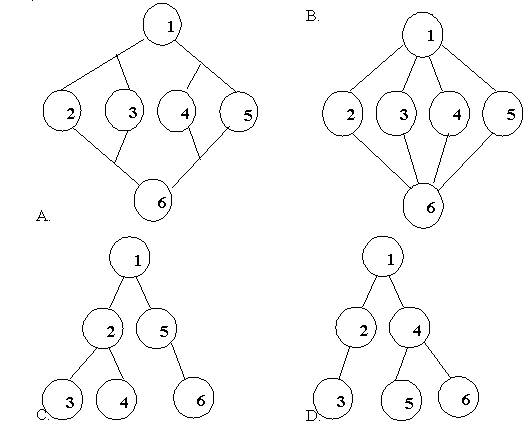
Which of the following shows the structure of the passage(1—6 refer to paragraph 1—6)?

A proven method for effective textbook reading is the SQ3R method developed by Francis Robinson. The first is to survey (the S step) the chapter by reading the title, introduction, section headings, summary., and by studying any graphs, tables, illustrations or charts. The purpose of this step is to get an overview of the chapter so that you will know before you read what it will be about.  In the second step (the Q step), for each section you ask yourself questions such as "What do I already know about this topic?" and "What do I want to know?" In this step you also take the section heading and turn it into a question. This step gives you a purpose for reading the section. The third step (the first of the 3 R's) is to read to find the answers to your questions. Then at the end of each section, before going on to the next section, you recite ( the second of the 3 R's) the answers to the questions that formed in the question step. When you recite you should say the information you want to learn out loud in your own words. The fifth step is done after you have completed step 2, 3 and 4 for each section. You review (the last of the 3 R's) the entire chapter. The review is done much as the survey was in the first step. As you review, hold a mental conversation with yourself as you recite the information you selected as important to learn. The mental conversation could take the form of asking and answering the questions formed the headings or reading the summary, which lists the main ideas in the chapter, and trying to fill in the details for each main idea.

The passage implies that the SQ3R method           .

   A. needs to be prove                B. leaves much to be desired

   C. turns out to be practicable         D. cannot be used by every reader

The SQ3R method consists of steps           .

   A. three        B. four        C. five        D. seven

According to the passage, the first step helps the readers           .

   A. read the first several paragraphs     B. scan the whole chapter

   C. study the graphs                 D. get the theme of chapter

Which of the following statements is true?

   A. In the last step, you should remember all the information.

   B. When you finish the last step, you will get both the main idea and the details.

   C. The mental conversation involves answering the questions asked by the author.

   D. While you are holding a mental conversation you select the important information.

违法和不良信息举报电话:027-86699610 举报邮箱:58377363@163.com

精英家教网