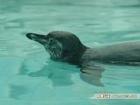
Pierre is a 25-year-old penguin at the California Academy of Sciences. Due to his old age, he was going bald, which made him feel too cold to swim in the pool. Therefore, biologists at the academy had a wetsuit created for this penguin to help him get back in the swimming pool.

Unlike marine mammals, which have a layer of blubber to keep them warm, penguins depend on their waterproof feathers. Without them, Pierre was unwilling to jump into the swimming pool and ended up trembling on the side of the pool while his 19 peers played in the water.

"He was cold; he would shake," said Pam Schaller, a senior biologist. Schaller first tried a heat lamp to keep Pierre warm. Then she got another idea: if wetsuits keep humans warm in the cold Pacific, why not make one for Pierre?

Schaller designed the suit, which covered Pierre’s body and had small openings for his flippers.

"I would walk behind him and look at where there were any gaps, and cut and refit and cut and refit until it looked like it was extremely suitable," she said.

One concern was that the other penguins would reject Pierre in his new suit, but in fact, they accepted his new look. He swam freely and got along with others well, although he was the only penguin with a black stomach.

Schaller couldn’t say for sure whether the wetsuit allowed Pierre to recover his fine feathers, but "certainly we were able to keep him comfortable during a period of time that would have been very difficult for him to stay comfortable".

Pierre will take off his suit after his new feathers grow back.

Pierre felt too cold to swim in the pool because of _____.

  A. not having a layer of blubber     B. having few feathers due to old age

  C. having no wetsuit              D. others penguins rejecting him

The idea of making a wetsuit for Pierre came from _____.

  A. total invention                 B. the use of wetsuit on humans

  C. the use of heat lamp             D. waterproof feathers

Schaller followed Pierre in order to see _____.

  A. whether other penguins would reject him

  B. if anywhere of wetsuit needed to be cut and refit

  C. if the wetsuit kept warm

  D. whether the wetsuit would keep the feathers from recovering

What does the underlined word in the second paragraph mean?

  A. feeling scared   B. staying alone   C. shaking with cold  D. keeping warm

The best title of the passage is _____.

  A. Wetsuit for An Old Penguin     B. Old Penguin Getting Bald

  C. Unwilling to Swim            D. Strange Look of Pierre

Mr.and Mrs. Gordon were sitting on the sand, reading their magazines. Mr. Gordon was too stingy(吝啬)to rent a chair. Their twelve-year-old daughter,Sandra, was playing at the water's edge. Suddenly a huge wave
lifted  Sandra up and carried her out to sea. Fortunately,
a lifeguard was on duty and he saw the wave carry Sandra away.
He ran along the beach and dived into the sea. He swam quickly to where
the girl,with her head only just above the water, was shouting for help. She was very frightened. When the lifeguard reached her,? she struggled(挣扎) with him, as drowning people often do. However, he was a skilful lifeguard and quickly took hold of her and swam with her back to the beach. By the time he reached it, Mr. and Mrs. Gordon had realized what had happened. They had run down to the water's edge. Neither of them could swim. They just stood in the shallow water, and worried about their daughter. Had the lifeguard reached her in time? Fortunately, he had. “That was quick work,young man,”Mr. Gordon said. He turned to his wife, “Give the lifeguard a dollar.” “A dollar!” Sandra cried. “Dad,how can you give him a dollar! He saved my life. I was half dead.” “Quite right, girl?” Mr. Gordon said, pleased by his daughter's awareness(知道) of the value of money. He turned to his wife again and said, “She's right. She was only half dead. Give him fifty cents. ”
36. What happened to Sandra?
A. She ran into the sea.   
B. Her life was saved by a lifeguard.
C. She was drowned.    
D. She died.
37. What did Mr. and Mrs. Gordon do when Sandra was carried out to sea by the wave?
A. They shouted to the lifeguard.         
B. They dived into the water.
C. Perhaps they were reading magazines.
D. They offered the lifeguard money to save Sandra.
38. Why was Sandra angry with her father?
A. He did not give the lifeguard any money.   
B. He did not swim out to save her.
C. He did not show the lifeguard hearty thankfulness.
D. He gave the lifeguard too much money.
39. Why was Mr. Gordon pleased with her daughter?
A. She was safe again.      
B. She was polite to the lifeguard.
C. He thought she did not want him to give the life-guard too much money.
D. She gave the lifeguard fifty cents.

Some years ago, on a hot summer day in south Florida, a little boy decided to go for a swim in the old swimming hole behind his house. He flew into the water, not realizing that as he swam toward the middle of the lake, an alligator (美洲鳄) was swimming toward the shore.

His father working in the yard saw the two as they got closer and closer together. In utter fear, he ran toward the water, yelling to his son as loudly as he could.

Hearing his voice, the little boy became alarmed and made a U – turn to swim to his father. It was too late. Just as he reached his father, the alligator reached him. From the dock, the father grabbed his little boy by the arms just as the alligator snatched his legs. That began an incredible tug – of – war (拔河) between the two. The alligator was much stronger than the father, but the father was much too passionate to let go. A farmer happened to drive by, took aim and shot the alligator.

Remarkably, the little boy survived. His legs were extremely scarred by the vicious attack of the animal. And, on his arms, were deep scratches where his father’s fingernails dug into his fresh in his effort to hang on to the son he loved.

The newspaper reporter who interviewed the boy asked if he would show his scars. The boy lifted his pant legs. And then, he said to the reporter, “But look at my arms. I have great scars on my arms, too. I have them because my dad wouldn’t let go.”

You and I can identify with that boy. We have scars, too. No, not from an alligator, but the scars of a painful past. Some of those scars are unsightly and have caused us deep regret. But, some wounds, my friend, are because someone has refused to let go. In the midst of your struggle, someone has been there holding on to you.

If you have the scars of someone’s love on your arms, be very, very grateful. Someone in your life did not and will not ever let you go.

Never judge another person’s scars, because you don’t know how they got them.

1. Which of the following is the most closely related to the underlined word “passionate”?

    A. determined   B. anxious   C. frightened   D. courageous

2.When the boy told the newspaper reporter about the scars on his arms, he felt     .

    A. painful and fearful   B. regretful and panic

    C. proud and grateful   D. excited and thankful

3.In the story the writer intends to tell us that     .

    A. scars always remind people of their past experiences

    B. wounds in the mind are more painful than those in the body

    C. a painful past always leaves scars on a person’s mind

    D. scars do not necessarily mean pain at all times

4.Which of the following viewpoints will the writer most probably agree with?

    A. Be grateful to a painful past, for you can always learn something from it.

        B. Other people’s criticism or blame may hurt you, but if it is for your own good, you should take it thankfully.

        C. The swimming hole of life is filled with danger, but you don’t need to be too serious about it as someone will never let you go.

   D. If someone hurts you, be grateful to them, for they mean no harm


完形填空  (共15小题;每小题1分,共15分)

On a hot summer day in south Florida, a little boy decided to go for a swim in the lake behind his house. In a hurry to dive into the cool water, he ran out of the ­ 36  door, leaving behind his shoes, socks, and shirt as he went.

   He  37  into the water, not realizing that as he swam to the middle of the lake, a(n)  38  was swimming toward the 39 . His mother in the house saw the two. Full of  40 , she ran toward the water, screaming at her son as loudly as she could. Hearing her voice, the little boy became  41  and made a U-turn to swim hurriedly to his mother. But it was too late. Just as he reached her, the crocodile  42  him. The mother grabbed her little boy by the  43  just as the crocodile seized his legs.

   The crocodile was  44  stronger than the mother; but the mother was much too  45  to pull her son back. A farmer heard the  46  , raced from his truck, took aim and shot the crocodile.

   Remarkably, a few weeks later, the little boy  47 . His legs were extremely scarred by the attack of the animal.  48 , on his arms, were deep scratches where his mother’s fingernails dug into his flesh(肉体) in her  49  to hang on to the son she loved.

   The newspaper reporter, who  50  the boy after the accident, asked if he would show him his scars(疤痕): The boy, with obvious  51  , said to the reporter, “But look at my arms. I have great scars on my arms, too. I have them because my mom would not let go.”

    You and I can  52  with that little boy. We have scars, too. Not from a crocodile, but the scars of a painful  53 . some of those scars are ugly and have  54  us deep regret. But , some wounds, my friend, are because our relatives have  55 to let go. In the course of your struggle, they have been there holding on to you.

1.A. back              B. front             C. open          D. closed

2.A. swam              B. flew              C. went          D. drived

3. A. child            B. fish              C. animal        D. crocodile

4. A. shore            B. centre            C. middle        D. lake

5. A. shock            B. surprise          C. fear          D. joy

6.A. realized          B. alarmed           C. cleared       D. pleased

7. A. hold             B. arrived           C. closed        D. reached

8.A. body              B. head              C. arms          D. hands

9. A. less             B. much              C. little        D. few

10. A. hurried         B. worried           C. eager         D. anxious

11. A. screams         B. shouts            C. voices        D. sound

12.A. lived            B. saved             C. rescued       D. survived

13. A. And             B. Therefore         C. But           D. However

14.A. force            B. power             C. effort        D. strength

15.A. asked            B. interviewed       C. questioned    D. reported

16.A. regret           B. pride             C. joy           D. worry

17.A. agree            B. disagree          C. admire        D. respect

18.A. past             B. future            C. memory        D. reminder

19. A. kept            B. made              C. left          D. led

20.A. accepted         B. delayed           C. denied        D. refused


违法和不良信息举报电话:027-86699610 举报邮箱:58377363@163.com

精英家教网